

How Ripley's Ship In Alien Got The Name USCSS Nostromo
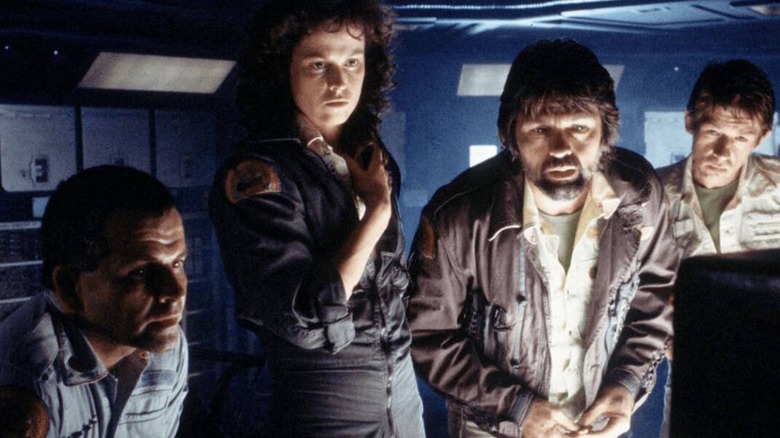
There are so many important elements that make Ridley Scott's 1979 sci-fi horror film, "Alien," the masterpiece it is. It's in the creature designs that were born out of the nightmares of biomechanical-obsessed artist H.R. Giger. It's in the pitch-perfect casting that made up the crew and the villain who was hiding in plain sight. The one element that was quite literally the biggest part of the entire film, though, was the doomed ship that this horror was taking place on.
That ship, the USCSS Nostromo, is possibly one of the ugliest hunks of junk to ever float its way through science fiction. Not built for transport or fighting enemy ships, this thing was designed to look like an oil rig chugging its way across the galaxy, with our motley crew of space truckers working hard to keep it moving for the good of "The Company." But where did the name Nostromo actually come from?
Even against vessels so essential that films are named after them, like "Prometheus" (which Scott admits wasn't great) or "Alien: Romulus," something about the name Nostromo stands out more than most. If it sounds like an ancient, worn seafaring vessel, that's because the name was lifted from the early 20th century novel, "Nostromo: A Tale of the Seaboard".
Nostromo was a man, not a ship
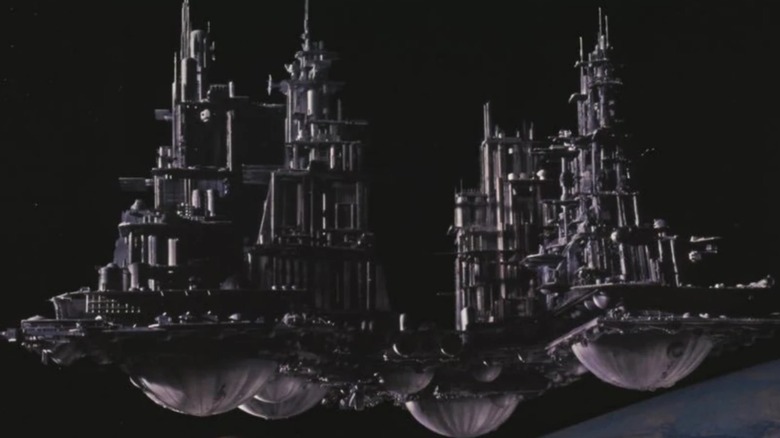
"Nostromo" is a novel by Joseph Conrad, published in 1904. It tells the story of Giovanni Battista Fidanza, a Nostromo (Italian for "shipmate") who is tasked by the owner of an abandoned silver mine to smuggle its contents out of the mine and away from rebel forces. There are many parallels between the novel and how Scott reapplied it in his scary space story. For one, the crew finds itself burdened with an additional "shipmate" that hides itself in one of their own.
Additionally, it's likely that Conrad's works were already on Scott's shelf, given that his first feature film was an adaptation of Conrad's short story "The Duellists." Originally, he planned to adapt "Tristan and Isolde" once he was done. But after seeing the original "Star Wars," Scott kicked off the "Alien" franchise at the end of the 1970s. The Nostromo connections don't stop there in the "Alien" saga, since Scott wasn't the only director to draw on Conrad's tale for inspiration. The location where Conrad's story takes place is the fictional town of Sulaco. This would be put to use by James Cameron for his military vessel that travels back to LV-426 in the 1986 sequel "Aliens".