

Can Wind Turbines Actually Interfere With Radar?
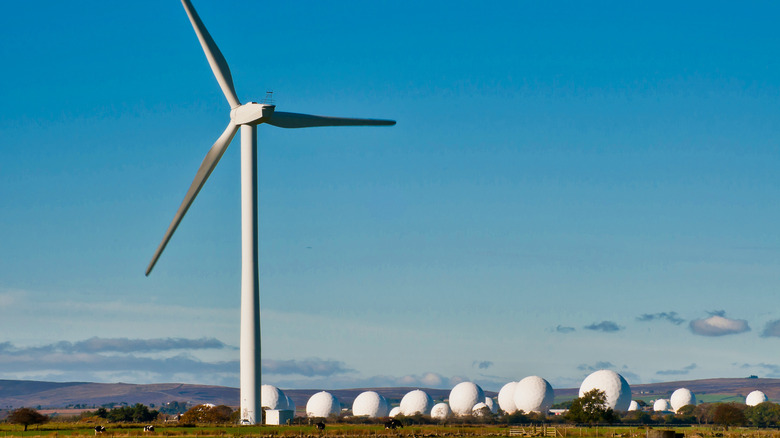
Wind turbines are becoming increasingly common in the United States and around the world, and while that's a great thing for renewable energy, wind turbines are causing an unexpected problem for military and civilian radar systems. From the late 1970s through the 1990s, the Department of Energy (DOE) and NASA ran the Mod-Series Program where wind turbine prototypes were tested. The DOE and NASA hoped it would develop into a full-fledged industry that would introduce commercially competitive wind-generated energy to the electric power market. It was during this program that the issue of radar interference was first studied by NASA and the DOE. Radar interference is one of many disadvantages of wind energy, and while the problem was picked up early on, foolproof solutions have proved to be elusive.
How exactly do wind turbines interfere with radar? Modern three-bladed wind turbines are massive, averaging 339 feet at the hub, and when taking the blade length into account, they can reach over 500 feet into the air. This is more than high enough for civilian and military air traffic and targeting radars to catch interference. Radar systems send radio pulses out, and by measuring how long the pulse takes to return after reflecting off a target, they can tell how far the target is. Modern Doppler radars measure how the phase and amplitude of the return change, and can calculate how fast it's going. Wind turbines can rotate at over 100 mph in higher winds, and when radar pulses hit a moving turbine blade, the reflections and scattering of radio pulses can easily send confusing signals to radar systems, making it look like a large, moving object. The problem is compounded where there are entire wind farms, and multiple returns can confuse radar systems.
How MIT's Lincoln Laboratory is helping to solve the problem
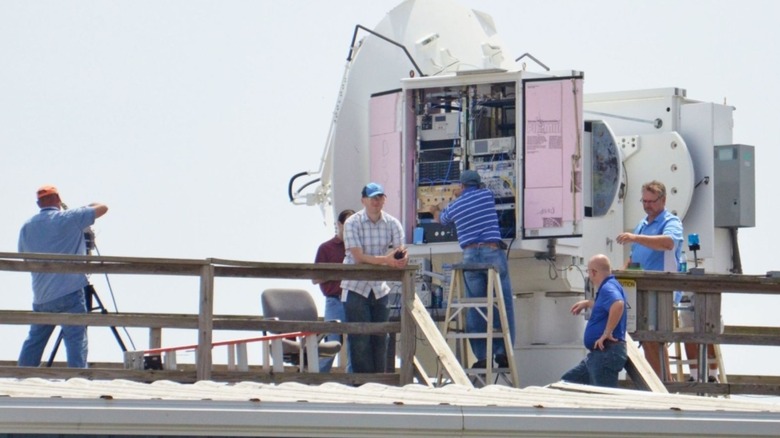
A report from MIT's Lincoln Laboratory details how the Navy asked MIT to look into this problem, as concerns were raised about the impact of wind turbine interference on air surveillance and weather radar systems at the Advanced Dynamic Aircraft Measurement System at Naval Air Station Patuxent River in Maryland. The system is part of a larger test range used for aircraft radar signature testing. Doppler radar has been an effective weather research tool in addition to its uses in aircraft detection, and was key to showing that tornadoes don't form the way everyone thought.
The research team used three methods to mitigate radar interference. First, they improved range resolution by reducing the size of radar range bins (wedge-shaped segments of the radar beam), reducing the likelihood that a target and a turbine would fall into the same bin, causing return overlaps. Second, the team used spatial and directional differences between targets and interference (so they could be excluded more easily), and third, changed radar pulse waveforms.
The team used aircraft as test targets, and emulated turbine interference by using a coherent repeater positioned on a ship in the Chesapeake Bay area. The mitigation efforts focused on a single frequency band and reduced interference within that band. The most challenging aspect of wind turbine radar interference is that the blades cause interference across multiple Doppler frequency bands, making it difficult to resolve. The mitigation strategy tested by Lincoln Laboratory proved successful, but more development is required to expand the mitigation across the radar operating frequency range to completely solve the problem. If spinning turbine blades continue to be a challenge for radar operators, new bladeless wind turbines could be an effective solution to the problem.