

This Company's New Bladeless Wind Turbines Are A Game Changer For Energy Accessibility
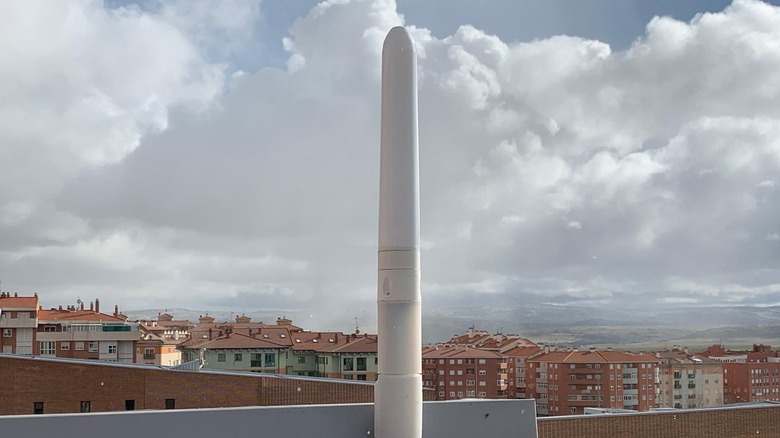
Wind is currently the most common source of renewable energy, accounting for around 10% of all electricity produced in the U.S. in 2025, according to the U.S. Energy Information Administration. However, generating wind energy famously involves massive turbines with spinning blades that, while efficient, can be incredibly disruptive to people and wildlife living near wind farms. That's why bladeless turbines developed by Spanish company Vortex Bladeless have the potential to be real game changers that make wind energy more widespread with less environmental impact.
Vortex Bladeless' website breaks down how these innovative turbines work. Rather than having blades that spin with the wind, these are composed of a base and a long cylindrical post that has a carbon rod in the center. While the base is anchored to the ground, the post sways back and forth as wind flows through it, creating pressure that can be converted into electricity.
Bladeless turbines can alleviate some of the current disadvantages of wind energy, the most obvious being the noise, aesthetics, and danger to birds and bats. The biggest advantage, though, is that these turbines could be installed in cities where wind speeds are often inconsistent and unpredictable. Bladed turbines need average wind speeds of at least 9 mph or 13 mph depending on size, which is why so much wind energy comes from Texas, California, and Midwestern states like Iowa, but bladeless turbines only need around 7 mph.
Bladeless wind turbines are great, but there's a catch
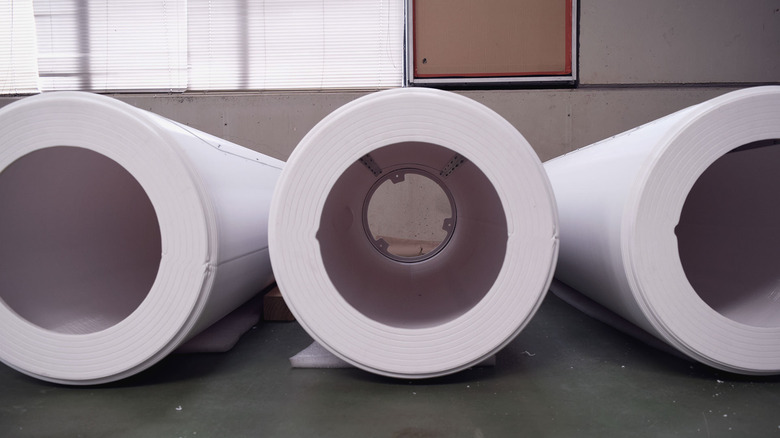
All of those advantages are great, but there is one big downside to bladeless wind turbines: They don't produce nearly as much energy. Currently, Vortex Bladeless' larger turbines only produce up to 100 watts, which is significantly lower than the several megawatts that conventional wind turbines can generate. That's because, while the compactness of bladeless turbines is one of their selling points, size does matter when it comes to turbines, and bigger turbines harness far more electricity.
Vortex Bladeless is designing larger turbine models that could have an output of up to 1 kilowatt, but even that's not nearly enough to replace bladed turbines to power the electrical grid. After all, as bladeless turbines get better, traditional ones will too. Innovations that address problems with existing and new bladed turbines, such as painting a single blade black to prevent bird collisions, are still crucial, as are more ambitious projects like China's flying wind turbine.
Where bladeless turbines can really make a difference is within cities and other places that aren't suitable for large turbines or solar panels. Making renewables more accessible is an overlooked part of the green energy transition necessary to fight climate change, and bladeless wind turbines look to be a big step in the right direction.