

A Single Black Wind Turbine Blade Is Having A Breakthrough Effect On Bird Collisions
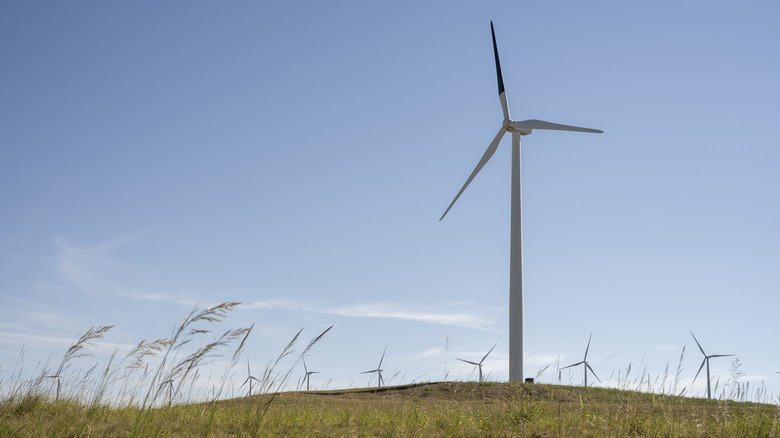
Wind power has an important role to play in expanding clean energy sources and phasing out use of fossil fuels, even if wind turbines take almost a decade to pay off. In 2023, wind accounted for 10.2% of all electricity generated in the United States, the most of any renewable. However, wind turbines get a bad rap, and not only from the anti-green-energy crowd. They have a reputation for killing birds that, while often overstated, is a legitimate concern that might actually have a simple solution: paint.
For several years now, researchers have been studying whether painting one of the turbine blades black could reduce the number of bird deaths. The paint is meant to provide contrast that makes turbines more visible while they're rapidly spinning. In a study published in Ecology and Evolution in 2020, Norwegian researchers found that annual bird fatalities fell by over 70% after the blades were painted, an incredibly promising result, though based on a small sample size of only four painted turbines and four unpainted as a control group.
Energy company PacifiCorp is leading a larger study at its Glenrock, Wyoming wind farm that involves painting individual blades on 36 different turbines. The effort involves several government agencies, NGOs, and Oregon State University researchers who hope to replicate the results of the Norwegian study while ensuring there are no harmful unintended consequences. Although it's too soon to start painting turbines en masse, this has the potential to be a breakthrough that addresses an important issue in wind energy expansion.
Clean energy can have unintended consequences

Clean energy is absolutely worth pursuing for its role in fighting climate change, and new innovations like China's flying wind turbine have the potential to harness massive amounts of energy. Still, these noble projects can have unexpected effects on the surrounding ecosystem. Some are positive, like a solar panel farm in Tibet that opened up a new opportunity for local residents, while others are not.
Birds are particularly vulnerable to clean energy technology. Just as they're unable to see spinning turbine blades, research shows birds can't tell the difference between solar farms and lakes, often with deadly results. While it's true that wind turbines represent only a small portion of overall bird fatalities, some of the species threatened are already protected by federal law. That includes the golden eagle and most migratory birds.
Even if PacifiCorp's study yields positive results, the black paint wouldn't be easy to implement. One of the researchers involved in the Norwegian study told Audubon the work was done by "a specialized team of painters who could rappel onto the turbine blades and paint them in midair," which was why that project was so small. Still, it's more actionable and reasonable than redesigning and replacing existing turbines, and simply including the black paint on new ones would remove that challenge altogether. In any case, the research into black turbine blades and their impact on birds is a great example of how we can improve green energy projects so they can help save the planet without disrupting the local environment.