

The Invention Of Facial Recognition Technology Traces Back To The 1960s
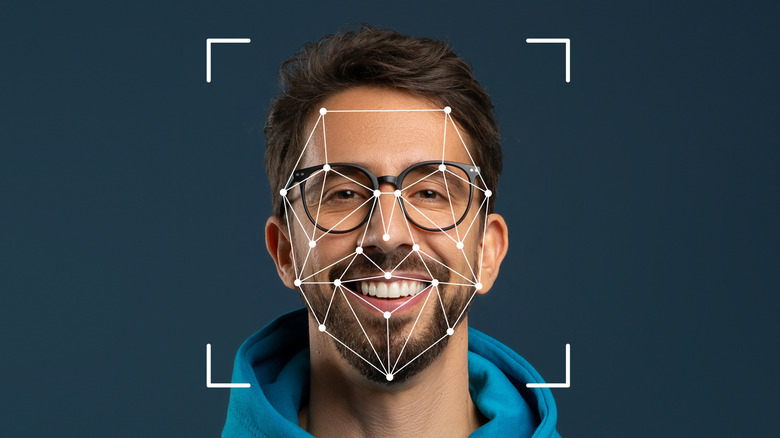
Facial recognition technology once seemed like a concept straight out of a James Bond spy flick or a futuristic sci-fi story. Such software is commonplace in today's society, whether it be used to unlock your phone, serve as a passkey, or as a Meta Glasses feature Norway considered banning. Between its more frequent modern usage and current debates surrounding whether Face ID or fingerprint are better for your phone security, some consumers may not realize the technology was conceived decades ago, in the 1960s.
The earliest traces of this technology are found in experiments conducted by Woodrow Wilson Bledsoe — not to be confused with former president Woodrow Wilson — in the mid-60s, which explored the concept of semi-automated computer-based facial recognition. It entailed pinpointing key features like the mouth's width to identify an individual. Wilson, who's recognized as a pioneer of artificial intelligence, devised a system that relied on humans to measure the distance between facial coordinates in photos from a sprawling database.
Their input was then compared to a computer's standard inputs, taking into consideration external factors that may warp a face's appearance, like light variations. The machines ultimately outpaced humans' abilities to match facial images. While this technology seems commonplace today, it wouldn't have been possible without these innovations.
20th century breakthroughs on facial recognition technology
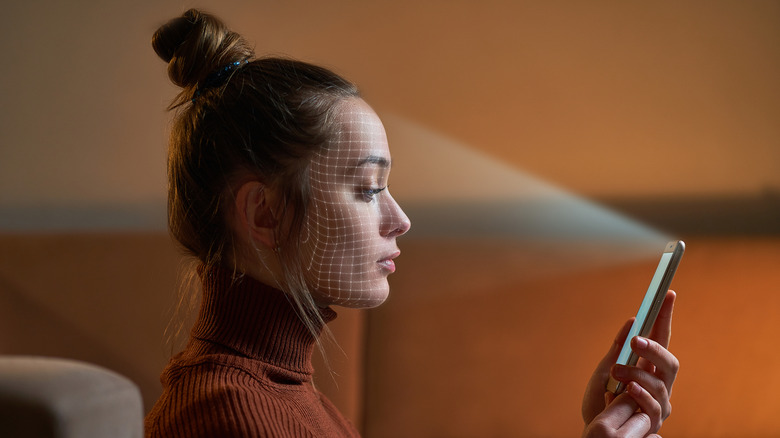
Mathematician and computer scientist Woodrow Wilson Bledsoe's early contributions to facial recognition systems in the '60s planted the seeds for the technology we know today. However, he isn't the only revolutionary mind credited for bringing the software to life. Bledsoe's colleagues, Helen Chan and Charles Bisson of Palo Alto's Panoramic Research, Inc. (PRI) assisted in the pursuit to condition early computers to identify human faces. Following his departure from PRI in 1966, computer scientist Peter Hart carried on facial recognition research at the Stanford Research Institute.
Japanese computer scientist Takeo Kanade further advanced facial recognition systems throughout the 1970s. He tested a program using over 800 photos to extract and identify facial indicators, including the nose, mouth, and eyes. It adopted an assortment of straightforward, flexible procedures which each focused on a portion of a facial image. Kanade also conducted an experiment designed to identify 20 individuals' faces. Like Bledsoe's efforts, Kanade's work was an early, yet crucial step toward establishing a piece of modern technology many people use today.