

Mercury Is Shrinking Faster Than Scientists Estimated - Here's What That Means
For those who have watched "Rick and Morty" since the beginning, do you remember the first season had an episode that "explained" why Pluto was reclassified from planet to dwarf planet? In the show's canon, Pluto was once a normal planet, but it eventually shrunk because aliens mined too much. Of course it's total sci-fi silliness, or is it? Minus the aliens, that is.
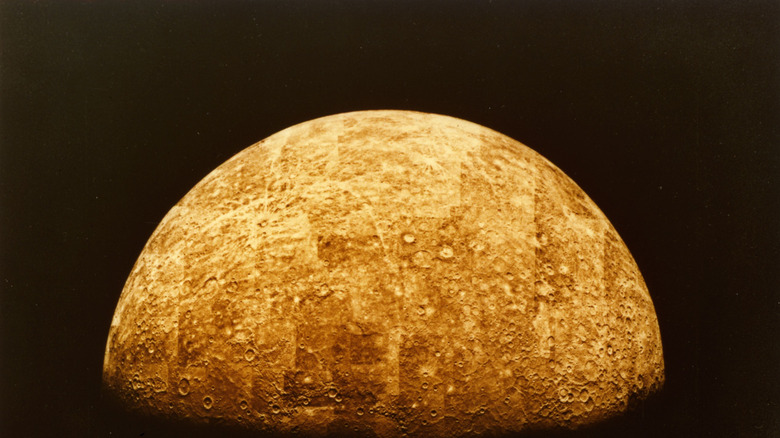
Recently, a surprising piece of news hit the internet: A planet in our solar system used to be much larger and has shrunk much more than previously thought. According to a study by the German Aerospace Center Institute of Space Research (published in Geophysical Research Letters), Mercury is showing evidence of shrinkage. Formations such as "wrinkle ridges" and "lobate scarps" (scalloped mountains that form when the crust surface moves over itself) demonstrate that the planet is shriveling like a grape left in the hot summer sun. That's how you make raisins, after all.
Technically, astronomers have known about Mercury's shrinkage for quite a while, but they previously underestimated the extent of the planetary reduction. Estimates were off by 10 to 30%, which means Mercury has lost up to 14.5 miles off its peak diameter over a couple of billion years ago. This isn't the first time astronomers were wrong about a planet's size. Earlier this year, scientists stated that Jupiter is smaller than they previously thought. Unlike Jupiter, however, scientists weren't wrong about how big the planet is now, just how big it used to be.
It's not the humidity, it's the heat (or lack thereof)
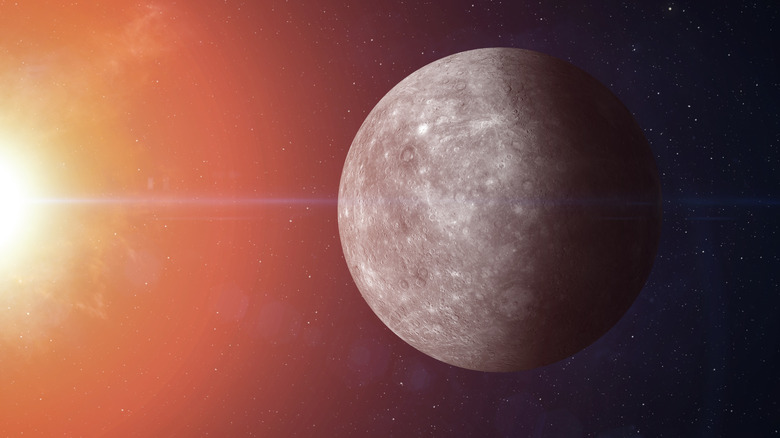
You might wonder how a rocky planet like Mercury can shrink without aliens mining it dry around the clock. The process primarily revolves around the planet's core, although the sun presumably played some part.
The running theory is that Mercury has shrunk as much as it has (so far) because the planet has been cooling ever since it initially formed, even though Mercury is within spitting distance of the sun. As the core cooled, it shrank, and the surface kept pace, resulting in Mercury's ridges and scarps. According to the paper's lead researcher, Gaku Nishiyama, Mercury's level of diminishment implies either its core's temperature was initially higher than that of most planets or Mercury's core was relatively large for the planet's size with few light elements mixed in.
In the spirit of fairness, last year, another group of researchers published a study that tied certain deformations in Mercury's crust to heat from the sun, but Nishiyama stated that even though he is confident the new estimates are accurate, he would not be surprised if Mercury has actually shrunk more than current models predict. Still, given what Mercury has taught us about the connections between wrinkle ridges and planetary shrinkage, astronauts could discern if Mars has experienced any shrinking of its own when we finally visit the planet.