

The First Speaker Bose Ever Made Was An Odd-Shaped Failure
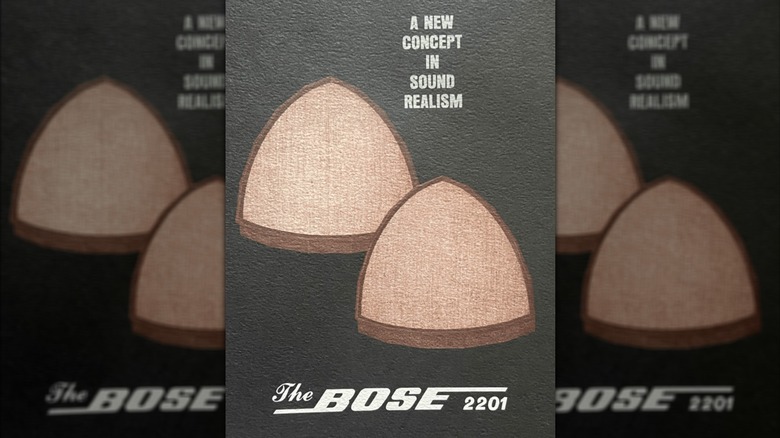
Although Bose is now widely known for its high-quality speakers, headphones, and other home audio equipment, the company's path to success wasn't always smooth. Bose's inaugural product — small, quirky, handmade speakers — make that much clear. In the 1960s, Bose crafted its first consumer product: The 2201. Advertised as a "new concept in sound realism", the speakers were based on a series of psychoacoustic experiments conducted by Dr. Amar Bose during his time at the Massachusetts Institute of Technology (MIT).
They were designed to capture the sound of a live, in-venue music performance as closely as possible — a first for live speaker technology at the time. This was achieved by spreading 22 transducers across each wedge-shaped speaker, which was designed to make up an eighth of a sphere. When the speakers were placed in two corners of a room, they worked to create a full sphere of sound across the space. The idea behind the speakers made sense. Instead of creating a singular spot where your hi-fi sounds best, the retrofuturistic-looking speakers would drench the room in sound across multiple directions. It's not altogether dissimilar from modern surround sound technology, despite only using two speakers.
However, a couple of problems emerged. First, the spherical design didn't fully account for the impact of sound that's reflected back from walls or other surfaces. Because of that, some instruments sounded unrealistic, losing the desired concert hall effect quickly. Also, you needed two empty corners of a room to set them up correctly, which could be off-putting for customers. In the end, despite their technological promise, fewer than 50 of these 2201 speakers were made, and they were considered a commercial failure.
How much are Bose 2201 speakers worth today?
Bose 2201 speakers are incredibly rare today. You won't come across them often, even if you're always looking for vintage and pre-loved electronics. But they do appear on second-hand markets and auction sites once in a while, albeit with high price tags. A set was listed on Reverb in 2023, selling for $5,000 before delivery fees. In 2024, a pair of 2201s were listed on Facebook Marketplace for $10,000, although it isn't clear if they sold for that price. Considering just how few of the Bose 2201 speakers were made, they don't appear on the secondhand market often.
As a result, it's hard to gauge how much they're really worth. So, if you're looking to add a pair to your collection, be prepared to drop a lot of cash. No one really knows exactly where all of Bose's unusual handmade speakers went, beyond occasionally showing up on the secondhand market. One pair landed at the MIT Museum in Cambridge, Massachusetts, as a part of their Technology collection, though the speakers are not currently on display.