

What Does The VoLTE Symbol Mean On Your Phone?
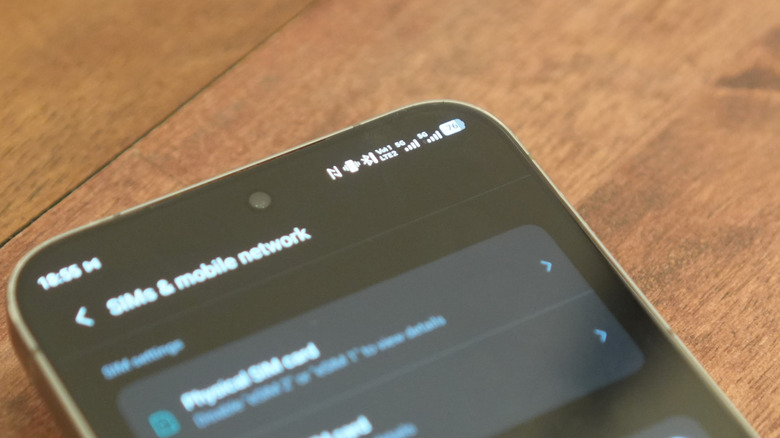
In the '90s, phone call minutes were the essence of any phone plan, both on wireline and cellular. Imagine being charged 55 cents each minute to place a long-distance call. Nowadays, those calls are part of the package, along with texts, and even unlimited data in many cases. The ways we carry on with those calls have changed as well and there are signs of it through the symbols we see in our phone's notification bar.
You might see a symbol for VoLTE, an acronym that stands for "voice over (4G) LTE." Simply put, it means as it says: Your calls will use 4G wireless signals. That process chops up your voice into digital pieces, sending over radio signals as packets, routed all sorts of ways through the network and across to your recipient where those packets get arranged back in the right order. If you own a device that's old enough, you might even see a symbol for HD Voice, a more consumer-facing brand that carriers adopted for VoLTE. And yes, with 5G being the cell network carriers are promoting these days, there's also Vo5G, VoNR (Voice over New Radio), or 5G Voice, depending on which carrier and phone you're using. The same packet-switching principle applies there as well as to Voice over Wi-Fi or Wi-Fi Calling.
Another benefit of VoLTE technologies is that they allow simultaneous data connections, meaning you can browse the web, use apps, and download new maps while talking on the phone. Some earlier wireless technologies would slow or even stop data when taking a call.
You can check the status of Voice over 5G or LTE on your phone by heading to system settings and looking through the mobile network section. If you use multiple SIMs, you may need to select one to access the appropriate toggle. You can also search for the term in system settings.
How do VoLTE and Vo5G work?
Voice over 4G and 5G are technologies enabled by your carrier. Manufacturers and service providers add specific VoLTE/VoNR configurations to your device during software updates. They also make sure settings for each cell tower are configured for calls and carrier roaming. If, for whatever reason, your VoNR-capable device cannot receive or make VoNR calls (i.e., your device cannot recognize a profile or the tower cannot allocate your traffic), you'll still be able to place them through VoLTE or Wi-Fi Calling where applicable. Nearly all U.S. carriers also do not count these voice calls against your data plan allowance, if you have a limit.
Up through the very early days of 5G, calls that could not be placed over LTE were routed through 3G cell service or even older 2G wireless instead. Most calls on those networks were circuit-switched rather than packet-switched. That meant a fixed, direct line of transmission was established between the caller and recipient—though a few exceptions were made for some calls on H+ networks. This older method tied up bandwidth, which meant your phone was typically incapable of using data while making a call.
VoLTE is different from VoIP, or essentially voice calls through chat apps like WhatsApp or FaceTime. These services use a standard internet connection to route a voice or video call, though they have to bounce from your wireless network to the app's servers before bouncing back to your recipient's carrier, which is why they can sometimes be less reliable than a standard phone call.