

Should You Buy An AI-Powered Air Conditioner? Here's What You Should Know
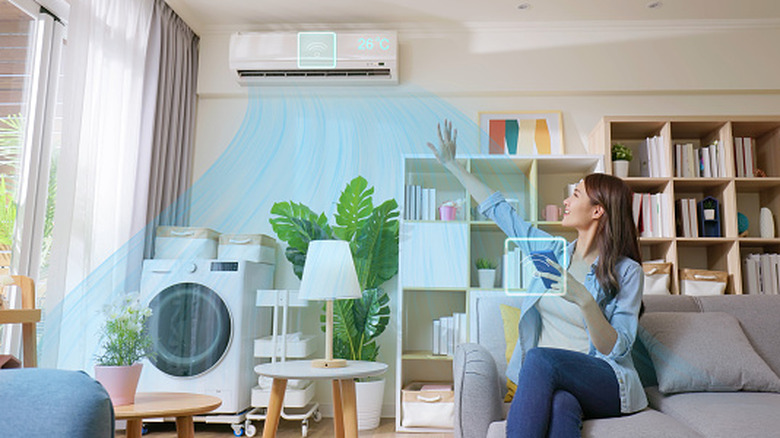
Have you been feeling the heat lately? If you've checked out modern air conditioning systems, you'll likely have noticed that things are decidedly more high-tech than they used to be. Various companies now offer AC units that use artificial intelligence to enhance your experience and, if their claims are to be believed, help keep your utility bills down. Whether they can live up to that promise is still yet to be seen.
A key hurdle is that an AI-powered appliance just costs more at checkout. You can get a standard, everyday, 8,000 BTU window-mounted air conditioner from Best Buy for around $245. That's suitable for a room of up to 350 square feet and some models even work with voice assistants installed in your home. But when you add AI to the mix, the price can jump more than 50%. For example, Midea's AI-powered 8,000 BTU units start at $380. That's a lot of extra to spend for the hope of saving on energy costs.
Midea's listing mentions an AI ECO mode, which accounts for daytime temperature fluctuations and predicts ambient heat load to help reach your target temperature faster. Samsung's WindFree range, meanwhile, starts around $1,300 in the U.S. while boasting energy savings of up to 30%. Samsung says it can also maintain a comfortable temperature even when in dehumidification mode.
Some manufacturers have added AI to their optional occupancy-detection systems as well, detecting the difference between a person or pet in the room, and adjusting the unit as needed. If any of this sounds interesting, you may well benefit from purchasing an AC unit with AI features.
Why AI-powered air conditioning might not be right for you

Realistically, If you're working with a limited budget, replacing a single AC unit, or if you live in a place where it's not hot enough to require air conditioning all year round, AI-powered units might be overkill. Aside from home automation, these AI-powered features tend to be focused on improving efficiency, and there are plenty of ways to do that without paying extra.
The first alternative is simply being mindful about airflow, for instance closing doors in rooms with window units to keep cold air contained. You could also invest in a Wi-Fi enabled AC unit; these often allow you to program a preset schedule and turn the cooling on or off remotely, providing similar benefits without relying on AI. If none of these options appeal to you, it's also possible to buy a "dumb" air conditioner and as a bonus, these are often the cheapest options on the market. Besides, if you realize you'd like advanced functionality later, you can turn your traditional air conditioner into a Smart AC for under $100 using an IR blaster.
Air conditioning systems boasting AI features are a fairly new development. It remains to be seen whether they'll become widely-adopted or fall by the wayside. To reduce the chance of paying extra for a unit that could lose some of its functionality in a few years, it may be pragmatic to wait until they grow more popular before you commit.