

NASA And Boeing's Starliner Is Going Back To Space Soon With One Big Change
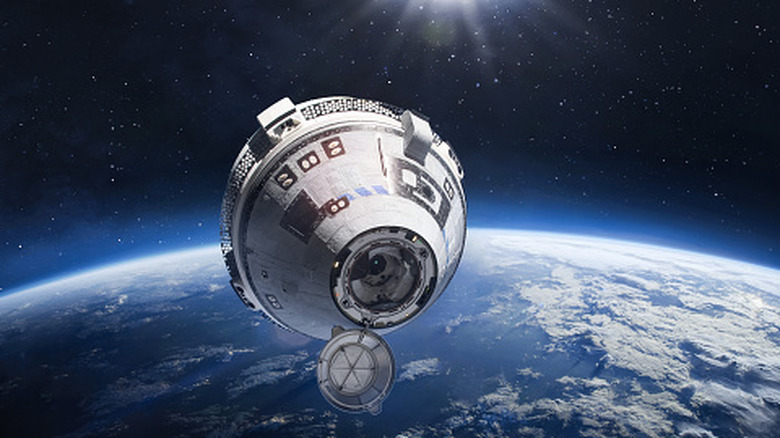
It's been more than two years since Boeing's Starliner last took a trip to space, and NASA is finally ready to talk about when the spacecraft will again escape Earth's clutches. According to the latest update from the agency and Boeing, the next flight for Starliner could happen as early as December 2026, with the launch window expanding out to January 2027. But, there is a catch.
We already knew that NASA planned to send up an uncrewed mission for the next Starliner run — confusingly called Starliner-1 despite the fact it already launched once. This will help the agency and Boeing check to make sure that any issues that popped up during 2024's ill-fated journey have actually been resolved without putting human lives at risk. It will still deliver cargo to the International Space Station, but the astronauts aboard the station won't be greeting any newcomers at the time.
Beyond just this Starliner-1 flight, though, Boeing is also already looking at the spacecraft's next flight. That might be a little optimistic, but the company has apparently planned for Starliner-2 to be ready to launch by 2028. So, that will give NASA and Boeing around a year or more to get any unexpected issues resolved after the second flight. And with SpaceX looking to potentially retire its Dragon spacecraft from low-Earth launches, Boeing may not have a choice but to step up its game.
NASA is already planning for another crewed Starliner flight
The last time astronauts flew on the spacecraft, Starliner ran into helium leaks and thruster failures that kept two of them on the station for nine months instead of the planned two weeks. NASA originally played off the incident, but astronauts have since revealed it was a lot worse than it sounded. That, itself, led to a slew of concerns about how NASA and Boeing had dropped the ball, and the agency now says that Starliner has to prove itself before it can hold astronauts again.
So far, Boeing has already made some thermal changes to the service module on Starliner, as well as agreed to a design change for the thruster valves. Those changes won't be complete until after Starliner-1 comes home, though, and NASA says that Boeing will need to install newer crew module thrusters as well as batteries. There are also changes planned to hit the parachute system as well, though those are considered minor. Boeing also says that it will replace the valves on all 12 crew module reaction control system thrusters for future missions, along with taking additional measures to prevent corrosion.
As for specifics on when Starliner-2 will take off with a crew, NASA has not given us anything beyond targeting a launch sometime in 2028. Perhaps that timeframe will change as Boeing continues to iron out the issues with Starliner — 19 out of 21 reported anomalies have been resolved so far — but for now we'll have to wait for more information to come down the pipeline.