

The Big Problem With Using Solar Roofs To Power EVs
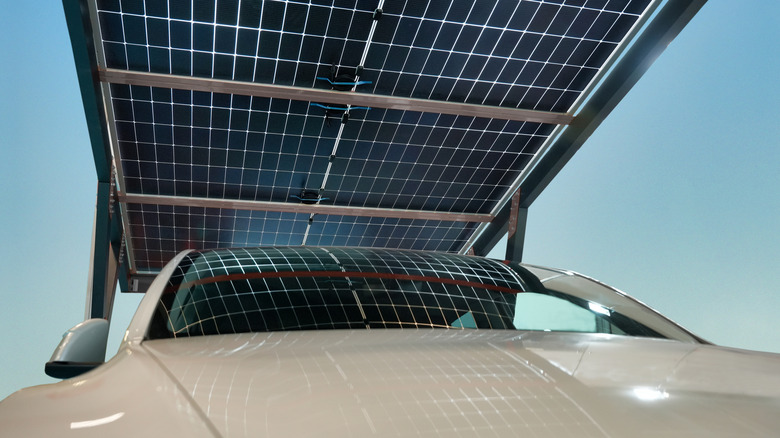
With utility bill spikes making inflation appear like it's going up at a snail's pace, sticking a bunch of solar panels on the roofs of electric vehicles (EVs) seems logical. However, solar energy and EVs aren't really "friendly" with one another. Just charging an EV with solar panels requires you to track down a backup energy source in order to provide a steady stream of juice — and that's for a stationary car.
So, why isn't there a solar-powered car? It's a combo of limitations in current solar energy tech and car size. Talking about real-world scenarios (one where you'd actually drive the car), the main problem with installing solar roofs on EVs is that the surface of the roof is relatively small, typically around 10 to 25 square feet. In the best conditions, which is the middle of the day, the sun is capable of delivering approximately 92 Watts per square foot.
It depends on the size of the roof and panel efficiency, but this setup will convert only about 20% to 25% of the power, meaning that you'd get maybe a couple of hundred watts. Considering that a run-of-the-mill EV is able to cover three to four miles per kilowatt-hour, solar panels would maybe give you an extra mile of range from an hour of charging — absolutely not enough for regular travel.
Are there any solar-powered EV prototypes?
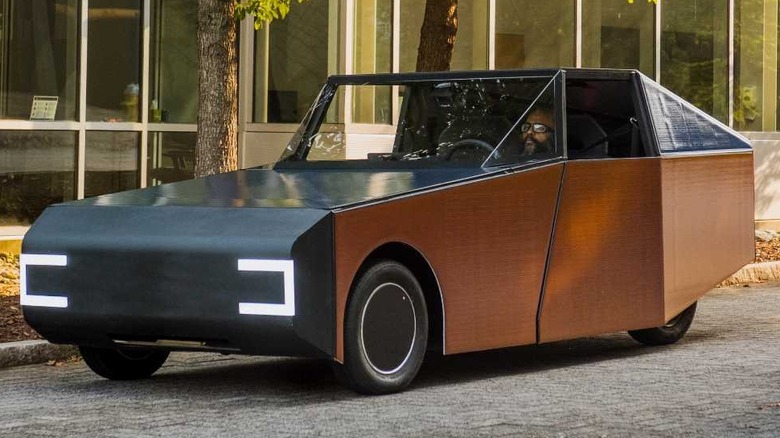
While solar-powered EVs may seem far from feasible, they could be arriving faster than you'd expect. In fact, there is a solar-powered BMW EV prototype that may produce enough energy for regular driving. Designed by students from the Clemson University International Center for Automotive Research, the car is practically a solar panel on wheels that can collect 5.7 kWh per day. That's enough to cover about 12 miles, which expends approximately 1.6 kWh.
Another advancement on this front is Fuyao Group's solar car sunroof that is designed to charge an EV as it drives. It's not just a solar panel strapped to the top, but rather glass panels embedded with solar cells. The maximum output of 720 watts is too weak to get the car from point A to point B on its own. Nonetheless, it can power onboard electronics, which may give you an extra few miles on the highway.
Solar-powered EVs are not totally uncharted territory. Just these two advancements represent a step in the right direction towards a fully functioning electric car running on solar power. Until then, we can only cross our fingers and hope that this potentially revolutionary vehicle looks like a car worth driving instead of something designed in Roblox.