

Astronomers Detected Radio Signals From An Alien Planet - Here's What We Know
Astronomers are always on the lookout for radio signals from outer space. Here on Earth, we rely on these signals for virtually all forms of wireless communication. Bluetooth and Wi-Fi are two different forms of radio communication you're probably familiar with, but many planets and other celestial bodies naturally emit their own radio signals. Thanks to recent advances in technology, astronomers can now use these signals to unearth the causes of these signals, even in planets that orbit other stars.
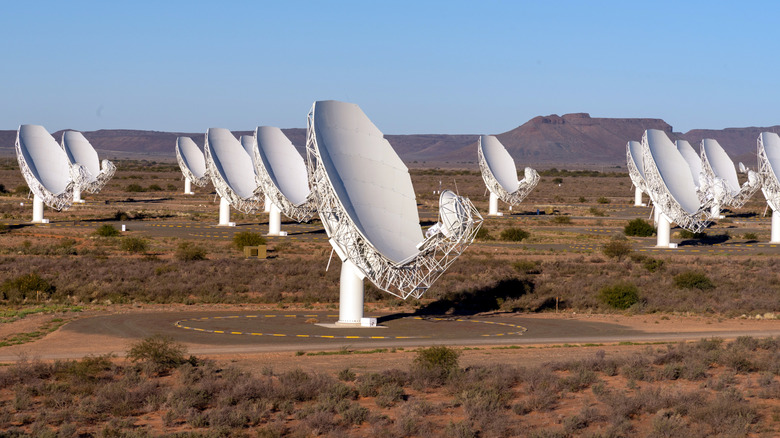
In summer 2026, astronomers discovered a scientific first: Radio waves were emanating from an exoplanet (a planet from outside our solar system). According to the findings, the planet, Beta Pictoris b (a gas giant roughly 10 times as massive as Jupiter located around 63 lightyears away) produced persistent radio signals. The astronomers detected these signals using the MeerKAT array — a radio telescope system consisting of 64 interconnected satellite dishes. The name isn't just a clever acronym; the array is situated in the Meerkat National Park in South Africa, which is meerkat central.
Now, most people might assume that if a planet is sending out radio signals, it must mean alien life is responsible. After all, we blast radio waves into space all the time thanks to our TV signals and radio towers. However, while those are indeed artificial radio signals, the universe can produce its own natural radio waves. In this case, astronomers described the signals as "auroral radio emission," which isn't possible without a magnetic field — or an atmosphere.
Beta Pictoris b is a giant leap for mankind (and science)

In the spirit of fairness, Beta Pictoris b is far from the first time astronomers have uncovered extraplanetary radio signals. Jupiter emits similar radio signals, and last year, the MeerKAT array recorded radio signals coming from comet 3I/Atlas, but those were the product of hydroxyl radicals absorbing ambient radio waves. The implications of Beta Pictoris b's signals are vastly different, not just for the planet but for science in general.
Initially, astronomers questioned whether the radio signals they detected were from the planet or its host star, Beta Pictoris, but with the help of radio images and reference frames, researchers concluded that the waves indeed spawned from Beta Pictoris b. Specifically, the electromagnetic waves were the result of "magnetosphere–ionosphere coupling," which can produce visual effects such as the aurora borealis. The key takeaway isn't just that Beta Pictoris b likely put on lightshows we will never witness in our lifetimes. Instead, researchers claim Beta Pictoris b is the first case where astronomers detected radio emissions from an exoplanet and used them to measure its magnetic field. According to the data, Beta Pictoris b's magnetic field is over 1,000 times stronger than that of Earth.
The implications don't end there. One of the paper's authors, Yvette Cendes, told the New York Times that the presence of a magnetosphere could indicate the potential for habitability. While Beta Pictoris b is out of the running since it's a gas giant, astronomers now have a better grasp of how to locate exoplanets with magnetospheres that could support life. Who knows; we might be able to find a potential planet closer than HD 20794 d — a theoretically habitable super-Earth just 20 light-years away.