

What Happened To Nokia's 4G Network On The Moon?

You may or may not already know this, but back in March 2025, Nokia deployed its Network In a Box (NIB) on the moon and successfully powered it up around the same time as NASA's Lunar Trailblazer mission. In the process, Nokia claimed, the company became the first wireless carrier to offer a 4G cellular network on the lunar surface. The maker of some of the best-selling mobile phones of all time also became the first to deploy a network in space. In reality, the network didn't last long, as it was part of a flawed undertaking — the Intuitive Machines IM-2 mission. Athena, the mission lander, actually ended up on its side, and due to the orientation of its solar panels, it couldn't properly recharge, so the mission concluded prematurely. Despite the complications, Nokia says it still deployed the NIB for 25 minutes before losing power, which means during that time a 4G network was active.
Had things gone according to plan, Nokia's space network would have sustained a variety of rovers and devices, which could have helped with data collection and analysis on the surface and, ultimately, in sending it all back to home base on Earth. Nokia also planned to make the first call from the moon, but because no equipment ever left Athena's internal garage, that never happened. In a way, the network was both successful and unsuccessful, having come online for a small window but never being truly used as intended.
However, the cellular provider might get another chance to make history. Specifically, Nokia is currently planning a return to the moon, working alongside Axiom Space to integrate wireless connectivity inside the space suits that will be leveraged by NASA's crew during the Artemis III mission, scheduled for 2027.
What is Nokia's NIB, or Network In a Box?
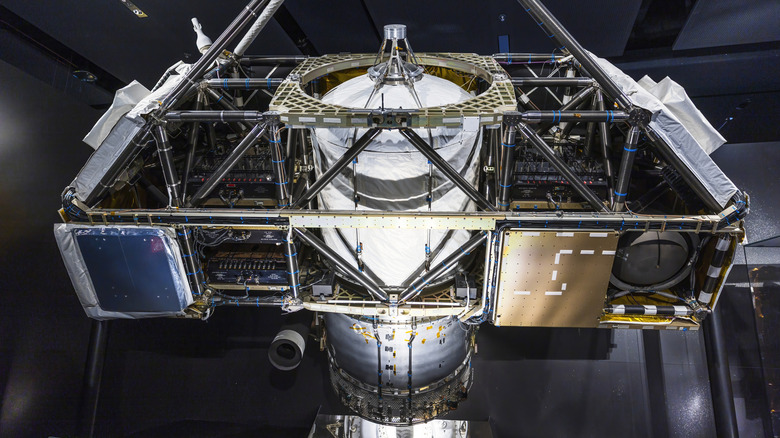
The mission was actually carried out by Nokia Bell Labs' Space Communications Solutions, an offshoot of Nokia Bell Labs — the company's research division – now called Modul8. The team insists the 4G network was viable and successful even though it was never utilized by any equipment. The researchers and engineers involved were able to verify various key indicators that the network was briefly operable.
That lunar network was largely powered and distributed by a piece of equipment called the NIB, or Network In a Box. Purportedly, tucked inside was a radio, base station, and both routing and core technologies, all integrated and designed to broadcast a network on the lunar surface. The telecom kit is customizable and generally meant for commercial and industrial applications. However, the NIB used by Bell Labs' space communications team was retooled with the unique environment in mind. More specifically, it was structured to be more lightweight, with the typical components swapped out for lighter alternatives, and it had a unique thermal management and radiation solution, alongside mechanical and electrical redundancies to help overcome potential failures.
Even if the mission had gone off without a hitch, the original timeline was only intended to last for about nine lunar days, the equivalent of 14 Earth days. So, Nokia and Bell Labs' space network was always going to be a short-term thing, and the equipment was never designed to withstand the extremely harsh conditions of lunar nights. It's an impressive feat, nonetheless, and one that will be explored further with the new implementations of Nokia's technology inside the Artemis III space suits. Those will be, by comparison, better suited for the volatile temperatures of space and the moon's surface.