

The Likely Reason Why Asus Stopped Making Tablets

You probably know Asus as a PC-oriented brand. Its name appears on laptops, motherboards, monitors, the premium Xbox Ally handheld consoles, and all sorts of other peripherals — including under its Republic of Gamers brand. There was a short time, however, when the Taiwanese company was best known for its tablets. And it sure had some unique ideas about what a tablet could be.
In 2011, Asus debuted the Eee Pad Transformer Book, an Android slab running on an Nvidia Tegra mobile processor that came with a keyboard attachment. The Transformer series, which also had Windows entries, proved an early success for the nascent 2-in-1 category with some models notching strong sales numbers. The party, however, died down, and it was likely because Asus simply couldn't keep up that momentum.
Much like how Apple and Samsung came to dominate the smartphone market, the two brands also developed firm grips on the tablet market. Asus's mobile division, which concerned both phones and tablets, was fluttering between misadventures from phone-tablet hybrids to a mish-mashed Android/Windows tablet. It also ended up in an ill-fated partnership with Intel to run Android on the a mobile version of the chipmaker's x86 CPUs. In the end, Asus quietly gave up on tablets in 2019 following a change in strategy that would focus attention on its Zenfone and ROG Phone products.
Asus killed tablets as part of a corporate reorganization
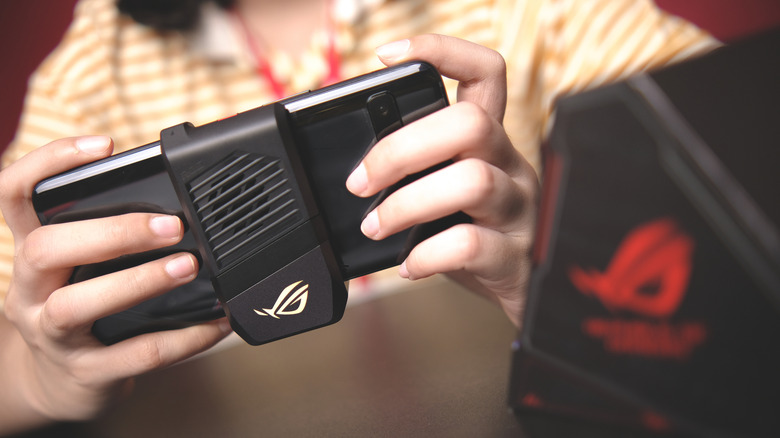
Asus began a reorganization of its business in 2018. The company replaced its CEO with two co-CEOs and set its sights on artificial intelligence, cloud compute, and the Internet of Things. Asus also repositioned its Zenfone line into a premium product for power users, rather than its earlier mid-range roots. These Zenfones would be promoted alongside the company's new ROG Phone slate — the debut model of which, Asus told investors, already achieved "#1 mind share" with gamers. As transformation plans took hold, the company then reportedly told distributor partners that it would no longer produce tablets.
The mobile division continued to flounder, though. The Zenfone line hopped between different unique selling points such as a camera that rotated between selfie mode and landscape mode and an emphasis on one-hand usability. On the other hand, the ROG Phone 2 — which BGR crowned as the most powerful avaialble at the time — delivered a strong early showing, but multiple releases to a niche audience of phone-based gamers could only deliver so many sales before saturation. Amid stagnating global smartphone market sales — and with greater interests in AI — Asus officially discontinued its Android phones in January of 2026.
There's a funny little epilogue here as Asus actually launched a new Android tablet at Computex 2026: the Asus Pad. It features a 12.2-inch OLED display with minimal bezels, and it can be accessorized with a kickstand, keyboard, and stylus (sold separately). As of time of writing, the company hasn't said why it returned to creating tablets. But considering the troubled arc of its previous efforts, the Asus Pad has a lot of work ahead to prove itself.