

Why SpaceX's Starship Falls Sideways Before Flipping Upright To Land
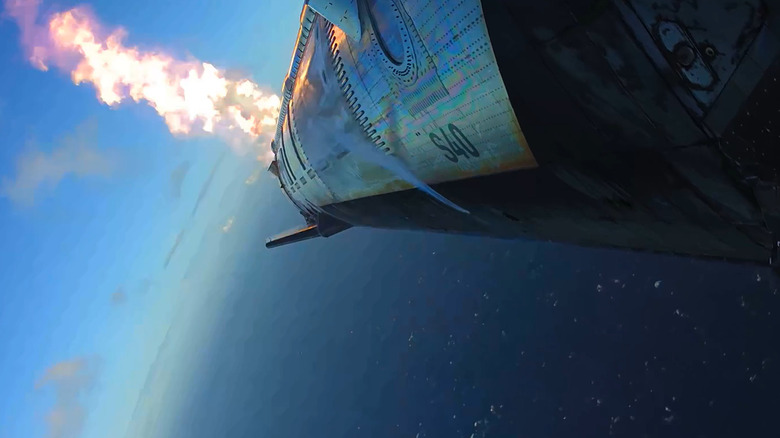
It would be fair to say that design teams at SpaceX threw a lot of the rulebook out the window when they designed Starship, which is the most powerful rocket ever built. SpaceX's flagship rocket, which is still under developmental testing, was designed for missions that had never been attempted before. Starship is expected to carry payloads and crew to Mars at scale, and this required out-of-the-box thinking. It is for this reason that the Starship vehicle and Super Heavy booster had to be designed using a different approach. One of the most novel parts of any Starship flight is the landing, where the Starship vehicle glides on its belly through the upper parts of the atmosphere after reentry, then flips into an upright position for landing at the last possible moment. This is done to gradually slow it down, to manage reentry temperatures effectively, and to use a flip maneuver to get Starship into an upright position so it can land on the surface of Mars, or to be caught by SpaceX's Mechazilla launch tower arms back on Earth.
SpaceX designed this flight profile (and designed Starship around the concept) for a good reason, which was to shed speed passively during reentry and to manage reentry temperatures effectively. In addition to changing the Starship's orientation for landing, the flip maneuver helps to maximize payload capability by efficiently burning fuel and to allow for contingency options should any of the ship's Raptor engines fail during landing. Crews inside the vehicle will likely only experience about 2.5 times the force of gravity during a nominal landing sequence, according to simulations. While Starship continues its test and development phase, SpaceX has to conclude the development of Starship by 2028 in order to meet NASA's deadline for the crewed Artemis IV mission.
How a Starship reentry and landing works
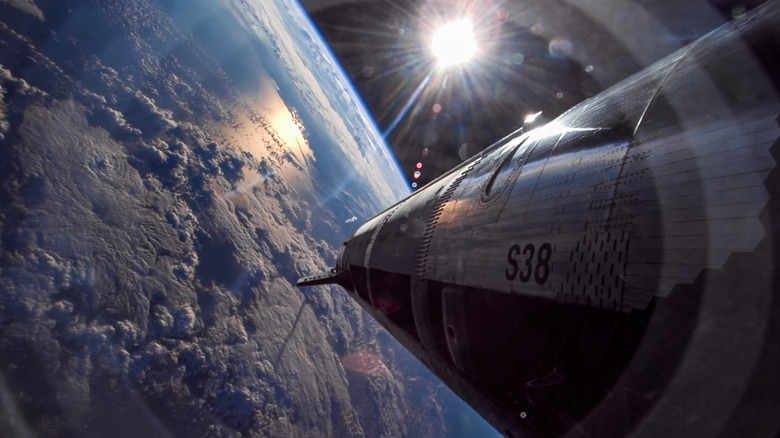
Once Starship is operational in the future and launched atop the Super Heavy booster, Starship itself would separate from the booster, which would flip around for a boost-back-burn and return to the launch tower to be caught. The booster, much like the current Falcon 9 boosters, would travel back to its intended landing zone at high speeds. The booster would perform a landing burn, where it fires its Raptor engines to translate horizontally to move into a catch position for the tower and slow into a hover in one fluid motion. While the booster would make its way back for a landing, the Starship vehicle would carry on with its mission to Earth orbit and beyond.
Once Starship returns to Earth, it would perform a deorbit burn by firing one of its Raptor engines in the opposite direction of its orbit, to slow it down just enough to exit the orbit and commence a descent into the Earth's atmosphere. Starship would descend belly-first at roughly a 60- to 70-degree angle in order to expose as much surface area on the Starship's belly and heat shield as possible. The Starship's heat shield deflects and absorbs the heat of reentry caused by the compression of air ahead of the vehicle, and as soon as Starship starts entering the thicker parts of the atmosphere, it would start a gradual free fall at terminal velocity, where the gravitational pull on the ship equals the amount of drag it experiences. To make this more controlled, Starship has flaps that can be extended or retracted to change the ship's terminal velocity or conduct banking maneuvers to control it.
How the flip is planned and executed
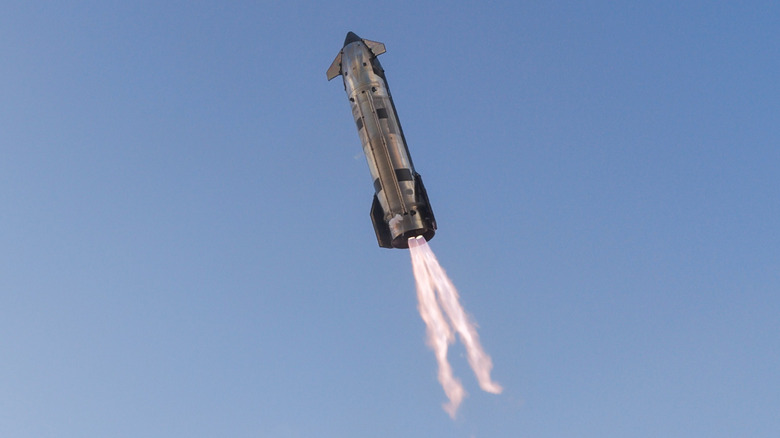
Starship can perform the flip maneuver anywhere between 1.5 miles and 980 feet above the ground. Each altitude has a trade-off, with the highest altitude requiring more fuel, which could ultimately cost useful payload on a flight. Meanwhile, the lowest point of the flip would require all three engines to be used at maximum throttle simultaneously, leaving no margin for error in case of an engine failure. The most efficient midway point between these altitudes would have to be predetermined for each landing attempt based on the parameters of each mission. The descent and flip maneuvers were successfully tested during Starship's recent 13th flight test. Starship survived a soft splashdown and was recovered from its splashdown point with great difficulty.
If Starship attempted to land by being caught by the launch tower's Mechazilla arms, an ideal landing sequence would be calculated for fuel efficiency and safety margins. Just enough engine thrust would be used to slow the rocket down after the flip had been done, to translate it into position to be caught, and then to settle into a hover at low altitude and minimize the amount of time the vehicle would have to stay in a hover.
Starship has three sea level Raptor engines (and three vacuum engines for use in space), and in more recent Starship flights, all three engines were used during the flip and landing burn, with engines gradually being cut as the speed of the ship decreased. This allows enough thrust buffer on each engine, which means that remaining engines would be able to throttle up to compensate if one of the other engines were to fail.