

This Wind Turbine Concept Could Recycle Old Parts Into Diapers And Even Gummy Bears
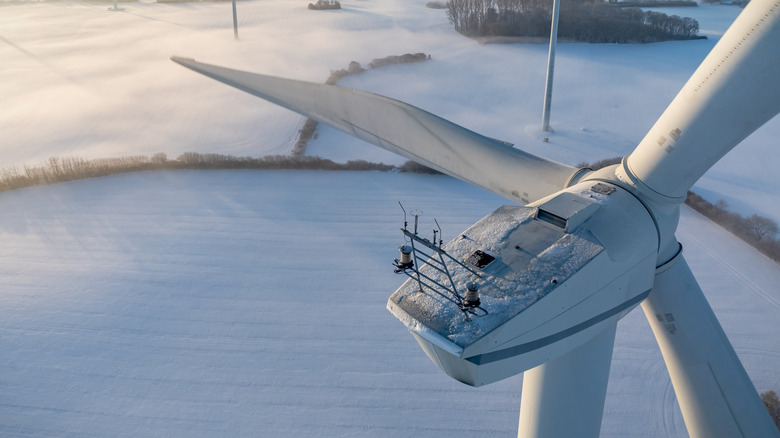
Wind turbines helping to stave off the planet's destruction? Check! Are wind turbines hard to recycle? Sadly, that one also gets a checkmark. So, it's only natural to ask what to do with all the out-of-commission turbines. Well, if they can't be outright recycled on a large scale, the most reasonable thing would be to repurpose them. In fact, the top minds are way ahead of you. In Europe, a company is transforming the giant blades into bridge girders (load-carrying beams that support bridge decks). In another case, the result is even cuter: repurposing wind turbine blades as small houses and benches.
Fortunately, things might change in the future, and we might even be able to one day eat wind turbines, quite literally. Researchers from Michigan State University created a material that could be used for the construction of new turbines: a combo of synthetic and plant-derived polymers and glass fibers. Though it's strong enough to be used for everything from cars to wind turbine blades, the most exciting part is that it's relatively easy to dissolve this material and remove glass fibers. Then, researchers were able to recast it into completely new products while also maintaining the same qualities as the original one.
The new resin is so versatile that by adding other stuff, it can be turned into almost anything. For instance, mixing in additional plastic resins can turn the resin into power tools or laptop covers. On the other hand, dipping it into an alkaline solution yielded an acrylic-like material perfect for taillights or windows. Just raising the temperature of the process resulted in a polymer used for diapers. Doing this at a high temperature also produced potassium lactate, which, when purified, is 100% edible. In fact, researchers used it to make gummy bears.
What can be recycled from a wind turbine?
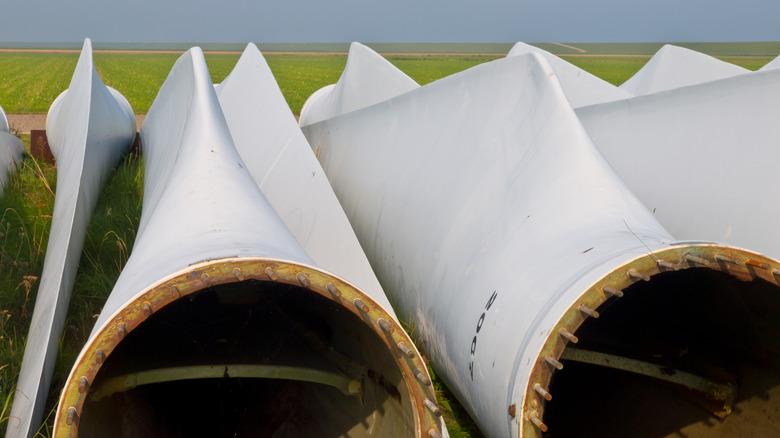
A material that can be processed to be both edible and resilient enough to be a wind turbine blade is a genuine silver bullet type of solution. Yet, we might have to wait a few extra years for the concept to be tested in the real world. Until the researchers are able to bump up the production volume, we'll have to stick with either repurposing blades or recycling portions of the turbines that are recyclable. One company, Paladin Envirotech, believes that old wind turbines could become a huge source of rare earth materials. The generators in direct-drive turbines are a treasure trove of precious metals like gold, silver, and palladium, and materials like neodymium — the latter of which is used in things like headphones and smartphones. Other recyclable things generally fall into the structural category. For example, the tower itself, the foundation, and other components like gearboxes.
It's all a work in progress. Gummy bears from turbines may seem exciting, but they're not the only attempt at recycling. Some companies shred the fiberglass blades into fine particles and mix them with other materials to create stuff like manhole covers or parking bollards. It's even possible to feed the finely shredded particles into cement, which eliminates the need to use coal. Ultimately, just because major portions of wind turbines are hard to recycle at this very moment doesn't mean that the concept of wind energy is in many ways flawed. It's still a greener way to generate electric power. So, think of the current challenges as nothing more than a stepping stone toward wind energy that will, when everything clicks into place, represent a prime example of an unimpeded circular economy.