

This European Company Is Turning Old Wind Turbines Into Tiny Houses
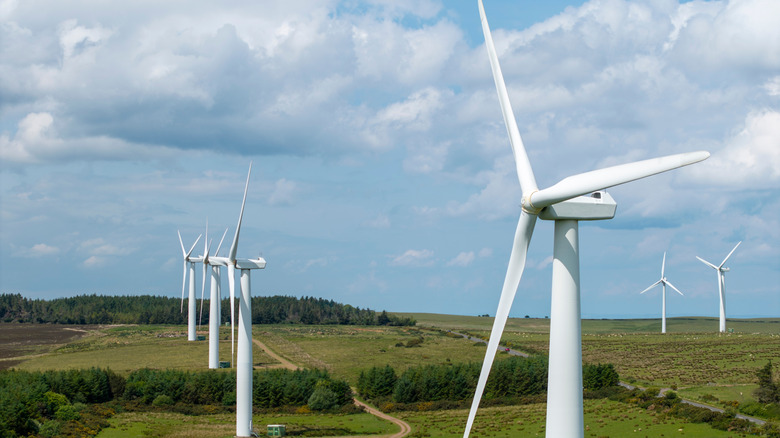
Wind power and solar power are often pitted against each other, but collectively, they might be the key to our planet remaining habitable in the future. Focusing on just wind turbines, they may not be perfect, but they're only getting better. Their blades are now longer and can capture more wind energy. They're taller and the rotors are larger. If this growth spurt continues, by 2035, they're expected to produce 30 megawatts. That's impressive considering that the output today has a maximum of a much more modest 15 megawatts.
A wind turbine typically has a service life of around 30 years, though that figure applies only to the foundations and the tower. Other components, like generators and blades, are generally expected to bite the dust a lot earlier due to wear and tear. Wind turbine blades are made of composite materials like fiberglass that can be hard to recycle or dispose of safely. This is the key reason why in places like Europe, people are actively trying to repurpose them.
Along with lending turbine blades new life as bridge girders, one company is turning them into cute tiny houses. Blade-Made, a company from the Netherlands, presented its Nacelle Micro Home, made out of wind turbine materials (seen below). The Dutch Design Foundation helped facilitate this construction based on concept drawings by Superuse, with Reliving.nl taking over the interior design. Though this use is experimental, Blade-Made has already made its mark with interesting projects that have found unexpected uses for four old blades. A sound barrier is one, but the more mainstream use cases include a small bench made out of three blades (currently found in a Shenzhen mall) and a functional Blade-Made playground in Rotterdam.
What makes wind turbines hard to recycle?
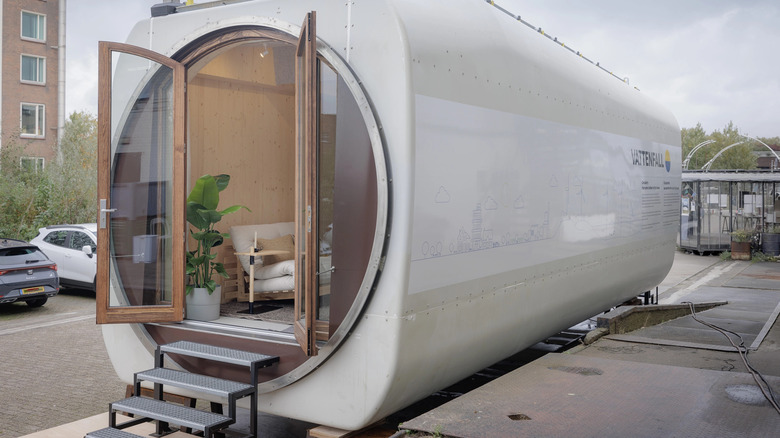
Although harder recyclability is usually not one of the most talked-about disadvantages of wind energy, it should be noted along with the tendency to put birds at risk. Wind turbines need to be robust enough to survive being bombarded by everything from heavy wind and humidity to lightning, but they should also be lightweight enough for efficiency. Hence, they're generally made with composite materials. For instance, fiberglass-reinforced plastic that is bonded with various epoxy resins is a popular one, as it rises to the occasion in both areas.
Unfortunately, the way fiberglass is produced makes it nearly impossible to recycle. Since it's basically a composite of glass and plastic, grinding or shredding fiberglass ruins the fibers, which means it usually can't be put to other uses. Disposal is a subpar option, too, because the material can pose a health hazard. Is fiberglass just as bad as asbestos? No. Fibers can float into the air and cause a variety of respiratory and gastrointestinal issues to persons who inhale them, but they're not carcinogenic. Still, reusing wind turbines in the way Blade-Made is doing is a step in the right direction.
Will this movement take off? Who knows. Wind turbines are only getting larger, so making such projects viable on a large scale doesn't seem that feasible. Transportation is a huge problem, so it would make sense to repurpose blades and other components in the areas where wind farms are located. Either way, a fine idea. Kudos to Europe.