

How Much Gold Is In Your Computer's CPU Pins?
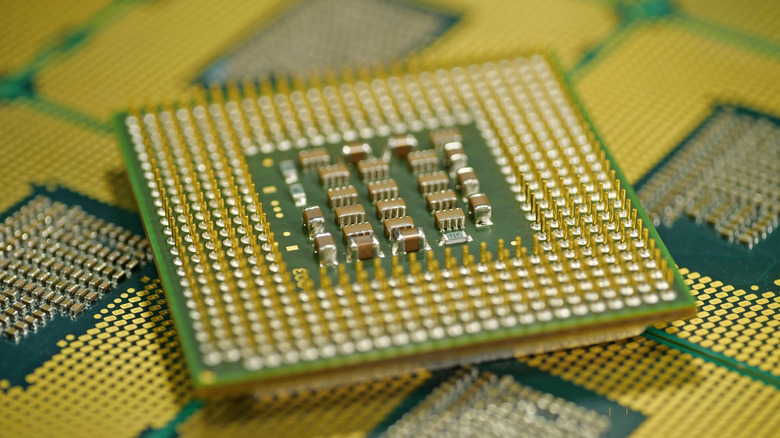
Just like your laptop, desktop components have a shiny golden plate covering pins, connectors, and other contacts. There's enough gold that some people spend time trying to excavate it from electronics. If you have the chemicals/equipment and are comfortable with the process, you can get tiny amounts, almost specks, off your CPU. Iman Gold Recovery's YouTube channel showed that, from 150 CPUs (Intel Pentium 4), they recovered slightly less than a gram of gold in total.
That's not much, and given how rigorous and involved the process is, you'd likely spend more on equipment and chemicals than what you'd acquire from the gold. That's because CPU pins are gold-plated, meaning the parts themselves aren't made of actual gold. Think of it as a small, thin sheet or a coat of paint over another metal, but done electrochemically. Gold plating is a process, known as electroplating, that passes an electrical current through a heated liquid bath. In the bath, gold ions bond to the underlying metal; in this case, the base metal is usually a cheaper alloy, like brass or copper alloys.
This is done for cost reasons and because of gold's physical properties. For example, the thin gold layer protects the underlying metal from corrosion, since gold does not oxidize or rust when exposed to air or moisture. It also has good conductivity, which helps electricity pass through more efficiently. Gold is malleable and ductile, which is essential for the metal contact pins and pads to maintain good contact with the motherboard socket without wearing down or losing connection. Lastly, gold plating protects other components from high temperatures, including anything above 257 degrees Fahrenheit.
When extracting gold from electronics becomes worth it
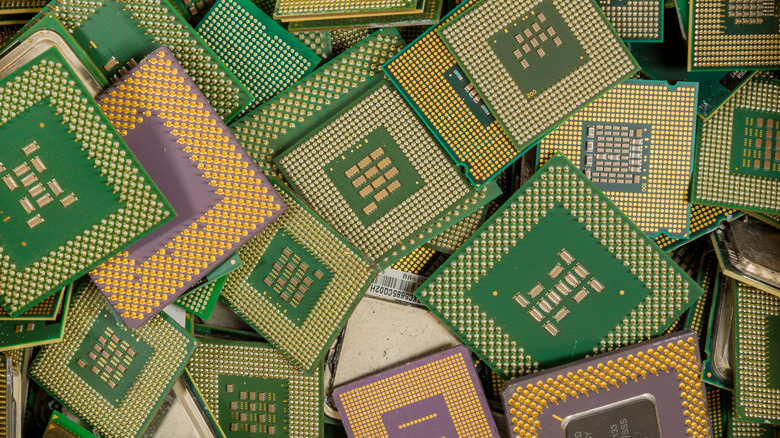
It generally isn't worth extracting gold because the cost outweighs the profit you'd get from a handful of samples. It mainly becomes worth it at an industrial scale, not in a small laboratory or personal setup. It's also not the safest process to do at home (it's highly recommended to send it to an e-waste or refiner service instead) because it involves dangerous chemicals that should be handled carefully in a fume hood.
Moreover, you should never dispose of toxic waste in your kitchen. Plus, it doesn't matter which equipment you're handling, since the process and recommendations are the same; extracting gold from smartphones is similar to what you'd do with computers. It may be more worth it if you can procure large quantities, especially from older electronics. Gold-plated electronics from the 1980s had a thicker coating than those found in more recent times.
Typically, the thickness was about 1 micrometer (µm) in the 1980s, compared with gold-plated components that are often 0.1-0.5 µm thick today. Then, of course, there's a sizing difference — most of what you see now is much smaller than it was in the 1980s and 1990s. So if you have a collection of very dated electronic equipment (and you're not selling it for cash), you can get a little more gold. According to Phoenix Refining, "a 1990s computer board can yield between 1 to 5 grams of gold, while a modern smartphone contains only about 0.034 grams." Keep in mind these are different devices, but the gap is still quite large.