

Is It Cheaper To Have A Landline Than A Cell Phone In 2026?

Expensive phone bills are likely the albatross in our utilities pile right now. We might've replaced cable with individual streaming services, and we might have put away the corded handsets at home, but are we really happy about paying this much for an iPhone or Android plus the data and related add-ons? Is it cheaper to ditch wireless and return to the landline? The short answer is a hard maybe, edging towards a no if you can't bear the one-time costs in making such a transition. That said, you could save big depending on how far up the price ladder you're coming from.
The largest one-time cost we're talking about is a terminal device that essentially has a phone number associated with it. Nearly all landline service today is delivered as voice over internet protocol (VoIP) rather than through mechanical exchanges. AT&T still dedicates some copper landlines to telephony in California, but it is actively winding down that network through 2029. This all means that the phone service itself depends on some sort of internet connection, be it wired or wireless.
Phone service on your home internet network can range from a few dollars a month with an independent outfit like Telo up to $30 per month at bigger carriers like AT&T, Spectrum, and Verizon, and that's on top of a dedicated internet plan. Xfinity does let you buy a voice-only package, but at a hefty starting price of $40 per month. AT&T and Verizon sell cellular terminals with standalone service plans beginning at $45 and $20 per month, respectively. Depending on the situation, you'll also be on the hook for said terminal at $100, more or less (it's free at AT&T, but you'll need to return that equipment if you terminate service), plus extra if you need new handsets.
Can you get the best of a cell phone and a landline for less?
Let's say you make the switch to home phone service but are looking to replace the mobile data from your former plan. Heck, you might still want a mobile phone number, given how many services send codes to it as a not-so-safe two-factor authentication method. There are quite a few options that may still keep you under your pre-switch monthly costs, though there are caveats here, too.
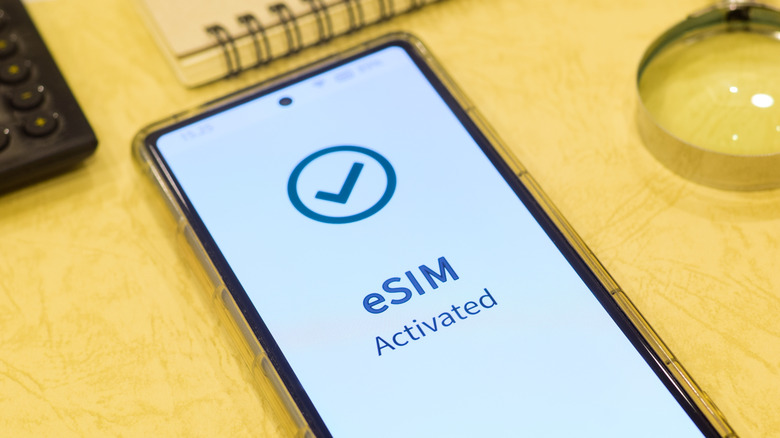
If you only want mobile data, think like someone traveling abroad and pick up a data-only eSIM plan. The cheapest ones come from providers buying access from a foreign carrier that has a roaming agreement with a counterpart in the United States. In our quick sampling, we found 30-day plans with a 10-gigabyte allowance for $5, or 50 gigabytes for $20. However, you'll want to read the fine print and check on any speed restrictions as well as network compatibility with your smartphone — that is, if you still have one after dropping your mobile plan.
Domestic carriers with light-use plans offer expanded options for those who want an extra phone number. Specifically, T-Mobile-based virtual carrier Tello lets customers craft plans that have no talk minutes and a data allotment, with unlimited texting being the only standard feature. A hard-capped two gigabytes costs $6 per month, while unlimited usage (with 10 gigabytes of mobile hotspot and a 50-gigabyte threshold for speed limiting) will cost $25. Other affordable prepaid carriers are available, but the reality we're trying to illustrate is that you're going to be jumping through many hoops to get the best of both worlds.