

The Big Problem Every Artificial Intelligence Company Faces

The AI industry is facing multiple problems, all at once, and they all feed into the same big, snowballing problem. There's a need for revenue that has to hit such a ludicrous height ($6 trillion) that it would have to rival or surpass the car industry. That holds 1% of the world's gross domestic product (GDP) as of 2024, at around $3 trillion. Major labs are facing copyright crises, as the underlying tech behind generative AI, large language models, is categorically built on theft, now admitted by Microsoft higher-ups (via TechCrunch).
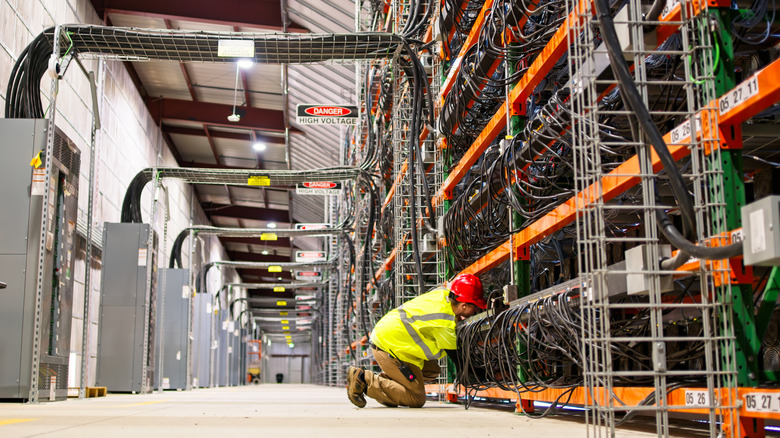
Then, the AI data centers required, which are polluting or destroying infrastructure and raising prices across the U.S., need to be rapidly built for the western AI industry to push ahead. Predictably, they are either trapped behind bureaucracy, planning, hardware shortages, and public pushback after the negative impact of them has spread widely on social media. A community tracking site, Brockovich AI Data Center Reporting, estimates less than 140 are fully operational, with demand being exceeded according to both data center operators and other AI businesses.
Despite all these social issues surrounding AI, the companies are ultimately only concerned with meeting revenue targets, seemingly plucked out of the sky. As of right now, with the information we've seen reported, there's no path to profitability unless almost absolutely everything lines up perfectly. Guess what's not exactly lining up perfectly? Let's take a look at some figures and use the major AI lab Anthropic, which develops Claude and is threatening the world by trying to go public, valued at $2 trillion.
AI industry needs to earn billions

Anthropic, whose financial information in its initial public offering document, an S-1, was leaked (via Reuters), showed that it lost $42 billion in 2025. However, $34 billion was done via a write-down, reducing the asset's worth while keeping it on the books. Recent reporting of it hitting $65 billion in revenue in 2026 is questionable, as no one is reporting on actual profit. However, breaking the numbers down further reveals that Anthropic — in 2025 – made $4.6 billion in actual revenue, with an operating loss of $8 billion. That means they spent $2.75 for each dollar.
As pointed out by David Gerard, author for Pivot to AI, these numbers have been "cooked" slightly too. A Reuters report details that Anthropic actually books the "full value of marketplace contracts," or platforms purchasing access to Claude, then reports the money made by the platform itself as "marketing cost." There is no discernible way to break down the company's recent dealings outside of opaque, unquestioning reporting from some mainstream outlets, where it has blatantly told investors that its "adjusted" operating income will make it profitable.
It should also be noted that this figure comes after Anthropic moved to a token-billing method. It now charges API, enterprise, and business customers per token, or how the LLM breaks things down when generating. This has caught multiple companies out, including Amazon and Microsoft, which reportedly had to tell their engineers to slow down on usage, despite pushing it just months prior.
Follow the money around this circular financing
The AI industry has buoyed its customers since exploding onto the market in 2023, subsidizing through its extraordinary investments, but the real cost is now bearing down on it, and it isn't pretty. The top model from Anthropic, Fable 5.1, currently costs $50 per million tokens. Programmers, for instance, can burn through millions of tokens in a week by having the model generate entire reams of code. Google has made the recent move to limit the free version of Gemini to "Flash-Lite," as it seeks more revenue from a sector that's bleeding money.
On top of this, there are questions about circular financing, as Nvidia has a scheme to finance its customers buying its hardware. The company, along with Microsoft, Oracle, and other major players in the AI space, is participating in circular financing. For example, Microsoft was paid by Anthropic $30 billion for compute space, but then has had to pay Anthropic out of the nose for access to its Claude models. Meta has also joined Microsoft in scaling back reliance on the AI.
There are also questions about Nvidia's shipments of graphics cards: where are they? If Nvidia has managed to ship billions to trillions worth of hardware, but the data centers are still in progress or nonexistent, and by the time the companies get them built, it'll be time to upgrade the hardware (pigeonholed at three years in some cases). Where are the data center GPUs? Where's all this money coming from? Once again, "All the President's Men's" famous quote from "Deep Throat" persists: "Follow the money."