

5 Essential Features To Look For In A Portable SSD
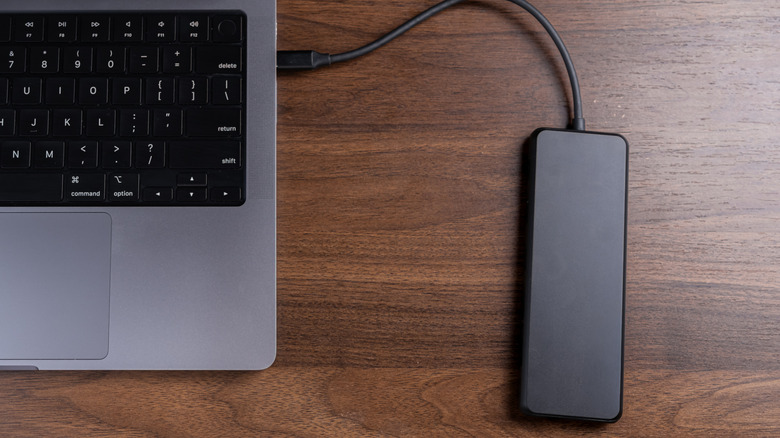
With the ongoing memory crisis, prices for portable SSDs, microSD, and anything related have skyrocketed. Still, not only AI servers require such technology. Everyday users also need reliable, safe products on which to store their information, photos from a vacation trip, documents for a work project, and so on. If you're in the market for a portable SSD, there are a few things to keep in mind, like taking a good look at storage capacity, brand reliability, and physical durability.
In 2026, BGR traveled to China to get to know one of the top companies making memory cards, Lexar, and its meticulous process for creating these products. After all, a faulty microSD, SSD, or portable SSD could ruin precious memories, a hours of hard work. Amid prices rising, these companies continue to innovate. Lexar, at IFA 2026, unveiled its Muse portable SSD, which is a MagSafe Wallet-like accessory that you can attach to the back of your phone and use a small USB-C cable to quickly access information or start recording in 4K ProRes without it being a bulky accessory. That said, here are five essential features to look for in a portable SSD if you're thinking about buying a new model to meet your needs — and don't forget that taking care of these products is really important, as some things can kill external drives quickly.
Storage capacity
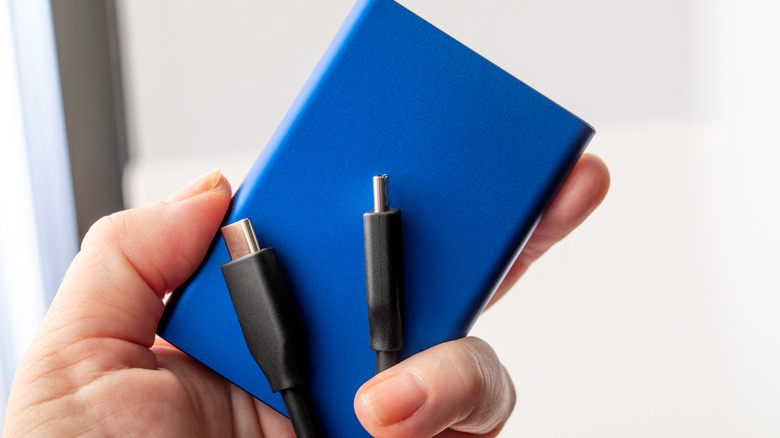
When choosing a portable SSD, the first thing you need to take a look at is the amount of storage, as this is what dictates what you can do with the drive. For example, if you want a portable SSD to store several hours of 4K or 8K recording, you'll likely need something with a few terabytes, while a portable SSD for some photos, sensitive documents could be served with something like 256GB, or less. However, if you choose a portable SSD that's too small, you might be forced to manage your files and offload information, or purchase additional SSDs.
To choose the right capacity, you need to take a look beyond your current storage needs and think about the next three to five years. For general productivity, basic document backups, and family photo archives, a 1TB drive is more than enough. For a media professional, high-resolution photo archive storage, or modern video game installations, a drive with 2TB to 4TB is a more realistic entry point.
You should also pay attention to usable capacity versus advertised capacity, as a 1TB drive actually delivers around 931GB of usable space, as solid state drives require roughly 10% to 15% of free space to maintain optimal write speeds and perform internal garbage collection.
Sustained transfer performance
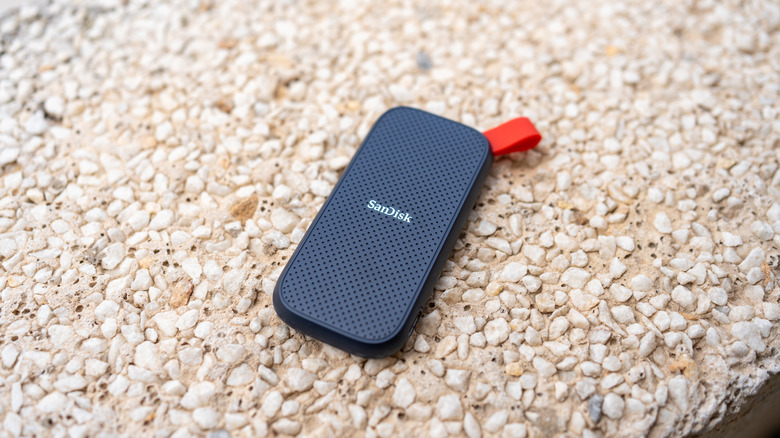
Even though the storage capacity is an important feature to look for in a portable SSD, it doesn't mean much if it doesn't come with sustained transfer performance. After all, sustained performance determines how the drive handles heavy, continuous workloads, such as backing up hundreds of gigabytes of a photo library, transferring raw 4K footage, or letting you stream a game from the portable SSD to your console. A cheap drive claiming 1,000 MB/s speeds might plunge to 60 MB/s after a few gigabytes, which can give you an unreliable experience. Proper high-sustained performance is important to ensure that the drive maintains fast transfer rates from the first gigabyte to the last.
Before buying a portable SSD, in addition to taking a look at the product's specs, you should look for real-world benchmark tests, independent reviewers that publish sustained write graphs or cache exhaustion tests. Avoiding drives that use Quad-Level Cell (QLC) flash memory without an adequate DRAM cache, and choosing drives built with Triple-Level Cell (TLC) NAND flash, an integrated DRAM cache, and effective thermal management — such as internal thermal pads or dynamic thermal throttling controls — can be the best way to prevent your portable SSD from overheating mid-way through a transfer and dropping speed.
Brand reliability and warranty coverage
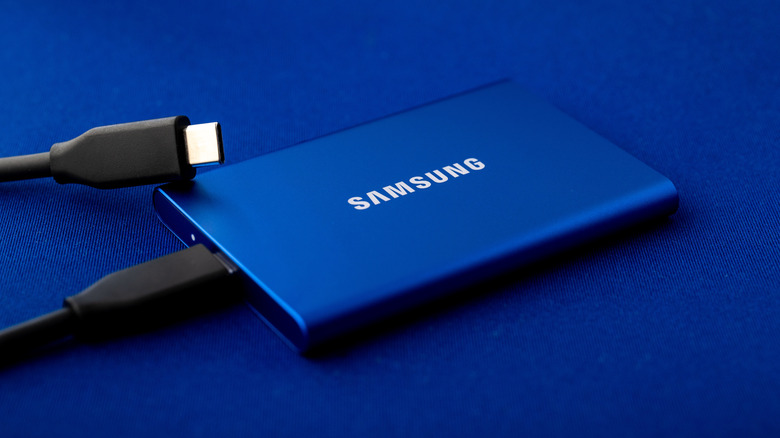
As with a smartphone, computer, or cable, choosing a portable SSD from a reliable brand is important. After all, a portable SSD will be responsible for backing up your data, holding sensitive documents, or even something you've been working on for a while. While I'd recommend going a step forward and taking a look at portable SSDs with an extra security lock, the most important thing is to choose a product from a reliable brand and with a good warranty coverage. After all, if, on paper, all the portable SSDs look the same, there must be something that allow some brands to charge $300 while one charges $70.
Since storage brands are not created equal, tier-1 manufacturers like Samsung, Micron and SK Hynix make their own NAND flash memory chips in-house, this gives them direct control over quality testing and firmware integration. Third-party brands, for example, may buy excess or lower-tier memory chips from various suppliers, leading to inconsistent performance across different batches of the same model. Moreover, widespread firmware bugs and component failures that plague certain popular drives like the SanDisk Extreme series show why brand reputation must be verified.
That said, to ensure proper standards, you should buy drives from established NAND manufacturers or trusted sub-brands. Checking independent hardware reviews for teardowns to see which internal controller and NAND flash are actually inside the casing is important. Also look for a manufacturer offering a minimum 3-year warranty, with 5 being the industry standard for premium drives.
Physical durability
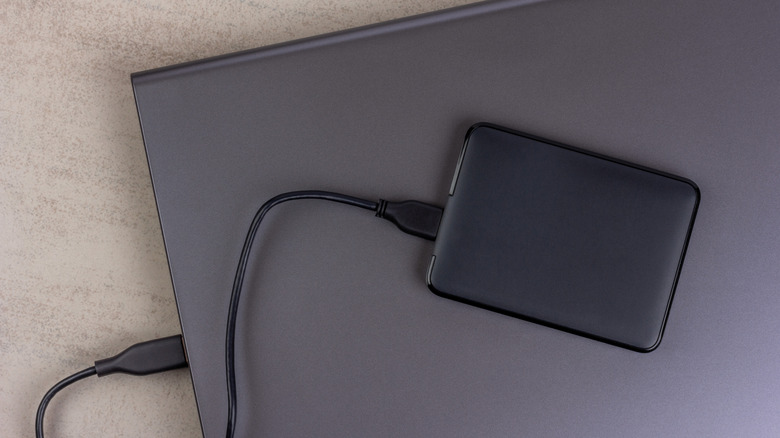
Accidents happen, and if you're buying a portable SSD, that means you want to take it with you. Still, in a real-world environment where anything could happen, it's important to understand physical durability to protect not only the internal circuit board, but also its ports. More than claims of "rugged" or "shockproof," you should look for the possible IP rating of the device, which measures resistance to dust and liquid.
For example, an IP55 rating means the drive resists dust buildup and light water spray. An IP65 or IP67 rating indicates complete dust protection and the ability to withstand low-pressure water jets or short accidental submersions. Drop resistance should also be explicitly rated in distance, ideally between 2 to 3 meters (6.5 to 10 feet) onto a concrete surface.
A good tip is to choose models built with a solid aluminum core or a heavy-duty rubberized outer sleeve, such as the Samsung T7 Shield or SanDisk ArmorATD. After all, aluminum housing serves a dual purpose by absorbing structural impact and acting as a passive heatsink to draw heat away from internal components. Besides that, you should make sure that the drive interface features a reinforced USB port rather than a loose, surface-mounted connection. Finally, checking if the drive includes an integrated port cover if you plan to use it in dirty or dusty environments.
Universal connectivity
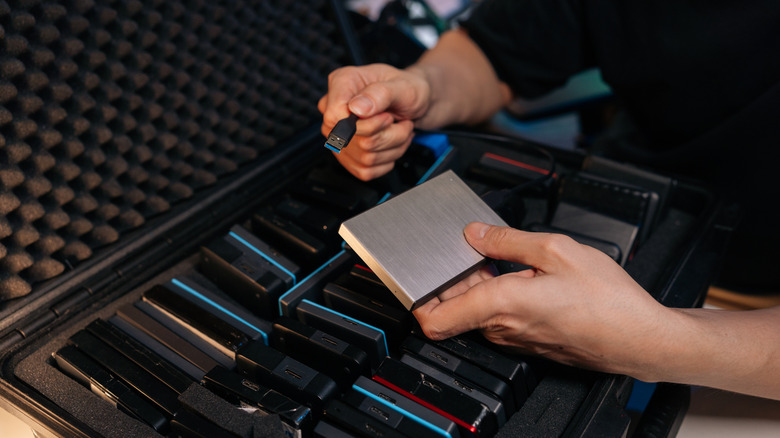
Last but not least, a portable SSD should work across each device you own, whether it's a Windows desktop, a MacBook, an iPhone, an Android tablet, or a camera. After all, incompatibility, missing cables, or restrictive file system formatting can make a fast drive into a frustrating device. This is why there are two main factors that determine if a drive is truly universal: its physical cable setup and its file format.
On the physical side, the drive needs a modern USB-C connection, which has become the standard for almost every gadget available these days. However, speed still depends on the port on your computer, meaning that if you plug a super fast-drive into an older USB port, it will automatically cap its speed to match the slower port. On the software side, on the other hand, the drive's file system dictates which computers can read it. Drivers formatted for Macs (APFS) will not work on Windows, and drives formatted for Windows (NTFS) won't work on the Mac.
To ensure everything works properly, make sure the drive is formatted as exFAT, as this is the universal format that allows Mac, Windows, Android, and iOS to read and write files freely. Besides that, you should choose a drive that comes with a quality USB-C to USB-C cable, plus a USB-A adapter, so you can easily connect to older desktop computers and devices as well. With those tips, it's going to be a lot easier to choose your next portable SSD.