

Google's Discontinued Social Media Platform From 2004 Could Be Making A Comeback

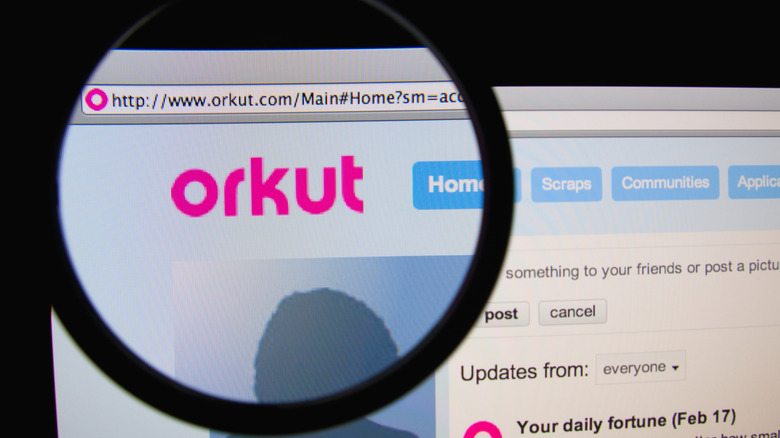
A social media platform from Google's early days has sparked conversations of a comeback — and no, it's not Google+. It's a social network called Orkut, a forum-style platform that allowed users to post statuses, send messages, and connect together long before today's social media platforms became dominated by video-first content and influencers. Orkut was created by a software engineer from Google named Orkut Büyükkökten and was launched in 2004 after the company had failed to acquire Friendster, a similar platform, in the previous year. Now, around 12 years past its shutdown, Büyükkökten has posted a call on X encouraging people to share supporter cards to help bring the platform back.
If you have never used Orkut, you can imagine it as a medley of Reddit's interest-based forums, mixed with a much earlier interface of Facebook, plus the ability to customize your profile with a variety of colorful themes. Since the platform bore resemblance to thriving competitors at the time, such as MySpace and Friendster, it never really took off in the United States. However, Orkut became especially popular in Brazil and India, to which former Yahoo! CEO Marissa Mayer explained it was because users in Brazil were used to slow internet, while Indian users populated the servers at a time when Western countries were offline. However, with slow development amid the fast rise of platforms like YouTube, Facebook, and Twitter (now X), Google eventually shut Orkut down on September 30, 2014.
The Orkut revival seeks to 'make the internet human again'
Büyükkökten's appeal to "make the internet human again" seems to be a pushback against bots and AI-generated content running rampant on social media — which many consider as part of the Dead Internet Theory. In his open letter, he envisions an online space where humans and genuine connection remain the center. "I see a different future for the internet, one built around real people, one with a human on the other side of every message. A future not focused on algorithms, eyeballs, and time-on-site optimization," he wrote.
The call for support has since reached over 332,000 signatures as of writing. Despite the growing support, however, the idea has received mixed reactions from former users on social media. One user, @daftari, expressed their interest, saying, "I've met some of the most amazing people I know on it, much like early Twitter. I'm signing up." Meanwhile, others aren't interested in a revival, with X user @AkitaOnRails explaining, "Hope you do well, but as a former Orkut user, I don't have any interest in having it back. It is a product of its time, and that time has passed, and we all moved on."
With newer social media platforms continuously evolving and adding new features, is resurrecting an old platform a solution toward human connection? This may be a concept to look forward to — nostalgic, even — but others may think that this particular format of online interaction may no longer thrive as younger generations take over online spaces. Moreover, it is still unknown whether Orkut will present itself as an app that millennials remember, bearing its original interface and features, or if it will integrate newer technologies such as AI to help the platform thrive.