

Are Apple's M Series Chips More Powerful Than Intel CPUs?
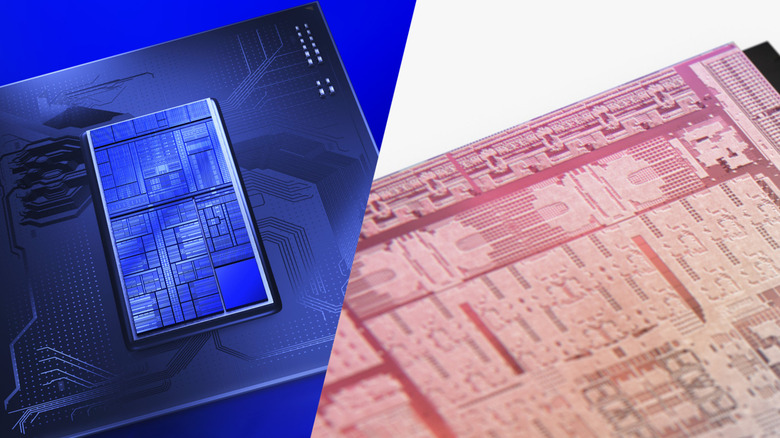
When Apple transitioned to Apple silicon in 2020 — thus giving Intel the boot after bringing them aboard in 2006 with the death of PowerPC — it essentially struck gold. The M-series chips have since been lauded for their performance gains over Intel in the mobile space, providing users with what feels like a snappier device, even on the very low end with the 8GB MacBook Neo (though that uses the A18 Pro chip instead of an M-series chip). Apple's most recent launches, the M5, M5 Max, M5 Ultra, and M6, have now completely dominated benchmark leaderboards such as Geekbench.
The Cupertino company has raced ahead in terms of raw performance with its processors, but may lag behind Intel in terms of customization or number of configurations. Where Apple is gaining the upper hand over Intel is that its hardware and software are so tightly integrated that it gives it a feeling of being snappier than Intel's fare. The work Apple's teams have done on the CPU has allowed for an increase in micro-operations between M3 and M4 releases and expanded the cache available for faster data processing.
Apple's decision to use unified RAM also comes with an advantage. As all the components share the same pool of resources, it allows for faster processing. As the processor, GPU, and Neural Engine are effectively working from one pool, there's less time spent moving data around.
Apple is reaching peak speeds
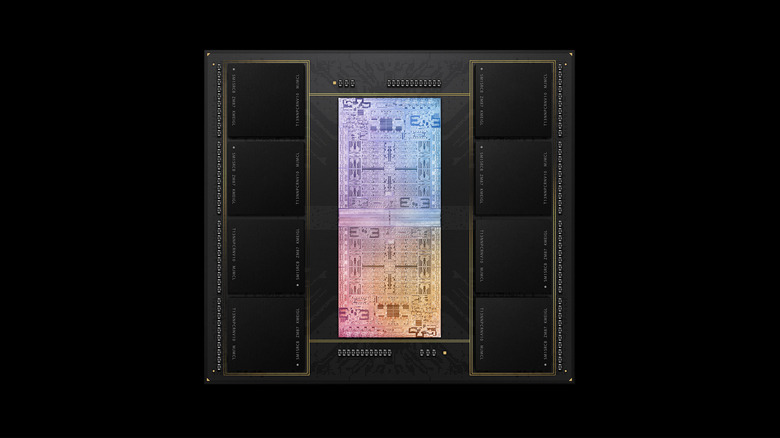
Even Apple silicon is still struggling in some areas, despite speed and processing improvements. The M6 chip currently offers similar performance to that of a 2022 RTX 3050, looking at some gaming metrics. At native full HD resolution, NotebookCheck found "Cyberpunk 2077" hit just 33 FPS, but would reach 80 FPS once upscaling and frame generation were involved. The more demanding title "Crimson Desert" also hit 30 FPS, but by making use of MetalFX's upscaling suite, it managed to squeeze 60 FPS out of a Mac Mini running the M6 chip.
Running "Total War: Warhammer 3" and "Cyberpunk 2077," PCMag found that the M5 Max with 40-core GPU, hit 102 FPS on average at 1080p and 1200p resolution, using Ultra settings, and 93 FPS in "Total War" and "Cyberpunk" respectively. Even the M5 Ultra chip struggles with "Cyberpunk" once all the bells and whistles are turned on, averaging around 66 FPS when running at 1080p with Ray Tracing and Ultra settings, according to Tom's Hardware.
Intel's chips have the nice bonus of being able to be combined with a wide variety of massively performant graphics cards, including via Thunderbolt to an external GPU. Intel's processors might not be able to output the best graphics — unless you look at its new handheld console chips — but they can join forces with other components to offer beastly performance.
Apple is even standing up to hardware titans
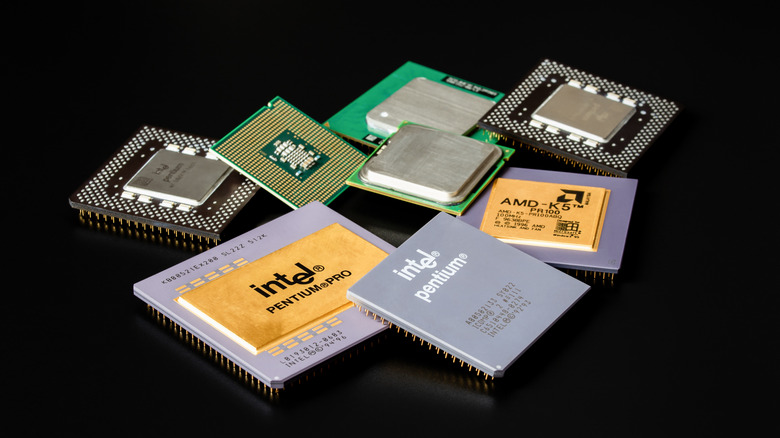
That is, if the Apple M5 Ultra didn't stand up to the top consumer card at the moment, the RTX 5090 from Nvidia, in creative powerhouse software, Blender. In Blender benchmarks, the 5090 has a median score of 15068.26, and the Apple M5 Ultra currently holds 13112.88. Its current laptop graphics processor, the B390, sits at 1266.02 as a median.
At the end of the day, Apple's hardware being under its complete control, allows them to build out processor architecture as they see fit, including its methods behind memory, cache, and power design. It is a finely tuned machine that no one else is allowed to touch. Intel and AMD have partnered to explore new methods of improvement for the x86 architecture, including new ACE CPU extensions to speed up AI computing, and Intel in 2024 introduced new Advanced Performance Extensions (APX), which doubled the number of general-purpose registers, which the processor uses to, well, process data.