

Meta's Petal Subsea Cable Is A World First - Here's Why
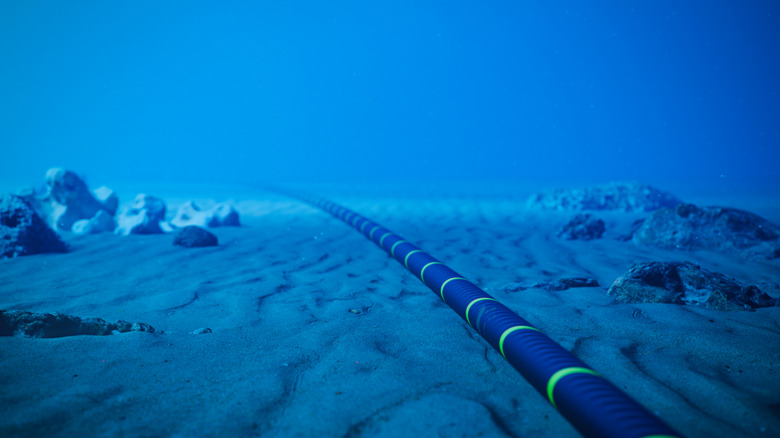
Staring at your smartphone screen or losing yourself in a new Netflix movie, it can be easy to forget that much of our digital world depends on a vast network of internet cables crisscrossing the ocean floor (and also serving a surprising scientific purpose), which connect continents and carry the massive amounts of data powering our everyday online activities. Meta already has more than 20 subsea cable projects around the world, but its latest plan, called Petal, will be a record breaker when it becomes operational in 2029.
Designed to stretch 4,300 miles across the Atlantic Ocean between the United States and France, Petal will be the world's first transoceanic subsea cable capable of carrying one petabit of data per second, which is twice the capacity of today's leading systems. That huge capacity will be made possible by the special design of the optical fibers. While conventional optical fibers typically use a single core to transmit data, Petal will use two cores within each fiber when it goes into service. This creates additional pathways along which digital information can travel, significantly increasing capacity without requiring a corresponding increase in power use or additional physical infrastructure.
The tech giant, led by Mark Zuckerberg, sees Petal as a vital investment in the age of artificial intelligence (AI). Developed in partnership with Japanese tech firms NEC and Sumitomo Electric, the new cable is designed to meet the growing demands of a world that's generating and moving an increasing amount of data. As AI usage expands along with the cloud facilities and data centers that support it, the importance of reliable, high-capacity connections will only grow. Petal is designed to help provide some of that capacity, strengthening the digital infrastructure on which our increasingly connected world depends.
What Meta's subsea cable means for you

The fact that Meta's Petal subsea cable will be able to carry a colossal one petabit of data per second is unlikely to mean much to most people, other than that it sounds really fast. So let's look at it another way. Essentially, data transfer at that speed is enough capacity to transfer around 30,000 movies per second, assuming each file is about four gigabytes in size. Alternatively, Meta itself estimates the cable could carry enough data for roughly 75% of the world's population to stream music simultaneously. So yes, "really fast" seems about right.
But what kind of impact will Petal have when you're, say, settling down to watch something on your favorite streaming service, making a video call, playing a multiplayer game, or asking an AI chatbot a question? Well, truth be told, Petal isn't going to magically turbocharge your internet connection, as the speed largely depends on everything from your broadband package and Wi-Fi capability to the servers you're accessing and network congestion. The cable's real value lies in helping the global networks behind our digital lives keep up with growing demand. As we use more data with increasingly sophisticated AI tools, better-quality video, and so on, and rely more on cloud services for everything from work to entertainment, the global networks carrying that information need more capacity. Petal is designed to help meet that demand while at the same time improving internet resilience.
Since Petal won't be entering service until the end of this decade, it will be a while before it's able to make a meaningful difference to the digital ecosystem. But as our appetite for data continues to grow, investments like this will help determine how reliably the internet can keep pace.