

Scientists Are Using Internet Cables For Something They Weren't Built To Do

Internet cables are becoming seismic sensors on land, under the sea, and possibly on the moon. Millions of miles of fiber-optic cable already cover the Earth, including about 920,000 miles of undersea cables on the ocean floor. As some of the oldest cables are being pulled from the ocean and new cables are laid, scientists are increasingly tracking natural hazards like earthquakes, volcanoes, and floods along this global network.
Distributed acoustic sensing (DAS) uses laser pulses to read minute changes in vibration, strain, ground movement, and water movement. Traditional seismometers measure ground motion at an isolated point. A fiber-optic cable can act as a continuous sensor over a larger area, collecting real-time, high-resolution data, and Iceland's volcanic Grindavík eruption showed how the technology can help track hazards beyond earthquakes. The U.S. National Science Foundation reported that the system supported a warning 26 minutes before the eruption, giving nearby residents time to evacuate.
Caltech researchers also proved how powerful the monitoring system can be. They tapped into a roughly 62-mile fiber-optic cable section, collecting data equivalent to 10,000 traditional seismometers. Their findings could have a sizable impact on seismic monitoring at a much lower cost than traditional systems. There are more than 700 seismometers in California, each costing up to $50,000. A DAS system needs one $200,000 interrogator to send laser light pulses down miles of cable. The same approach could help with underwater seismic monitoring, which gets even more expensive and difficult. In the Canary Islands, researchers turned a submarine telecommunications cable into 11,968 strain sensors across about 75 miles. The DAS system detected local and regional earthquakes along with seismic waves from oceanic earthquakes thousands of miles away.
How the same technology could detect moonquakes
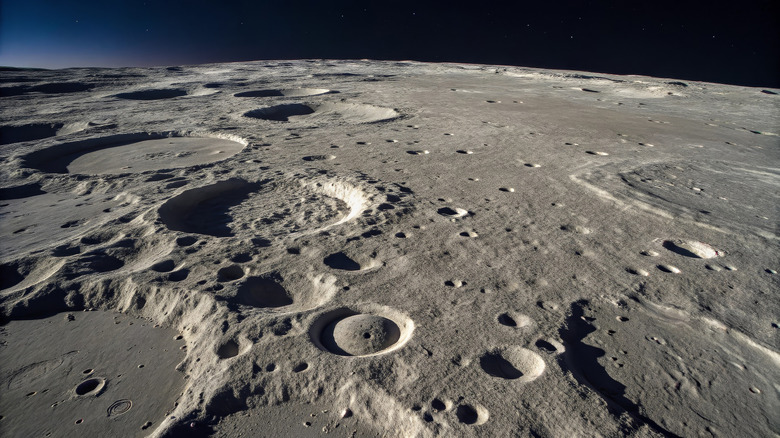
The same technology could be headed to space, as Los Alamos National Laboratory researchers propose using fiber-optic cables to detect moonquakes. Cables could be unspooled across miles of the moon's surface. Researchers suggest cables may not need to be buried after testing signal clarity in a lab using crushed basalt to simulate the moon's surface. The same cables deployed as seismic sensors could one day support communications for lunar missions.
The moon doesn't have the kind of tectonic plates that shake the Earth's fault lines, causing most earthquakes. Moonquakes are instead triggered by forces such as Earth's gravitational pull and meteorite impacts. Also, scientists say the surface of the moon is even colder than we originally thought, dropping lower than -410 degrees Fahrenheit at night and heating up to 250 degrees Fahrenheit during the day. These temperature fluctuations make the surface expand and contract, adding to the moon's seismic activity.
Scientists believe understanding seismic waves caused by this activity will help them learn more about what's inside the moon, such as its density, composition, and whether it contains liquid.
If scientists discover faults, it could indicate the moon is more geologically active than previously believed. In 2019, researchers used moonquake data to infer that the natural satellite's size was shrinking. However, additional moonquake data could reveal new insights into how the moon formed.