

The Real Issues With Free Apps That Claim To Pay You
If the prospect of making real cash quick by playing games, watching videos and ads, testing digital products, or completing surveys on your mobile device almost sounds too good to be true, that's because it often is. But there are plenty of free mobile apps out there that claim to offer users the opportunity to earn real money or gift cards by completing specific digital tasks. Some, like Mistplay and JustPlay, focus on mobile gaming and reward users based on their playtime or for hitting certain in-game milestones, while others, like Freecash and Swagbucks, also offer additional tasks to earn money from, such as completing marketing surveys and polls.
These GPT (or get-paid-to) rewards platform apps can therefore be quite alluring. They are generally accessible (you just need an internet connection and smartphone or mobile device) and seemingly offer the opportunity to use your downtime productively to earn a little extra cash, without having to leave the comfort of your home.
However, these apps aren't necessarily a way to make cash fast and can come with several downsides, including low pay, high pay-out thresholds, and extensive personal data collection and tracking. Elsewhere, others have been accused of misleading customers and deceptive marketing techniques. Below, we break down how these cash payout apps work, including how the users and app publishers make money off them and the real issues with using these free apps that claim to pay you.
How do cash payout apps actually work?
Apps that claim to pay real cash often reward users with credits (like coins or points) for meeting in-app milestones and completing tasks, such as playing for a set amount of time. These credits can then be traded for real cash, digital currency, or a gift card. For example, Swagbucks rewards users with a certain number of SB when they complete tasks, like playing games, answering surveys, and shopping online. Most of its surveys pay around 100 to 300SB, with a minimum of 300SB needed to claim a gift card and 2,500 SB needed to start cashing out via PayPal.
So, how do the app publishers make money? These platforms are powered by offerwalls, a form of rewarded advertising that sees an advertiser setting specific tasks they want users to complete. The app publisher acts as a bridge between the advertisers and users. When a user completes a task set by the advertiser in the publisher's app, the user is rewarded by the publisher — but the other parties benefit, too.
The publisher is paid by the advertiser for each task completed, through performance-based models like cost-per-action (CPA), with the user reward being only a small portion of what the publisher earns for each completed task. This also allows them to monetize non-paying users, who otherwise may never pay into the free platform. In turn, advertisers gain measurable engagement from voluntary users, potentially leading to users becoming paying customers later.
The real issues with cash payout apps
However, this isn't a no-strings-attached way to make lots of cash fast. Users often need to invest a lot of time to earn more than a few pennies in these apps. For example, according to experts, the typical earning rate for Mistplay users is between $0.50 and $1.50 per hour. For context, the federal minimum wage is $7.25 an hour. In addition, users often need to meet a payout threshold before they can trade in their points for rewards — with gift card thresholds typically being lower than cash. InboxDollars, for example, has a minimum first-time payment threshold of $15 (which drops to $10 thereafter), but users report it can take a while to meet this.
In addition, some users and experts have reported that, while you may find yourself completing tasks — like game levels — quickly early on, the progress soon slows down, with the time investment required to earn increasing significantly. Users have also reported not receiving their rewards at all. In 2021, the Federal Trade Commission (FTC) finalized a settlement with Tapjoy Inc. after alleging the advertising company had "deceived consumers" by failing to provide the rewards it promised for completing activities.
Then there's the sensitive data these apps can collect. This may involve overly personal survey questions, and the terms of certain apps may see you granting permission to track and collect data. In 2026, JustPlay and Gimica Games settled a class-action lawsuit (for up to $4.5 million) that alleged the entities had collected and stored the biometric data of JustPlay app users in Illinois without written consent.
Allegations against Freecash
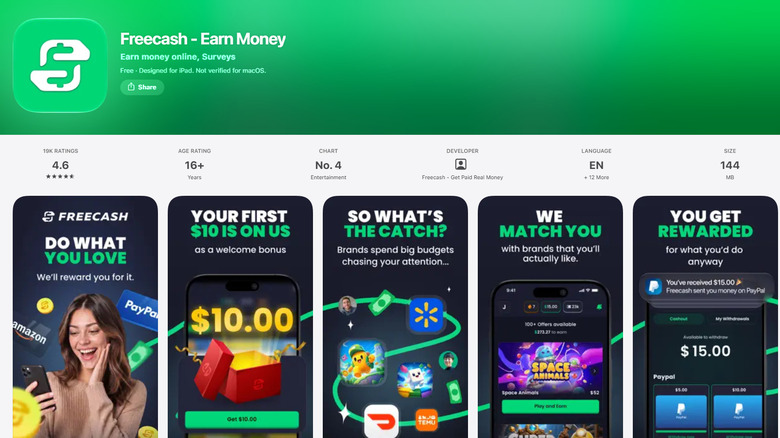
Bottom line: If it seems too good to be true, it probably is. This was the case with the Freecash app. According to a 2026 Wired report, Freecash was marketed as a way to make money by scrolling TikTok, claiming you could earn up to $35 an hour simply by watching your For You page — the ads never promoted Freecash by name but linked to the app's site. The prominence and allure of Freecash's ads on TikTok helped it surge to the number two spot in Apple's free iOS app chart in the United States.
However, cybersecurity company Malwarebytes released a report alleging Freecash's claims were "misleading" and that, upon installing the app, "the promised TikTok paycheck vanishes" and you're directed to pay-for-play mobile games instead. The company also claimed the app's privacy policy allowed it to automatically collect highly sensitive personal information, including data about race, sex, health, religion, and biometrics.
Following these reports, TikTok removed some of Freecash's adverts and both Apple and Google pulled Freecash from their respective app stores (though it's since been re-added to both). Almedia Press also released a statement to Malwarebytes stating, "We investigated the issue and identified an affiliate operating in breach of our policies. That partner has been removed from our network. Almedia does not sell user data, and we take compliance, user trust, and responsible advertising seriously."