

Here's How Much A Computer Cost In 1986 Vs. 2026

Computer costs are on the rise as AI data centers hoover up a majority of the hardware, and what's available is quickly being funneled into the AI industry as well. RAM, processors, and storage have all been affected, with PCs today costing a hefty sum if you want something decent either for gaming or just for office work. Looking at PCs today, like the latest AI-driven hardware, Nvidia RTX Spark Laptops start at $2,599.99 and can run up to over $6000 with 128GB of RAM. Prebuilt gaming PCs, at the entry level, are around $1200 or more. Office devices, like mini PCs, which used to be a killer deal, are now seeing prices skyrocket as desirable hardware is harder to come by.
In 1986, the PC price wars were the talk of the town, and IBM even waded in with a price cut that particular year to compete with the "PC clones." It was the start of the PC clone truly exploding. At the time, IBM set the industry standard over the "Personal Computer," as well as hardware and software. A PC clone, or IBM/PC Compatible, put out PCs that either competed with or undercut IBM, but remained compatible with what was available. At the time, IBM's entry-level PC cost $1,995 ($6,097.49 adjusted for inflation), but was ran as low as $1,595 ($4,874.94). In December 1986, Tandy released an updated version of its 1984 Tandy 1000 with the EX variant. This ran for $1000 ($3056.39).
1986 still had its share of beefy PC price tags
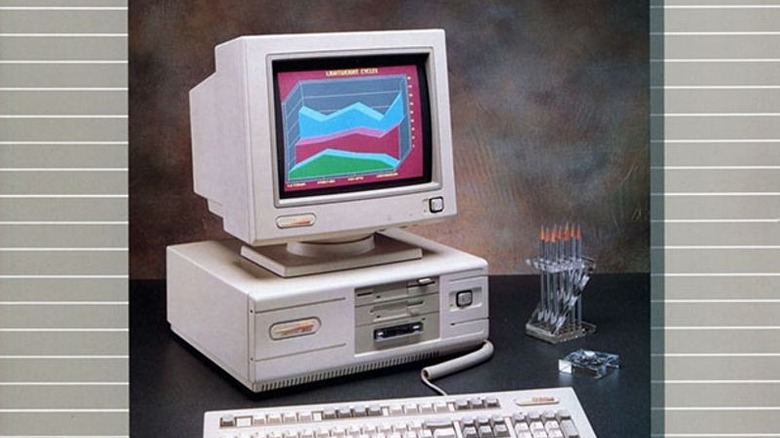
PC prices have yo-yoed throughout the years (particularly graphics cards), with the pandemic in 2020 and crypto bubbles being recent causes before the AI hardware race kicked off. In 1986, it wasn't unreasonable to be lumped with a $3000+ bill for a new PC, like with Compaq's high-end DeskPro 386, which beat IBM to the punch, launching the new Intel 386 processor (introducing 32-bit computing to the masses) before the legacy company could. In 1986, the DeskPro launched at a minimum of $6,499 ($19,863.46) for the Model 40, the Model 70 for $7,299 ($22,308.57), and Model 130 for $8,799 ($26,893.15). This was the latest advance in consumer-level computing, and if you look at the top-end development-focused PCs using the latest cutting-edge hardware, prices start to reach those levels in 2026.
Framework, the repair and upgrade-centric PC brand, is currently selling its Desktop with 192GB of RAM, an AMD Max+ Pro 495, and 2TB of storage for $7,449. At a -67.3% rate of inflation back to 1986, this would cost $2,437.19. So why were prices high in 1986, even if PC clones were becoming more and more prevalent? The simple answer is that the technology was new, and the '80s had its own share of hardware price crises too, including a RAM price hike. Another is that manufacturing hadn't scaled to the level that it is today.