

This New Motor Could Be A Game Changer For Humanoid Robots And Wearable Tech
Over the past few years, we have seen major advancements in robotics. However, their movements still mostly rely on rigid motors at each joint. This is a big part of why robots always appear to move so stiffly. However, researchers at the EPFL research institute in Switzerland have come up with a motor that could provide much smoother movements for robots. The motor is being called the FiberMotor, and in a new study in Advanced Materials, the team says it could eventually be used in soft exosuits and other wearable assistive devices to provide less jerky movements all around.
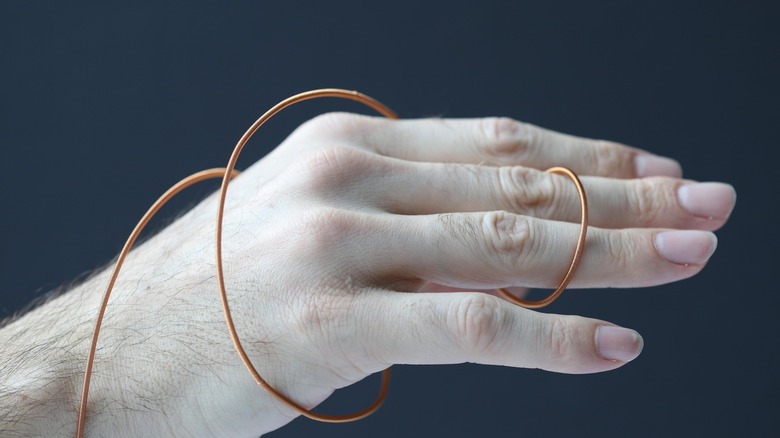
The motor itself is made up of two hollow fibers that are both wrapped in insulated copper wire which is only a little thicker than a human hair. When voltage is applied to the fibers, the electrostatic forces pull the fibers into alignment, causing the inner fiber to slide through the outer one, kind of like a telescope.
In the past, we've seen self-healing robot muscles that work just like our own, designed help robots move by contracting and relaxing. Because of this design, the muscles can only travel as far as the material allows. However, FiberMotor's range is limited only by the length of its fibers. So if you need the motor to move something farther, all you have to theoretically do is make the fibers longer instead of having to build a bigger motor.
Early demos show how it could work in clothing
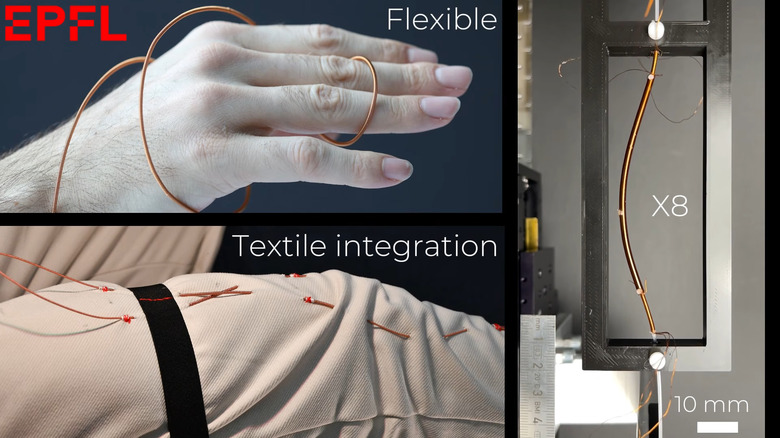
Right now, the demos are still fairly small. According to the research, a single FiberMotor can hold about 75 grams in place, and when four of them were bundled together, they were able to lift a 46-gram chocolate bar and even bend a tendon-driven robotic finger. The researchers also tried building the motors into a prototype garment for a person's knee.
Because one of the big goals is to eventually use the technology for mobility assistance in tools such as lightweight prosthetics, proving it could work in that kind of concept is important. The knee garment does show why a motor like this could be useful in clothing, though. Since FiberMotor can follow a curved path just as well as a straight path, it could easily be placed within garments that need to bend with the human body.
The motor is also considered what the EFPL staff call "backdriveable," which means that if something pushes against it hard enough, the fibers will slide past each other instead of locking up like other motors might. In fact, the researchers' paper says that is a key feature for safe human-robot interaction. We've already seen wearable robots in China that gives hope for children unable to walk, and a design like what we're seeing with FiberMotor could help advance those products in even more ways.
Humanoid robots are a possibility, but there's a lot of work left

We have seen a lot of interest in humanoid robots over the past few years, especially as AI has continued to be at the forefront of our technological advances. However, bending one robotic finger isn't the same as moving an entire humanoid. Each FiberMotor only produces modest force by itself, which is why the team had to bundle them to create its demos. While some people might be looking forward to the day that humanoid robots will take over your smart home, new motors like this are still going to need to prove they can do the legwork in real world situations.
For much of the tests that the researchers ran, the motors ran at 3,000 volts and were hooked up to a high-voltage power supply. The researchers would need to configure and design a fully portable version if they were ever going to put FiberMotor into humanoid robots or even clothing. The current design of the motors also required the researchers to apply a thin layer of silicone oil between the fibers every few hours of use to help keep friction down.
Restrictions like that are going to be a hard sell for something you want to wear every day, especially if you ever plan to wash it. The team said it is already working on putting together smaller electrodes and on getting feedback that would let the motor adjust to how the wearer moves. But, it's still likely going to be years before we see this kind of tech actually available in clothing or humanoid robots.