

This Wearable Robot In China Gives Hope For Those Unable To Walk

People often use wheelchairs because they have lost the use of their legs. However, the underlying cause of this issue isn't the same across all people, and sometimes they can regain the use of their legs with some rehabilitation. And high-tech robots.
In May 2026, researchers at Beihang University, Peking University Third Hospital, and the Massachusetts Institute of Technology published a paper in Nature about how they used robots to treat patients with spinal muscular atrophy (SMA). People with this condition gradually lose control over their muscles because, as the name suggests, the nerves that connect to them deteriorate. The muscles are still there, just highly atrophied due to lack of use, which means they can be retrained and strengthened via specialized equipment.
According to the paper, researchers strapped an isokinetic training robot to the legs of six participants (all children) with SMA. After six weeks of physical therapy, the patients displayed significantly increased leg strength, enough to move from a sitting position to a standing one with their hands and knees but without the use of external support. Scientists noted that the participants' knees were more flexible and their legs had noticeably more muscle tone. Even though this robot helped facilitate the recovery, researchers believe it isn't necessary for the end goal; participants only need to engage in specific training routines to regain their strength, or at the very least, minimize the debilitating effects of SMA.
How the robot achieved this feat
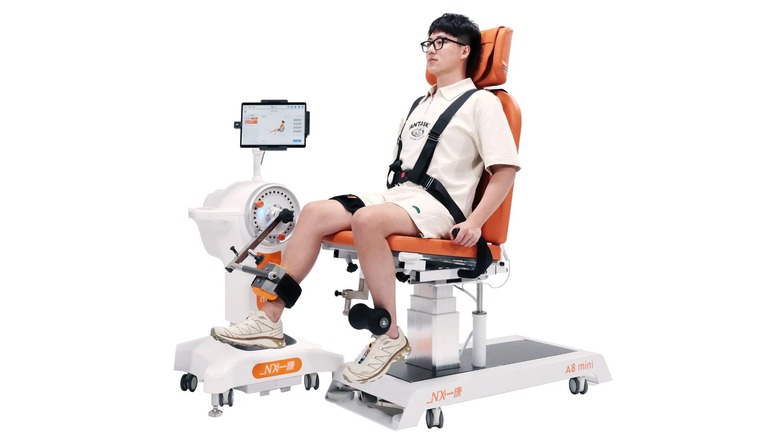
When you think of the word "robot," many images likely spring to mind. Robotic vacuums such as the Roborock Q7 M5+ that clean your house are one example, as are humanoid robots that can control smart homes. However, the robots used for the study are a very different breed of beast.
An isokinetic training robot is a lightweight robot that delivers isokinetic resistance training. This special form of strength training makes users move at a constant speed, independent of applied resistance. The idea is that these exercises let all involved muscles gain strength at the same pace.
Most isokinetic training devices are large, bulky machines with chairs that sit on the floor and are hooked up to computers. If you have ever visited a physical therapist, you probably saw one without knowing what it was. However, the researchers behind this study built a specialized isokinetic trainer that weighed only 0.96 kilograms (2.12 pounds). This device utilizes a variable stiffness mechanism and a back-drivable damping motor to both train users and make it safe for them to use. One of the study's authors, Feng Yanggang (professor at Beihang University's School of Mechanical Engineering and Automation), told the South China Morning Post that they have received multiple requests for help from foreign patients and plan to "promote this device to a larger SMA population."
These aren't the only wearable robots around
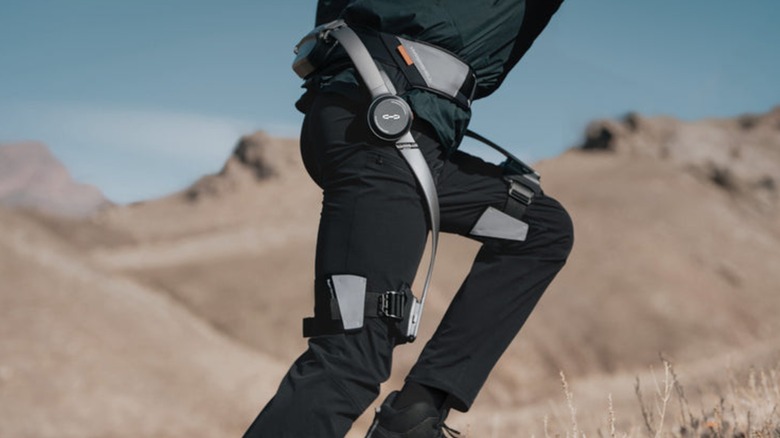
While the isokinetic training robot is a relatively new invention, it isn't the only wearable robot people can use to regain movement in their legs — or just make it easier to walk. Granted, it's the only one that achieves this goal by way of specialized resistance training, but that's because all the others were designed to support the weight of their users and supplement their leg strength.
Most, if not all, of these robots come in the form of an exoskeleton. For instance, Toyota (the most reliable car brand according to Consumer Reports) manufactures the rehabilitation robot known as the Welwalk WW-2000. This advanced medical brace — which is only available in Japan — fits around the legs of people with paralyzed limbs and supports them while assisting in knee movement. These robots are only available in medical settings.
If you want to actually own a robotic exoskeleton, there are devices like the Hypershell X. However, this device is designed for hikers. It can't restore movement in paralyzed or weakened limbs, just reduce some of the strain that comes with backpacking. The latest models use AI that dynamically adjusts to shifting terrains and gaits. While the Hypershell X is one of the few exoskeletons out there that you can purchase, it costs just shy of $2,000. Plus, its battery only lasts 30 kilometers (18.64 miles), so you might want to invest in camping trip-oriented mini gadgets like the Blavor Solar Power Bank.