

This Mini Military Spy Drone Can Fit In Your Pocket
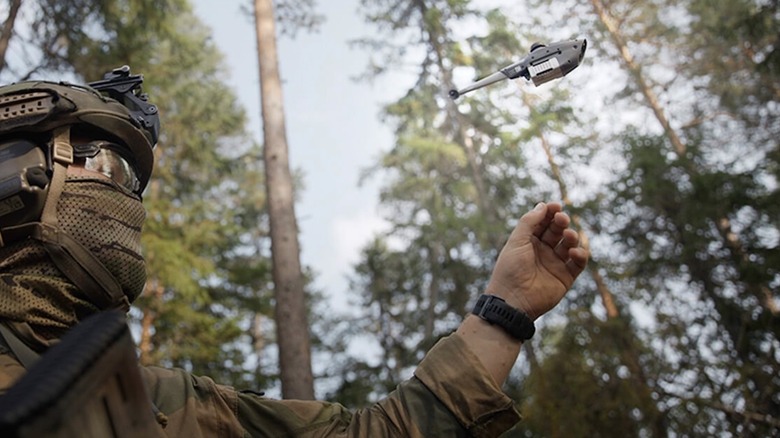
At first glance, with its small size and simple design, you'd be forgiven for thinking the Black Hornet drone was anything but a child's toy. However, at an estimated $28,000 per unit, it's anything but. The Black Hornet has offered troops a bird's-eye view of a battlefield since the early 2010s. Small enough to slip into a pocket and quiet enough to make it hard to detect, the diminutive drone is ideal for short-range reconnaissance, from looking around corners to peering inside buildings, without putting humans in harm's way.
The U.S. Army started testing this feat of miniaturization in 2016 before fielding them two years later. It's already seen several iterations, with the latest one, the Black Hornet 4, arriving in 2023. It weighs just 70 grams and launches in under 20 seconds. It uses a 12-megapixel camera with a high-resolution thermal imager capable of capturing video in low light. While flying at speeds of up to 10 meters per second, the Black Hornet's single rotor produces little noise, giving the operator maximum time to gather intelligence before it's noticed — if it's seen at all. Mainly human-operated using a hand controller and images beamed back to a tablet, the Black Hornet can stay flying for around half an hour and reach distances of at least 2 km (1.24 miles) from the operator, with obstacle-avoidance technology. It can even handle rain and winds of up to 25 knots.
The drone has seen plenty of action, including with American troops in Afghanistan for short-range reconnaissance. More recently, Norway and the U.K. supplied Black Hornet drones to Ukraine, where unmanned systems have become an increasingly important part of its war with Russia.
Minuscule drone, monumental price
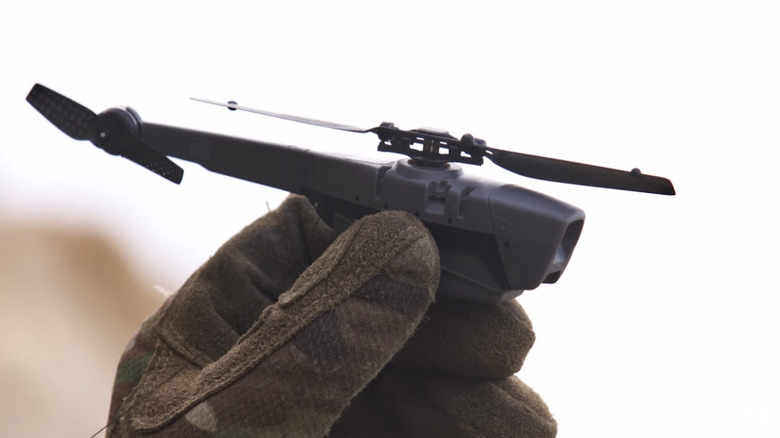
How can such a tiny, lightweight drone cost tens of thousands of dollars? Well, paradoxically, its size is very much a part of the reason. Packing sophisticated components like cameras, sensors, communications, and flight controls into such a compact device requires specialized engineering. Technology used for military purposes also requires testing, reliability checks, software development, maintenance, and training, all of which contribute to the final cost. The Black Hornet was originally developed by Norwegian company Prox Dynamics, which started business in 2007. American defense technology firm FLIR Systems acquired the company for $134 million in 2016, and today, the latest Black Hornet 4 is manufactured by Teledyne FLIR Defense in Norway.
When it comes to value for money, calculations go beyond the price of the equipment itself. If the Black Hornet can help a group of advancing soldiers locate a threat before entering a building or making their way across an exposed area, the cost of losing troops in an ambush puts the drone's price into a very different perspective.
As we move forward into a new age of robotic and autonomous warfare, the Black Hornet is starting to work alongside these systems. FLIR has paired the drone with its FirstLook 125 ground robot, enabling coordinated ground-and-air reconnaissance. The combination shows how aerial and ground-based systems can work together on the battlefield, though as the technology evolves, the balance between those systems could change.
The Black Hornet's future
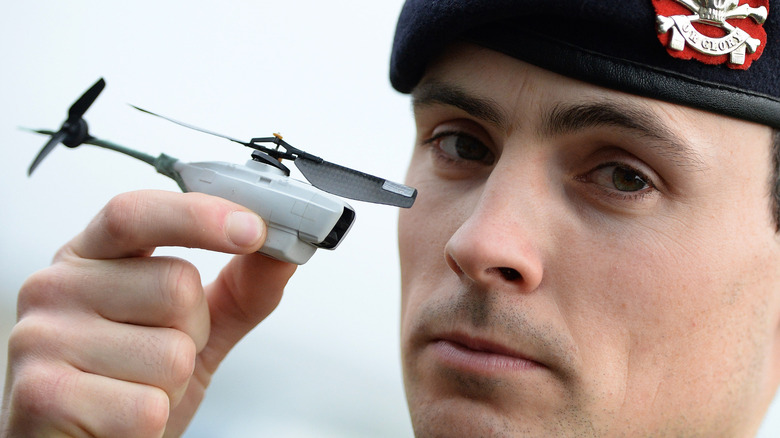
As military robots become increasingly sophisticated, you might wonder if they'll always need dedicated reconnaissance drones to assist them, as advances in robotics and AI could allow them to gather the information they need by themselves. This raises the question of whether small drones like the Black Hornet will stay essential to military operations in the long term.
Even as military technology advances, tiny aerial drones could retain an important advantage in providing eyes in the sky. Ground robots can be slowed by obstacles blocking their view, but a drone can quietly check the situation from above, providing an important perspective that's not available to ground-based robots. However, future robots may be able to carry even smaller drones than they already do as part of their own systems, or use more sophisticated sensors for scanning an environment, reducing their dependence on independently-operated reconnaissance aircraft like the Black Hornet.
Of course, it could be that a future version of FLIR's drone will be incorporated into a robot soldier, or become part of a broader network of sensors and machines. For now, though, this powerful little device will continue to give troops in war zones an extra set of eyes, keeping them safe as they work to achieve their combat goals.