

How Much Would It Cost To Max Out Your PC's RAM In 2026? (More Than A High-End Gaming PC)
We may receive a commission on purchases made from links.
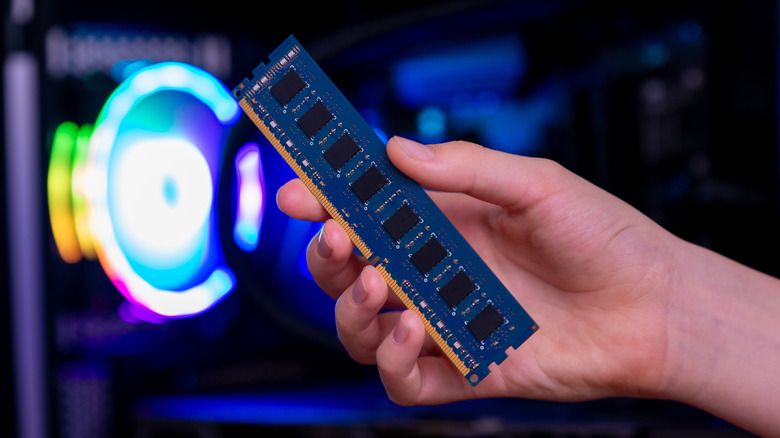
We know memory chips are hard to come by right now. Nvidia, OpenAI, Anthropic, and all those AI data centers they and their ilk have built are consuming most of the manufacturing capacity and appear set to do so for years to come. So let's do a price check: how much would it take to max out your PC with the most RAM possible?
Let's get some verbiage out of the way upfront. User-replaceable RAM comes in various types of Dual In-line Memory Modules, or DIMMs. Laptops use Small Outline DIMMs (SODIMMs), desktop motherboards generally use a lengthier disk known as Unregistered DIMMs (UDIMMs), and servers require Registered DIMMs (RDIMMs). All of these DIMM types adhere to performance standards, with the latest being Double Data Rate 5 (DDR5). Among many other features that have been introduced and improved upon, transfer speeds are an integral one, and they're measured in megatransfers per second or MT/s.
With that established, let's talk about laptops. Hopefully, you've got one that lets you swap out its disks, as many come with soldered RAM. Those user-friendly machines typically have two slots. Grabbing a pair of Crucial 64-gigabyte (GB) DDR5 SODIMMs running at 5,600 MT/s for a total of 128 GB will cost you more than $2,000 (or the price of a midrange gaming PC) from third-party sellers on Amazon. The majority of desktop motherboards have four UDIMM slots, and two pairs of Crucial 64 GB DDR5 sticks at 5,600 MT/s will set you back over $6,000 from a single third-party seller on Amazon. Finally, for servers that can feature eight or more slots, a single 256 GB DDR5 RDIMM made by SK Hynix running at 5,600 MT/s retails for nearly $13,000 at ServerOrbit, though it's been reduced to a bit below $9,500 as of this writing.
The saga of Crucial's 64 GB RAM sticks
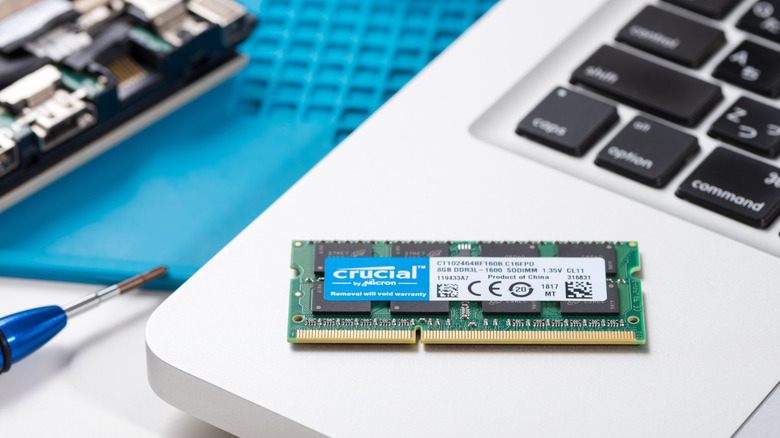
Let's go back to Crucial, the consumer-facing subsidiary of chipmaker Micron that no longer produces RAM for consumers. Micron is one of the largest memory chip makers in the world, and Crucial's price saga is representative of the memory market as a whole.
It was Crucial that introduced 64 GB DDR5 sticks back in early 2025 and, as far as we're aware, they were only sold in kits of two and at 5,600 MT/s. Records from Amazon price tracker Keepa indicate that the desktop kit started out life at $365 in February 2025 and fell as low as $280 multiple times through the spring and summer. Prices spiked above $400 starting in August and only continued to rocket from there. A week before Black Friday, Amazon ended its own sales of the product, checking out its last orders near its peak price at $730.
The laptop kit launched at the same time as the desktop kit and trended similarly through to September 2025, when Amazon stopped consistently stocking inventory. Kits were only available for a day at a time — sometimes only hours — through the next several weeks. For three weeks in January and February of 2026, Amazon booted up sales with prices edging $1,200. It did so again in mid-April at around $1,350, and that ran until late July when another spike took the number up to just shy of $1,600. Stocks dried up again over the course of a couple of weeks. A RAM upgrade for your PC in this day and age can still bring strong performance improvements today, but it's definitely not a cheap and easy upgrade the way it was even as recently as 2024.
New PC vs. RAM upgrade?
Even modest improvements are a painful investment these days: a pair of TEAMGROUP Elite 16 GB DDR5 UDIMMs running at 4,800 MT/s ran about $70 or so in late 2025, but that cost had grown to $460 by October 2026. To put that in perspective, we found a mid-range Alienware pre-built on Amazon with 32 GB of RAM selling for about $2,200 as of this writing, or $700 more expensive than it was on Black Friday last year. Granted, you're paying for other components that have had their own price fluctuations, but it's still galling to realize half that PC's price increase is basically because of the RAM. Nothing inside has physically changed, just the perceived value, driven by the RAM crisis. And in fact, many retailers have raised prices on devices they're currently selling over the course of 2026. One Lenovo notebook started out life at $670 in March but was in the $1,000 range by fall. Apple raised prices on many of its computers in June, including a $100 premium on the MacBook Neo and $500 for the Mac Studio.
Sure, older DDR4 memory can be had for a relative discount, but it's a non-starter if you're stuck with an AMD AM5 or Intel LGA 1851 socket setup. Other tricks you might think of will have their own catches and simply provide no escape from dreadfully large bills. The bottom line here is that the RAM shortage is affecting prices for both upgrades and new machines, so maxing out your memory in either case will be a costly proposition.