

This Nokia-Owned Lab Is Behind 10 Nobel Prizes And An Oscar
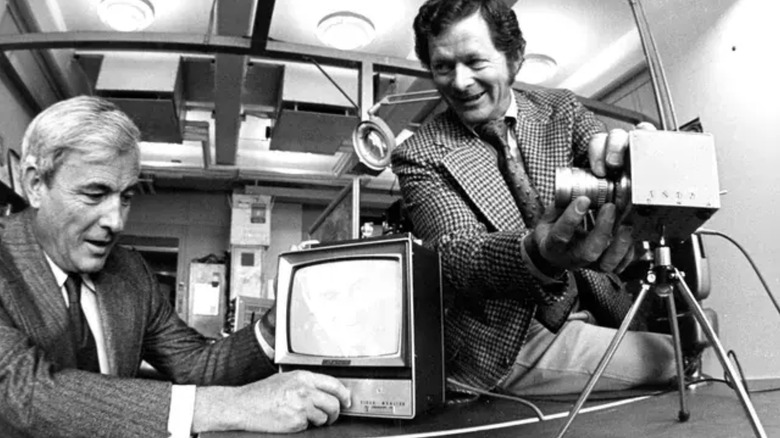
The Finnish tech company Nokia is best known for making near-indestructible phones like the Nokia 3310, but it extends far past the early mobile phone days of the '90s and '00s. In 2016, it acquired Bell Labs, a research and development company with over a century of experience developing tech for a wide range of fields, such as telecommunications, programming, space exploration, and even film.
Bell Labs' work has earned numerous accolades over the years, including 10 Nobel Prizes, four Emmys, two Grammys, and an Academy Award. The lab won its first Nobel Prize in 1937 for physicist Clinton J. Davisson work proving that matter behaves like waves; most recently, former Bell Labs researcher Louis E. Brus won the 2023 Nobel Prize in Chemistry for his discovery of quantum dots, tiny nanoparticles used for TVs, LED lights, and even surgeries and biomedical research.
As for the lab's entertainment awards, Edward C. Wente and Bell Labs won an Oscar, the Scientific and Engineering Award, way back in 1936 for producing a multicellular high-frequency horn and receiver. The rest are much more recent. Bell also won Technology Emmy Awards in 1997, 2016, 2020, and 2021. The entire lab won a Grammy in 2006 for overall contributions to recording technology, and in 2016, Harvey Fletcher (who worked at Bell between 1916–1949) received a posthumous prize for research that directly led to better-quality recording technology.
Bell Labs made modern computing possible
Bell Labs was founded in 1925 when AT&T consolidated various research operations into a single organization. It also has connections to the Bell Telephone Company, which formed in the late 1800s to handle Alexander Graham Bell's patents. In its early years, researchers mainly dedicated their efforts to telephone improvements and the development of electronic sound recording, technology that made "talkies" possible.
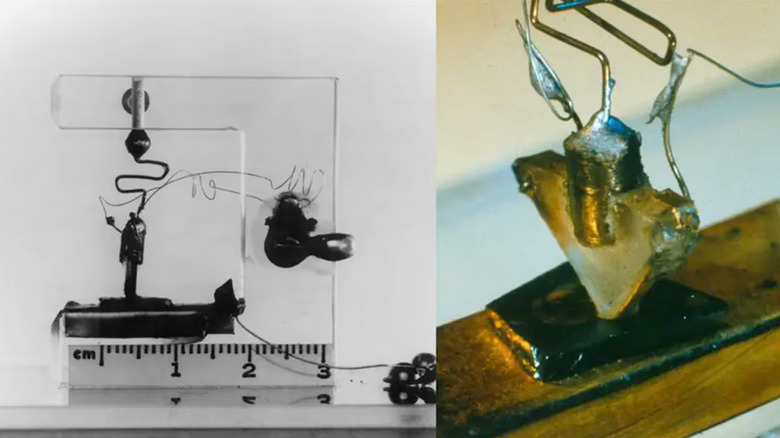
That's already a huge development, but Bell Labs' most revolutionary contribution is undoubtedly the transistor, which made modern electronics (particularly computing) possible. Invented in 1937, these small semiconductors could amplify electrical signals using far less power and generating far less heat than the vacuum tubes used at the time. Transistors are the reason computers were able to go from fixed, room-sized machines to pocket-sized devices, as modern ones are so tiny that you could fit tens of millions of them on the head of a pin. The breakthrough earned scientists John Bardeen, Walter Brattain, and William Shockley the 1956 Nobel Prize in Physics.
Beyond that, Bell Labs helped launch the first communications satellite for TV signal transmission alongside NASA, developed the C++ programming language, and invented the multiple-input multiple-output (MIMO) wireless technology that improved network capacity.
What Bell Labs is working on now
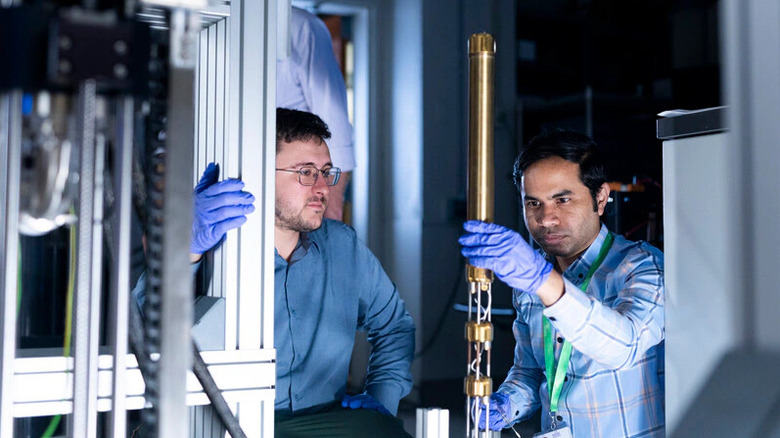
AT&T owned Bell until 1996, when it broke off to become part of Lucent Technologies, which merged with Alcatel a decade later; in 2016, Nokia acquired Lucent-Alcatel. Now called Nokia Bell Labs, its researchers continue to work on communication and (of course) semiconductor research, with one of its goals being to help develop 6G technology. Unsurprisingly, it's also working on AI and automation advancements.
Even more ambitious is Nokia Bell Labs' effort to bring a 4G cellular network to the moon. In 2025, its Network In a Box (NIB) was included on the Athena lander and completed multiple telecommand tests with a control center in Sunnyvale, California, for about 25 minutes. While harsh conditions at the landing site caused it to fail before scientists could make the first call from the Moon, the NIB wasn't intended to last for longer than a week or two anyway, and Nokia intends to continue testing in preparation for future lunar missions like Artemis III, scheduled for 2027.