

What Made Nvidia's 'First GPU' Special?
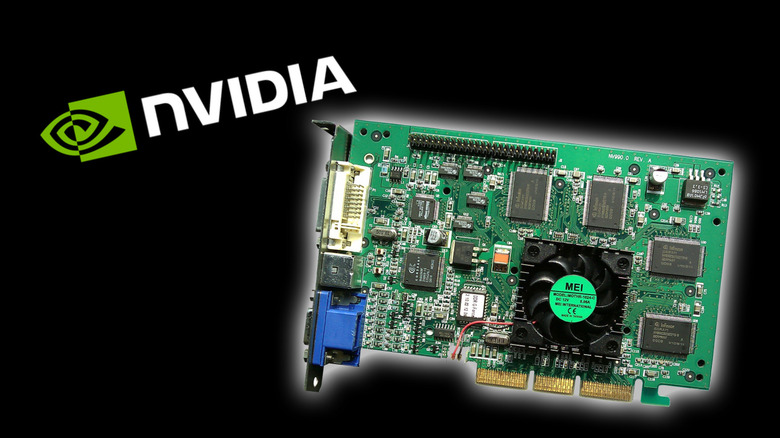
The Nvidia GeForce 256 was dubbed Nvidia's "first GPU" when it launched in 1999. However, it was only in name, as the now multi-trillion-dollar monolith had already produced "GPUs," or graphics processing units, with its "graphics accelerators" — chips that boosted 3D performance and competed alongside now-extinct companies like ATI and 3dfx. The GeForce 256 was marketed as the "first GPU" (despite Sony getting there five years earlier) as it was the first to be a fully integrated system, with transform and lighting geometry processing taken off the CPU. That said, while technically the fifth in Nvidia's attempts at breaking into the mass market with a GPU, the GeForce 256 represented a lot of firsts and is still very special.
When it launched, the Nvidia GeForce 256 was not only the first "GeForce" branded GPU from the company, but it was also the first card to fully support DirectX 7. DirectX is Microsoft's API (application programming interface) that handles a lot of the multimedia end of things, particularly with 3D graphics in games. We're currently on DirectX 12, but 7 was a major leap in terms of what PCs could do at the time.
According to Phil Scott, Nvidia's director of EMEA developer relations, in a 2022 Digital Foundry video, DirectX quickly became the API for developers to latch onto, with 3dfx's Glide previously holding the top spot. The GeForce 256 went on to sell over a million units, but was rapidly outpaced by Nvidia's own advances, as well as competitors picking up the pace.
Nvidia packed a punch back in 1999
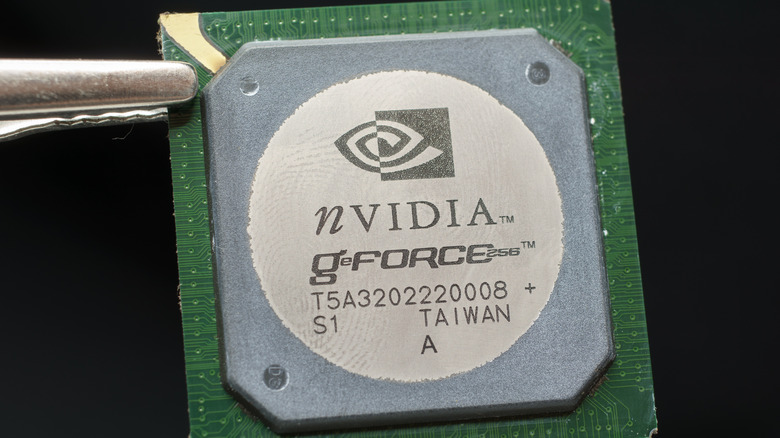
Reviews at the time showed just how performant the Nvidia GeForce 256 was in particular games that could take advantage of it. Popular games that fully supported the various tricks of the trade the 256 could do included "Quake 3: Arena" and "Unreal Tournament." In a Tom's Hardware review from 1999, the benchmarks showed that in "Descent 3" at 480p, using DirectX 7, the GeForce 256's two models (DDR and SDR, two types of memory from SK Hynix- Hyundai Electronics and Samsung) scored 101.9 and 101.8 fps, beaten by a hair by the ATI Rage Fury Pro's 102.7 fps.
However, popular alternatives like the Voodoo3 and Matrox G400 could only muster 84-86 fps and 86-89 fps. In 1,024-by-768 OpenGL results, the GeForce 256 trounced the competition, maintaining above 83 fps on average, while the ATI dropped to 36 and Creative Labs came in at 57.2 to 69.4 on its TNT2 cards. Other reviews from the time also found it and subsequent variations to be great for performance, even if the software was sometimes lacking.
The GeForce 256 lasted quite some time

As it featured certain technologies that just weren't widely accepted as normal in the development scene, the GeForce 256 laid the foundations that would kickstart a vast improvement in PC gaming performance. By supporting them in the very early days, it meant that the 256 actually enjoyed an unnatural lifespan, if combined with an appropriate CPU. As pointed out by Digital Foundry, "Max Payne," which launched two years later, still ran quite well on the two-year-old card, despite Nvidia already being on the third GeForce generation by that time. 2004's "Half-Life 2" was able to run on it — albeit with the graphics settings lowered. Bear in mind that everything was advancing rapidly at the time, with Nvidia already on the GeForce 6 series in 2004.
As the GeForce 256 hit its 25th birthday in 2024, Nvidia repositioned the card as what "laid the foundation for an AI-driven future." As its GPUs reach absurd prices and its business appears to be drifting away from the consumers that built the company up and toward the AI data centers that risk restricting new hardware purchases thanks to supply chain constraints, the era the GeForce 256 comes from starts to have more of a rose-colored tint to it.
Regardless, the Nvidia GeForce 256 did ignite a race that has benefited us, the video game enjoyers, quite nicely. With decades of experience under its belt, Nvidia has released DLSS, improving performance for its lower-end cards or presenting us with a generative AI hellscape on its high-end cards.