

This 13 Year Old's $25 Invention Solves A Big Limitation For Solar Panels

We've seen solar spread all over the last few years, and several states in the U.S. have seen widespread adoption of solar panels with people in houses and even apartments adopting the energy solution. While plug-in kits are being considered in more than 30 states, solar panels still mostly sit at one fixed angle all day while the sun moves across the sky, and that plays a big part in what time of day is best for solar panels to actually generate power. One way to improve how much sun solar panels are getting is to use trackers that can tilt a panel to follow the sun. And now, a 13-year-old in Massachusetts has built one for around $25.
Jason Chang, a seventh grade attending Worcester Academy built his own solar tracker that moves using water and gravity instead of a motor. He got the idea from the solar-powered Christmas lights his family has, since his mom was always asking him to move them around so they'd get sun. "What if I could fix this problem?" Chang asked himself. So he set out to find that answer.
Chang's tracker uses water instead of a motor
The tracker has a set of containers filled with water on a frame that rocks like a seesaw, and the water drips out slowly into a bucket on one side. Once the bucket gets heavy enough, it pulls that side down and the panel tilts with the sun as the day goes on. "All you have to do is pull on the plug and the water starts flowing," he told CBS. He says it didn't make sense to have to use electricity to generate electricity. Another exciting aspect of Chang's tracker is that he used mostly recycled and simple parts to create it.
Chang tested it outside against a regular fixed solar panel and his tracker put out about 20% in additional voltage. Chang says he worked on the tracker for more than a year and wrote down every step in a notebook. The most difficult part, according to his comments to CBS, was figuring out the fluid control frame, as the measurements had to be very precise. Unfortunately, the current version of the tracker doesn't do well in the cold since the water freezes, and it evaporates when it's hot, so he's working on another version that could work for year-round use.
Trackers usually cost way more than this
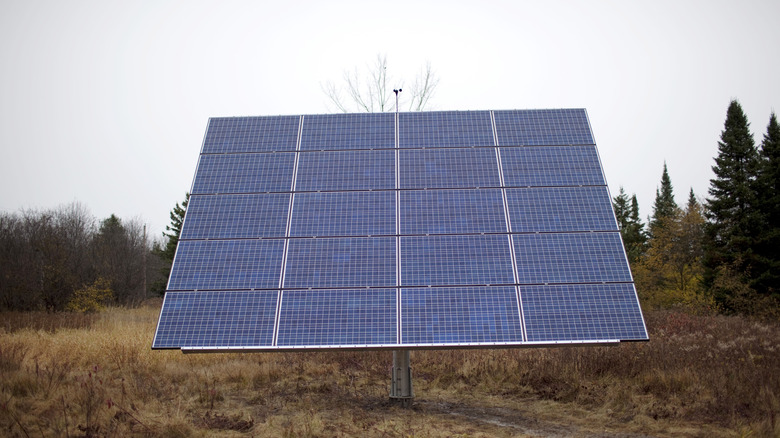
A regular single-axis tracker can increase production by 25% to 35% and dual-axis trackers can get up to around 40%, but they cost anywhere from $500 to more than $1,000 per panel and utilize motors and moving parts that require maintenance. Adding a couple more fixed panels usually costs less than that, but, with a tracker like Chang's, it could become more viable.
Plug-in solar is more aimed at renters who can't put panels up on a roof. Because all you need to do here is set the panel up on a balcony and plug it into a regular outlet. While kits can be expensive, there are some ways to get them for as low as $285, though the company that offers this does require a monthly membership to unlock that discount. Still, having a tracker attached to one could help make it easier to track the sun from an apartment balcony. California legalized plug-in solar on September 30, and the law goes into effect at the start of 2027. But if you're curious whether one would pay off, there's a free tool that calculates exactly how much plug-in solar saves on your electric bill.
Chang thinks his tracker could also help off-grid communities, developing regions and disaster zones, and this project was enough to get him named one of 55 National STEM Champions this year, along with a trip to the National STEM Festival in Washington, D.C. The festival's co-founder, Jenny Buccos, called him "one of the 55 reasons to believe the future is in incredible hands." Right now, the tracker is only a prototype, and there's no guarantee a real version of it will ever be sold.