

Chinese Scientists Just Found A Way To Make Diamonds 5 Times Stronger
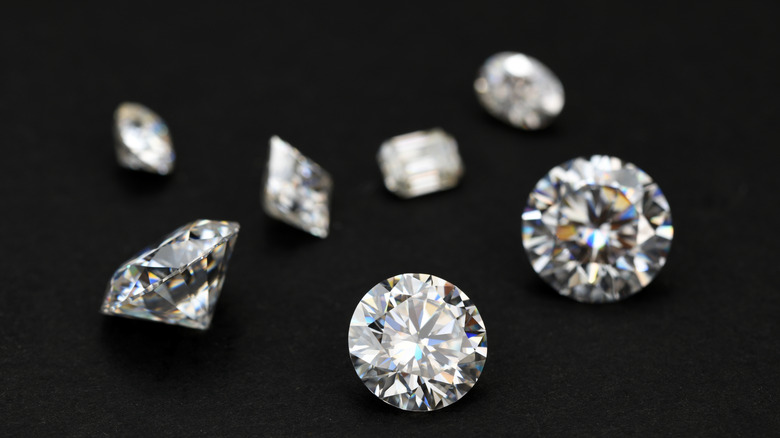
When you think of diamonds, you probably think of them as the hardest substance on the planet, and in a lot of ways that's true. However, being hard to scratch isn't the same as being hard to break, and diamonds are fairly brittle. Now, scientists in China say (via Nature) they've made a diamond composite that is roughly five times tougher than single-crystal diamond, and they pulled it off by adding carbon nanotubes to the diamond.
The new diamond was made by researchers at the Chinese Academy of Sciences' Institute of Physics and Beihang University, and a few other universities and labs in China worked on it as well. The paper was published in Nature Synthesis in July, and the team says the new diamond is just as hard as a normal diamond, even with all of that added toughness. But it is important to note that making diamond tougher without losing its hardness has been a big problem for scientists, as most past attempts focused on changing the structure inside the diamond itself.
China also created an artificial diamond that's harder than natural alternatives. The researchers did this by creating an entirely new form of diamond made from graphite. This new study, though, takes diamond powder and then reinforces it with carbon nanotubes, rather than trying to create a brand new kind of diamond.
Carbon nanotubes make it tougher than tungsten
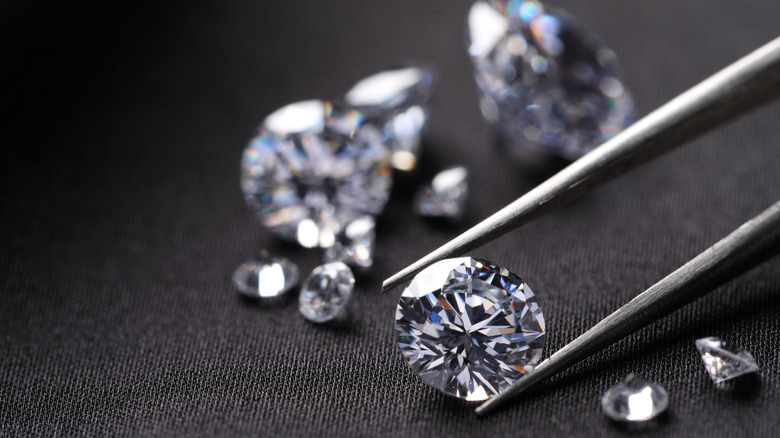
To make the diamond composite, the team filled the gaps between diamond grains with multi-walled carbon nanotubes. Each carbon nanotube is only about 1/10,000th the width of a human hair. After that, the mix was heated to 2,000 degrees Celsius and put under 15 GPa of pressure. This heating and subsequent pressure caused the carbon nanotubes to bond with the diamond grains at an atomic level, causing the nanotubes to form a 3D network that runs all the way through the diamond composite.
They then tested the composite and found that it measured a hardness of about 91.6 GPa, putting it in the same range as a single-crystal diamond. The composite also had an average fracture toughness of 31.9 MPa·m½, and that is where the carbon nanotubes come in. If a crack forms, the nanotubes push it in a different direction and hold the two sides of it together. This takes a lot of the energy out of the crack, making it harder for the diamond to break. The diamond composite is reportedly even tougher than tungsten alloys, as a tungsten alloy the team tested only hit 25.6 MPa·m½, compared to the 31.9 average for the composite.
Tungsten is used in some demanding places, including fusion reactors. The largest human project ever entered its final reactor phase last year. Known as ITER, the project chose tungsten for its divertor because it has the highest melting point of any metal. As for what the diamond composite will be used for, the team has only mentioned next-generation superhard tools and impact-resistant materials so far.
This changes how scientists look at diamonds
Diamond has long been considered the hardest natural material on Earth, and it's rated a 10 on the Mohs scale, which is the highest score possible. The Mohs scale only measures scratch resistance, though, and diamond also has perfect cleavage in four directions. However, these cleavage planes act as weak points in a diamond's structure. If a diamond suffers a hit along one of them, then it can even split apart. This is why a steel hammer that can't scratch a diamond is still able to shatter it completely if you hit the diamond hard enough.
So, is diamond the hardest material known to humans? It depends on how you look at it. The hexagonal diamond that China created is slightly harder than regular cubic diamond, so technically, regular diamond isn't the hardest material anymore. However, the difference between the two is very small, and you could still make the case that diamond is the hardest material. It just all depends on which kind of diamond you're talking about.