

This Is The First Robot Lawnmower That Sharpens Its Own Blades

You've probably never heard of Pudu Robotics. The company has spent most of the last decade building robots that carry plates around restaurants and scrub commercial floors. But the Pudu Tomo changes that, launching as the brand's first consumer device. It's a robot lawnmower with a blade system that sharpens itself at the charging station.
After getting my hands on the Tomo, I've realized it's a better device than I first gave it credit for. Every robot mower I've used (even the ones built to cover more than an acre a day) treats blades as something you have to replace yourself. It's annoying, fiddly, and something most owners — myself included — often forget to do.
Pricing hasn't been confirmed yet, but the company is aiming for a spring 2027 launch. The Tomo will come in three models: the S150 for lawns up to about 54,000 square feet (5,000 square meters), the S130 for approximately 32,000 square feet (3,000 square meters), and the S115 for around 16,000 square feet (1,500 square meters). All three of the models come with the self-sharpening system, wire-free mapping, and four-wheel drive as standard.
How the blades sharpen themselves
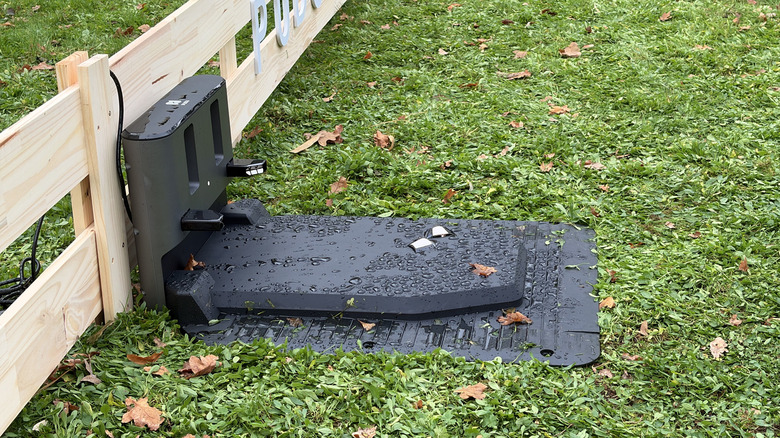
Pudu calls the sharpening system SharpLoop, which, while not the most creative name, is as simple as it sounds. When the Tomo returns to its charging station after mowing, it spins its own rotary blades against a stone edge at 24 degrees before heading out again. The blades are corrosion-resistant 65Mn steel, designed to withstand the outdoors. The mower will automatically sharpen the blades after around 30 hours of use, or you can set it off using the app. Pudu hasn't shared how long a set of blades will last or how much they cost to replace. Since sharpening removes some of the metal, there's a finite number of cycles in any blade.
Blade sharpness is more important than you might expect. A dull blade tears the top off each grass blade instead of slicing it. Torn tips turn brown within a day or two, which is why a lawn can look tired even if it was recently cut. Robot vacuums have been moving this kind of upkeep into the dock for a while now, with stations that wash and dry their own mop pads between cleans. The Pudu Tomo brings this kind of automatic upkeep to robot mowers for the first time.
Two 636 W motors spin a 15.7-inch dual-blade deck at up to 6,000 RPM, and the blades are shaped to move enough air to lift flattened grass into the cutting path. A rear discharge channel pushes clippings out behind the deck instead of letting them pack into it. This should help to minimize clogging in wet grass, which is something cheaper mowers tend to succumb to.
Navigation, terrain, and which Tomo to buy
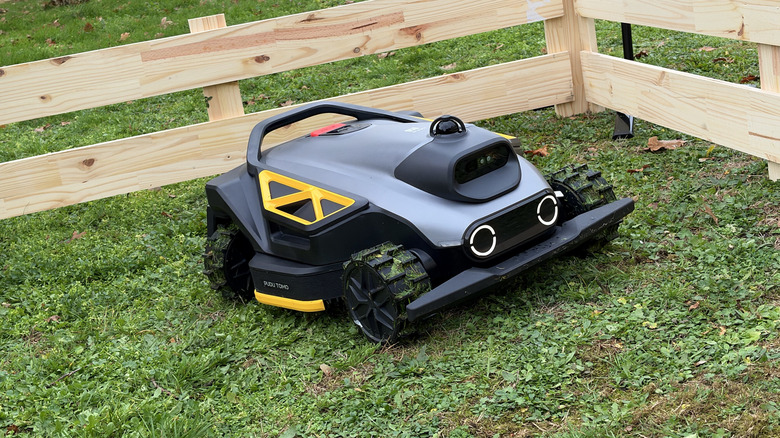
The Tomo doesn't require a boundary wire or manual mapping during setup. Instead, the mower maps out your lawn on its first run, working out where the edges are and planning a route from there. It uses a navigation sensor made of three components: a 360-degree LiDAR unit paired with a solid-state sensor, an AI vision system that separates grass from paving or other objects, and NRTK positioning that Pudu claims reaches centimeter accuracy without a base station. LiDAR should keep the mower on track even if there are lots of trees around. Pudu's commercial history gives it an unusually large amount of training data that should make its AI vision system more reliable than most other robot mowers and even robot vacuums.
Traction comes from four independent hub motors, which Pudu rates for slopes up to 45 degrees and obstacles up to 2.4 inches high. The deck can lift up to follow ground contours, and rear-wheel steering turns the mower in place without having to reverse back and forth, which can damage turf. To keep the cut looking fresh, it follows the perimeter when returning home rather than navigating across the lawn.
Which model you should go for depends mostly on the size of your lawn. The S150 can run for 210 minutes per charge on a 15 Ah battery and can handle 50 mowing zones. The S130 drops to 140 minutes and 30 zones, while the S115 handles 115 minutes and 15 zones. Blade speed drops from 6,000 RPM to 5,000 RPM on both smaller models. All three carry an IPX7 rating, lift and perimeter alarms, and built-in 4G.