

3 Open-Ear Wireless Earbuds To Buy Instead Of The Samsung Galaxy Buds On

We may receive a commission on purchases made from links.
Wireless headphones and earbuds are a great way to enjoy your favorite music and podcasts, but they can also make it difficult to hear what's happening in the world around you. On the one hand, distracting sounds like chatty coworkers or that construction site across the street are noises you don't want to hear, but blocking out too much audibility can also be dangerous (especially for walking commutes).
Fortunately, audio brands have started working with open-ear designs, and one of the latest products to hit the market is the $230 Samsung Galaxy Buds On. These comfortable buds sit just outside your inner ear, allowing ambient noise to filter in. They support Samsung's proprietary hi-res codecs (SSC and SSC UHQ) — plus AAC, SBC, and LC3 — on top of Google Gemini and Bixby. They also deliver up to 9.5 hours of battery life on a full charge, and a topped-off case holds an extra 28.5 playback hours.
For the Android user who wants one of the best pairs of open-ears money can buy, the Buds On are hard to beat, but hard doesn't mean impossible. We found three alternative open-ears we'd recommend over the Samsung flagship, and we'll be breaking down all the reasons why. There's plenty to discuss, so let's get started with our first selection: the Bose Ultra Open Earbuds (2nd Gen).
Bose Ultra Open Earbuds (2nd Gen)
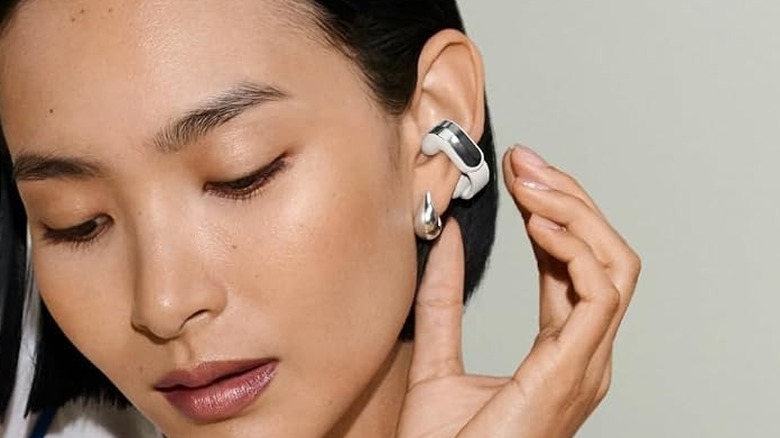
On paper, the $300 Bose Ultra Open Earbuds (2nd Gen) offer a lot of the same features as the Galaxy Buds On. Driver-wise, they're each tuned to deliver strong bass performance, and both Bose and Samsung offer spatial audio and head-tracking audio, which can make your music feel more immersive. But Bose has had an entire generation to refine its open-ear design, whereas Samsung is just getting into the technology.
Traditionally, Samsung Galaxy devices are best paired with Galaxy phones and tablets. Bose offers better cross-platform compatibility, on top of Bluetooth multipoint, so you can pair the Ultra Open with an iPhone and a Windows laptop simultaneously. The Galaxy Buds On support instant audio switching between Galaxy devices (similar to the AirPods' Apple ID switching), but conventional multipoint isn't available. And while the Buds On support Samsung Seamless Codec — along with its enhanced UHQ version — Bose trades hi-res for aptX Adaptive.
Bose also has the upper hand when it comes to audio presets; options like Cinema Mode do a solid job of steeping you in the on-screen action of a movie or show. Bose punches above its weight class for battery life, too; our friends at SoundGuys clocked just over 13 hours of playback on a full charge (Bose says the buds should last 9.5 hours).
Shokz OpenFit Pro

Samsung may be the new kid on the block when it comes to open-ear headphones, but Shokz is one of the pioneers of the technology. Competing with the Galaxy Buds On are the $250 Shokz OpenFit Pro, which beat out the former in a couple of key categories. For starters, the OpenFit Pro uses an active noise-canceling (ANC) system to attenuate distracting sounds; the Samsung buds don't have this capability at all. Mind you, the ANC deliverables of open-ear buds will pale in comparison to in-ear buds and over-ear headphones.
The OpenFit Pro also offers the stronger battery life of the two products: 12 hours on a full charge, with an extra 38 hours when the case is topped off. The Galaxy Buds On are supposed to deliver 9.5 hours and up to 38 hours with a fully-charged case. Volume level and audio processing will ultimately have the final say (for both Shokz and Samsung) when it comes to playback hours, though; and at the time of writing, no publication has reviewed the Buds On, so we're still just going on Samsung's word for projected battery life.
Similar to the Bose Ultra Open (2nd Gen), the OpenFit Pro also support Bluetooth multipoint, while Samsung reserves multi-device pairing for Galaxy hardware. Both buds are closely matched for dust and water resistance, but Shokz' IP55 rating ultimately wins (IP54 for the Buds On). We're willing to bet some folks will like the OpenFit Pro's hook design over Samsung's clip-on buds, too.
Nothing Ear (Open)
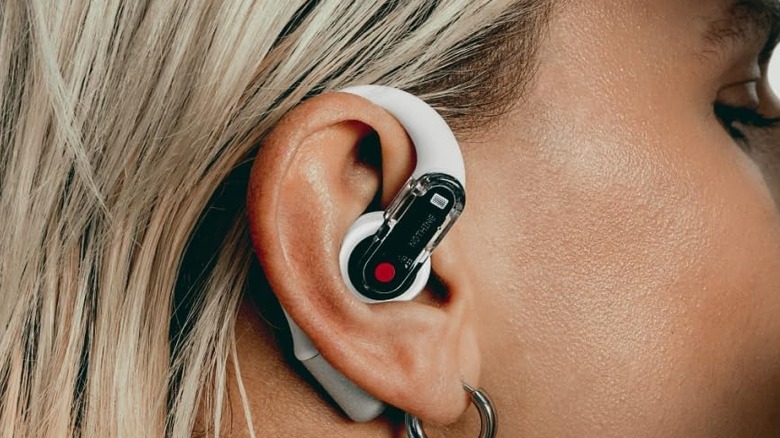
Sometimes an affordable earbuds price is enough to win us over, which is exactly what the $100 Nothing Ear (Open) did. Yes, we know that we're comparing them to a $230 Samsung product — and that the latter is far and away the better option for hi-res and AI tools — but Nothing doesn't fall that far behind the Galaxy Buds On. While codec support is limited to SBC and AAC, the Nothing X app provides a custom EQ and several audio presets to help you dial in the perfect sound. (The Buds On will be supported by the Galaxy Wearables app).
If you're planning on some long listening sessions for your open-ear buds, the three-point balance rig of the Ear (Open) is going to be more comfortable than Samsung's bud clips. Nothing doesn't fall too far behind for battery life either; you'll get up to 8 hours with charged buds, and an extra 22 hours from a topped-off case (9.5 bud hours and 28.5 case hours for Samsung's open-ears). Nothing also offers Bluetooth multipoint, and if you're pairing to a Nothing phone, you can even interact with ChatGPT using voice commands — no touchscreen required.
We feel it's worth mentioning that both Nothing and Samsung offer the same IP54 dust and water resistance. If premium sound quality is super-important to you, the Galaxy Buds On are the better choice, but you'll also need to pair them with a compatible Android device for hi-res playback. Or, you could just save yourself $130 and see if Nothing Ear checks all the boxes.