

CMF Speaker M Review: Sounds So Good, I Bought One Myself
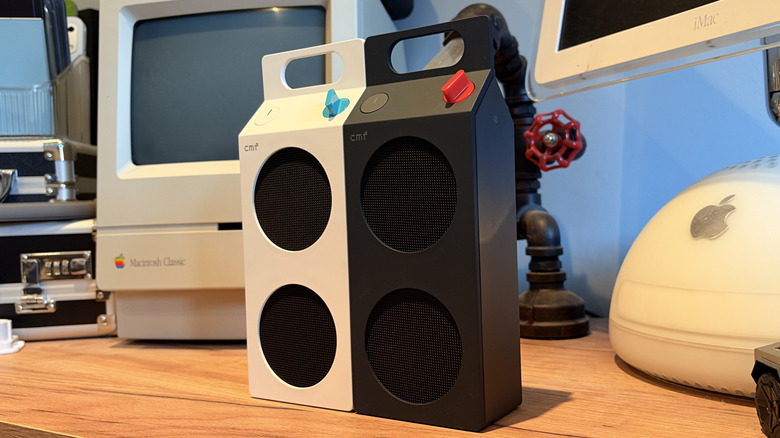
CMF by Nothing released its first Bluetooth speakers in October, with the Speaker M being the larger and more expensive of the pair. It costs $109 compared to $59 for the smaller Speaker S. Spending more gets you a 70mm woofer paired with a 16mm tweeter for 35W of total output, whereas the smaller speaker only has a single 45mm full-range driver and 10W of total output.
I've been testing two Speaker M models, which is particularly interesting due to the fact that they come with stereo pairing. I spent the past two weeks with them in my home office, listening to everything from acoustic singer-songwriter tracks to heavier rock albums. Without spoiling the review, I liked the pair so much that I bought a Speaker S with my own money partway through testing, and I very much hope that CMF releases a Speaker L in the future.
The CMF Speaker M looks like nothing else you can buy on the market. Its list of features is more impressive than the $109 price suggests, and two of the speakers playing in stereo sound great, which tracks with how CMF keeps releasing cheap, quality phones. But the low end is the problem, as I've found with many of Nothing's audio products. Bass doesn't quite deliver in the way the spec sheet implies and the way I'd expect from the larger speaker. That said, if I were looking to spend $100 on a Bluetooth speaker, the Speaker M would probably be my top pick.
Design
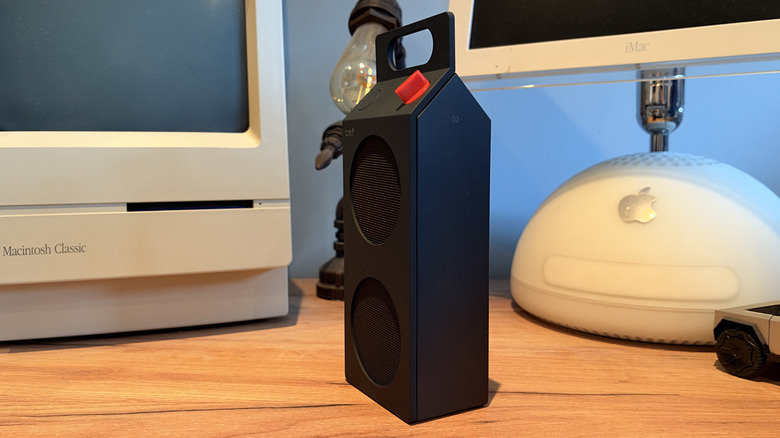
The CMF Speaker M certainly looks unique. Nothing describes the design as one that's based on the sharp geometry of a milk carton. What you get is a tall, flat-sided box with a gable top, a cutout handle, and one contrasting knob on the front. My speakers came in white and dark grey, and the red knob on the dark grey speaker looks seriously good. There's a small part of me that wishes I'd been sent the orange speaker, which looks truly striking. There's no RGB or any lighting anywhere, and the CMF branding is subtle enough that you probably won't notice it.
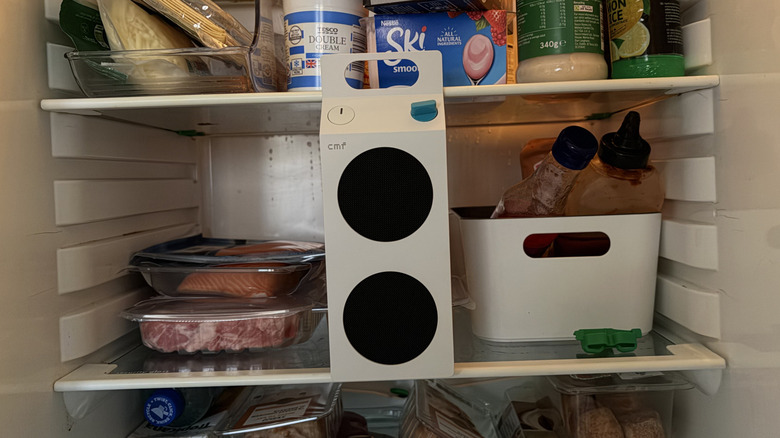
The Speaker M measures 220mm x 85mm x 54mm, weighs 602g, and has an IP68 water- and dust-resistant rating, along with a 0.76 m drop test, which is roughly tabletop height. The handle is a nice touch, cut straight into the body, so there's no strap to get in the way, and carrying it from room to room is effortless. At 602g compared to the Speaker S's 334g, the M is still light enough to travel with.
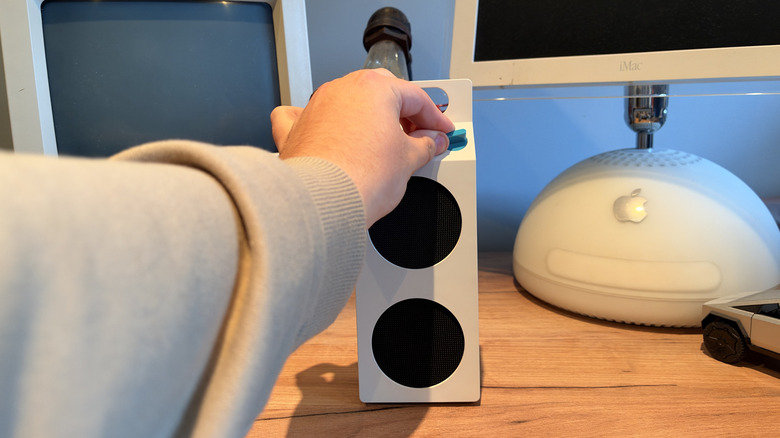
One interesting feature — if not quite complete yet — is the option for customization. You can unlock a slider on the back of the speaker, pull the knob off, then slide the front panel off as well. The idea is that you can swap panels and knobs to make the speaker look truly tailored to your personal taste. But getting the panel back on is rather difficult. The first time I tried it, I was convinced I was going to snap the handle at the top of the speaker. CMF also doesn't actually sell the replacement panels yet, so while it's a nice idea, you can't really do anything with it yet.
Features
The CMF Speaker M comes with Bluetooth 6.0 with a claimed range beyond 100m, supports NFC tap-to-pair alongside Google Fast Pair and Microsoft Swift Pair, and can hold two device connections at once, so both your phone and laptop can stay connected to the speaker. You can also plug a USB-C cable into the back of the speaker. It offers lossless playback at under 60ms of latency, which makes it a reasonable desk speaker if you mainly watch video.
Pairing was easy, taking only a few seconds, and worked fine from my iPhone's Bluetooth settings, without having to download the app just to get music playing. However, there's no 3.5 mm input or output, no microphone, and no support for voice assistants, which rules out any kind of hands-free control.
But the physical controls are where the Speaker M shines. Rotating the knob changes the volume as you'd expect. It sits next to a button where one press plays or pauses the track, two presses skip forward, three skip back, and holding it for two seconds toggles Ultra Bass. While they are unlabeled, the buttons on the top are easy enough to figure out when you first use the speaker.
My one complaint about the knob is that it spins infinitely in both directions, with no stop at either end. That means you can never tell where the volume sits without listening for it, so adjusting the volume down before you start listening is going to be complete guesswork. Night Mode and Low Lag Mode complete the speaker's EMS feature set, the first capping volume and softening bass, and the second cutting latency for video.
Stereo Mode
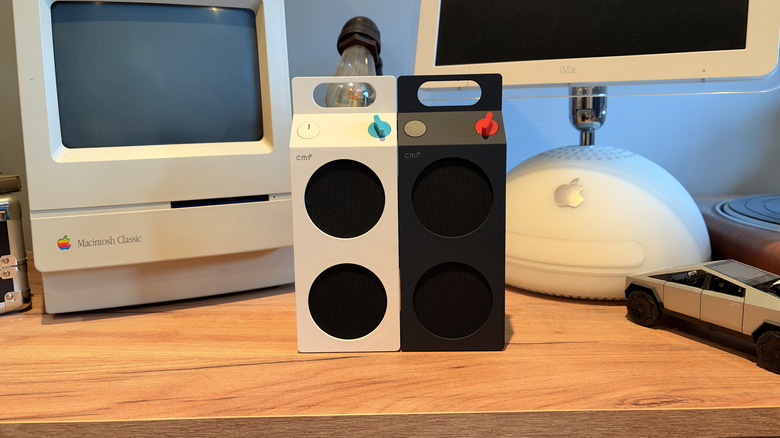
The best feature the CMF Speaker M offers is the ability to connect to and play music as a stereo pair — which is when this speaker sounds its best. Dedicated left and right channels give tracks room to breathe that a single speaker just can't deliver, and the soundstage opens up to become borderline enveloping. The tall, narrow design helps here, as these speakers are fairly directional. That means that where you point them changes what you hear, and a few minutes of angling them properly will pay off more than playing with the EQ settings.
But actually creating the stereo pair is fiddlier than it should be. You can't actually create a pair if you've already connected your phone to both speakers in the Nothing X companion app. You have to pair one speaker, then use the dedicated Stereo Mode option inside the app to pair the second. Nothing in the app actually tells you to do that before you've done it wrong already. The pair also behaves oddly sometimes afterwards; switching one speaker off switches both off, while switching one on only wakes that one. Plus, sometimes the stereo pair didn't actually both start playing.
If you've got multiple CMF speakers, then Party Mode might be a better alternative. Built on Auracast, it syncs multiple compatible speakers, including a mix of Speaker S and Speaker M units. One of the compromises is that playback is mono rather than stereo, which is disappointing, and it switches off several of the sound enhancements while it's running. Pairing with other speaker brands also doesn't always work. It is more flexible than Stereo Mode, which requires two identical CMF speaker models, but Stereo Mode definitely sounds better.
Battery and charging
Nothing claims the CMF Speaker M will last for up to 18 hours of playback at 50% volume with Ultra Bass enabled, powered by a 4,900mAh battery cell. I probably got closer to 17 hours of continuous playback at a slightly higher volume level of 70%, which is close enough to Nothing's claim. Nothing quotes 3 hours for a full charge from a standard adapter and says a 10-minute top-up will give you about an hour of playback. While I didn't time any of the charges my speakers went through, a few hours sounds about right from how often I plugged it in.
18 hours of battery life is competitive with a similarly matched speaker such as the JBL Go 5 but falls short of more expensive options that often push 24 to 30 hours. For a speaker this size, with a handle that's almost begging you to take it out with you for the day, I'd have liked to have seen a little more battery life. The front light turns red when the charge drops below 15%, which is a nice touch that gives you fair warning before you need to juice up again.
Sound quality
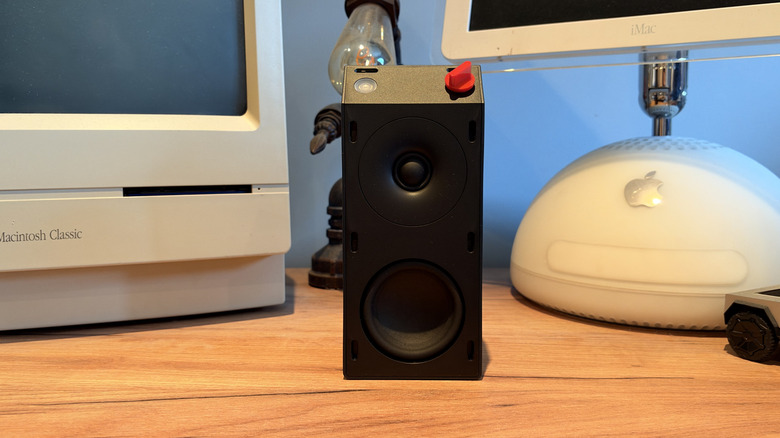
Straight out of the box, the CMF Speaker M leans hard on bass, though it favors high frequencies more than you'd assume. I ran my own analysis on the curve the speakers produce while playing music with a home microphone, so these are not lab measurements. The shape came back with a broad lift centered between 80 Hz and 100 Hz that stays inflated up to around 300 Hz, then falls away quickly below that. There's effectively nothing left by 30 Hz, which is why although the bass is warm and punchy, it doesn't have the kind of weight for you to feel it in your chest.
As a result, the low-end sounds present but doesn't really have much body behind it, which is almost exactly what I said about Nothing's Headphone (1) Pro earlier this year. That points toward a tuning choice by Nothing rather than hardware limits necessarily. The Ultra Bass Mode helps it sound fuller, but doesn't fix it entirely; the weight just isn't there. Switching to the More Bass preset or playing with your own custom EQ will get you closer to better-sounding bass, which is how I always listen to these speakers now.
Moving to the higher end, vocals and percussion instruments come through clearly, with decent separation in less busy tracks. That clarity comes from a modest lift around 6 kHz to 7 kHz, which roughly tracks with what you're hearing. Pop, acoustic, and electronic tracks suit the speakers well, but heavy rock is where it struggles, with guitars, bass, and drums smudging together. I settled at around 70% volume as the sweet spot for my ears.
Companion app
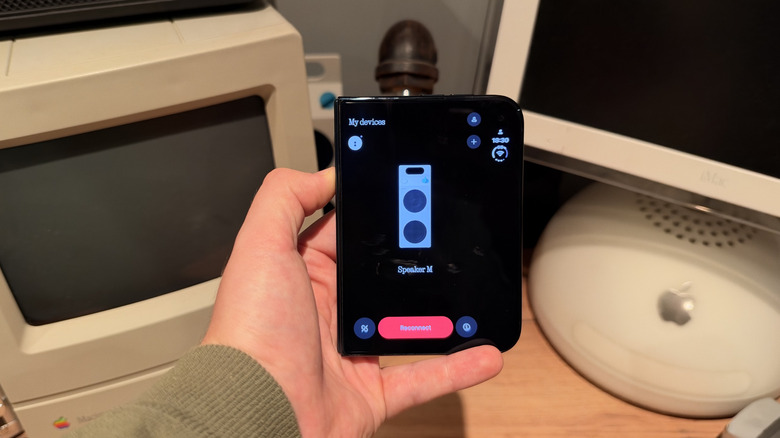
You'll need to download the Nothing X companion app for anything beyond basic volume and playback controls. It's a relatively clean app once you're inside it and using it, but setup can be quite irritating. There are several pop-ups to dismiss before you reach the controls — such as joining the beta program, allowing notifications, and so on — which is strange to put in the way of just getting on with listening.
You get four EQ presets to pick from: Balanced, More Bass, More Treble, and Voice, plus a three-band equalizer and toggles for Ultra Bass, Wide Soundstage, Night Mode, and Low Lag Mode. Software updates, battery info, and control customization options all live in the app as well. The app also includes an explainer showing what each control on the speaker does when you use it for the first time — which is more useful than it sounds since none of the buttons have a label.
Switching on Wide Soundstage disables Ultra Bass and overrides any EQ that you've set, but I'd leave it switched off anyway. On the Speaker M, its effect is subtle, and its altered audio sounds worse to my ears, with reverb pushed further forward than it should be. The effect is more noticeable on the Speaker S, for whatever that's worth. Party Mode also switches off several settings if you activate it. None of these conflicts are flagged clearly in the app, so you'll likely only find out when you start wondering why your music suddenly sounds different.
Conclusions

The CMF Speaker M is Nothing's first attempt at a portable speaker, and its quirky design is reason enough to buy one. It's playful shape, real physical controls, minimal branding, and an IP68-rated body add up to something that's far less generic than most of the best Bluetooth speakers at this price. The audio quality and feature set only make it more appealing, with Bluetooth 6.0, multi-point audio, NFC pairing, USB-C lossless audio, and decent out-of-the-box sound.
What holds it back is the low end. The bigger cabinet and the extra 25W of output should buy the Speaker M a little more punch than the S, but it isn't better enough to justify nearly twice the price. Consider that alongside the below-par battery life, confusing software, and a customization option you can't actually use yet, and you'll understand why this is definitely still a budget speaker.
I'd happily live with the Speaker M for everyday listening, travel, and small gatherings, especially for the kind of music I listen to most. I point people to the Speaker S if they want much of the experience for half of the money and don't mind giving up the handle and a bit of audio quality. Two Speaker Ms in stereo sound excellent, though $218 is a lot to spend on a pair of portable speakers. Still, it's cheaper than using a stereo pair of HomePod minis, which is what I was using before. Nothing's first CMF speaker is great for what it is, but the company needs to focus on better software, more reliable pairing, and the availability of customization options.
The closest rival to the Speaker M is, of course, the Speaker S, which costs $59. It uses a single 45mm driver with two passive radiators for 10W of total output. It keeps the same design language, companion app, and most of the feature list. If you want to use two of them in stereo, you can do so for less than the cost of one Speaker M.
The JBL Go 5 sells for around $55 and is the most obvious budget alternative from another brand. It's smaller and simpler but has no stereo pairing option. JBL's Flip 7 retails for $149.95, which is a more bass-friendly option. Bose's SoundLink Flex 2nd Gen speaker is $159, which gets you more refined tuning but only offers 12 hours of battery. If water resistance matters to you more than stereo audio, BGR's roundup of the best waterproof Bluetooth speakers covers the rugged end of the market in more detail. But if design matters more to you than deep bass, and you want a more affordable way to get stereo audio, the Speaker M is a truly compelling new option.