

What Auracast Is, And Why Your Next Headphones Should Support It
Bluetooth technology can be a wonderful thing, especially for those of us who can't fathom a day without our wireless headphones. While the last several years have brought a range of improvements and new features to the greater world of Bluetooth, one of the most exciting is a feature called Auracast. Baked into the Bluetooth LE Audio standard (which hit the market in July 2022), Auracast allows you to instantly connect a compatible pair of headphones, Bluetooth speaker, phone, or hearing aids to a single, shared audio source — no pairing required.
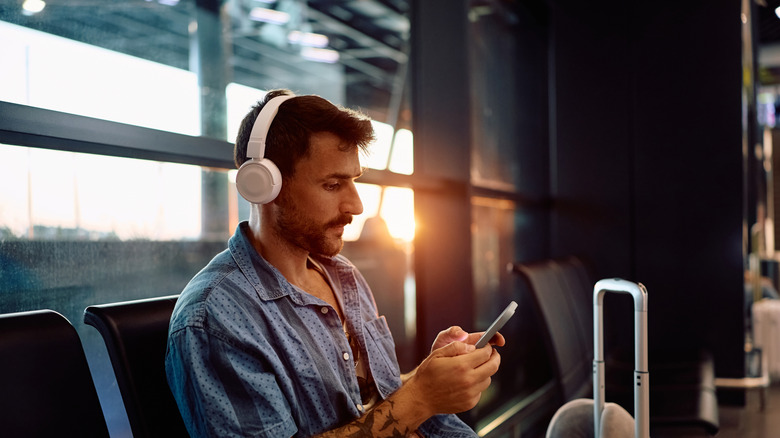
"Wait, isn't Bluetooth fundamentally built on pairing Device A to Device B?" At its core, yes, but one of the benefits of Auracast is being able to simply "tune in" to a specific Bluetooth source. Imagine you're sitting idly at the airport; bad weather strikes, creating a delay for the flight you're supposed to take and a gate change. With Auracast-ready headphones, the airport can broadcast all that updated information via Bluetooth; all you have to do is tune into the audio transmission.
Unfortunately, device manufacturers aren't doing the greatest job at publicizing Auracast. JBL and Sennheiser were some of the only brands singing its praises when the feature first dropped, and not many other companies have matched that gusto. You might actually own one or several Auracast devices without even knowing it. Do a quick Google search for your daily driver headphones with "Auracast" at the end of your prompt to find out.
How common are Auracast broadcasts so far?
While audio manufacturers could do a better job of spreading the good word of Auracast, wider adoption could also be aided by the venues that elect to use the technology. Many airports, train stations, churches, and colleges are leaning on Auracast to communicate with patrons, along with several movie theaters, arenas, and a couple of healthcare facilities. Altogether, that isn't the biggest pool of Auracast early adopters, but the Bluetooth Special Interest Group (SIG) has high hopes that other venues will invest in the tech, too.
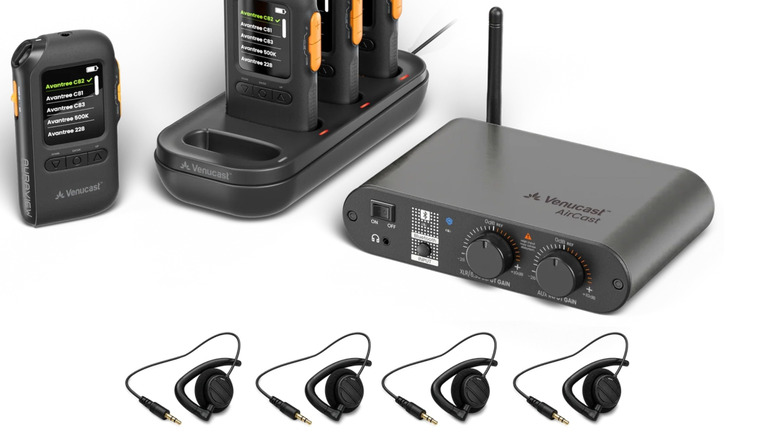
Of course, "investment" is the key word here. Auracast requires public places to install Bluetooth transmitters and other equipment in order to broadcast LE Audio media. Generally speaking, Auracast is able to sustain itself at distances of over 330 feet without some type of repeater. We were able to find pricing for a commercial-grade Auracast transmitter — the VenuCast AirCast — which sells for $350 and features three source inputs: Bluetooth, XLR, and 3.5mm auxiliary.
This specific product doesn't come with Auracast headsets, but listeners can tune in to broadcasts using their own Auracast headphones or hearing aids. VenuCast also sells a handful of Auracast bundles that come with a transmitter, on top of several Auracast OLED display modules and headsets. Our fingers are crossed that Auracast starts catching on more than it already is, because the more forums that implement it, the more the technology has a shot at getting even better. (Bluetooth on the moon, anyone?)