

Most Drivers Don't Realize This Handy Car Gadget Is Actually Illegal In Some States
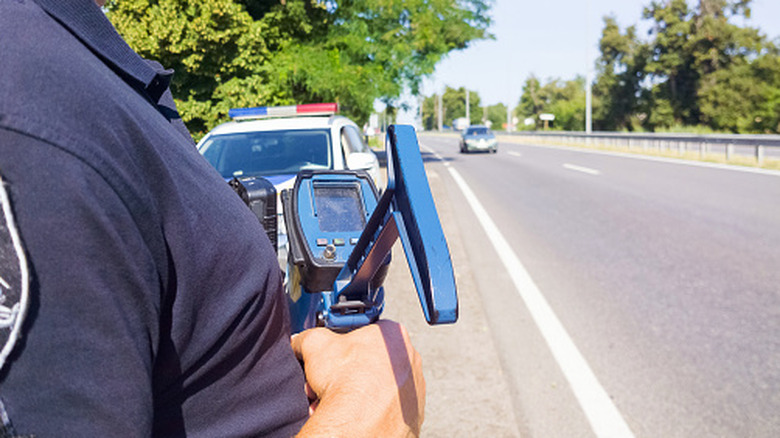
Some drivers hoping to avoid speeding tickets have opted for devices like laser jammers to lessen their chances of getting pulled over. These gadgets use laser technology to help drivers avoid sticky scenarios by sending out infrared lights to interfere with the laser speed guns employed by police officers. This gives drivers time to slow down before they get pulled over, which might make laser jammers sound like handy car companions. But these devices are not legal everywhere in the United States, even if they are one of the cool new dashboard gadgets that can update your old car.
According to Automoblog, 12 states had outlawed laser technologies from passenger and commercial vehicles as of early 2025: South Carolina, Texas, Virginia, Tennessee, Nebraska, California, Utah, Colorado, Oklahoma, Iowa, Illinois, and Minnesota. The devices are also illegal in Washington, D.C., despite the fact that they're still legal under federal law. Given that they're intentionally designed to tamper with police equipment and help drivers avoid speeding tickets, it isn't completely shocking that some states wouldn't be thrilled they exist. Deeming them problematic devices for vehicles to have — and passing laws to restrict them — is a natural follow-on.
Some drivers have also resorted to technologies similar to laser jammers, like radar detectors, which are outlawed only in Virginia and Washington, D.C., as of 2025, per Automoblog. The devices also can't be used on military bases or in commercial vehicles weighing over 10,000 pounds. Unlike laser jammers, which directly interfere with infrared beams emitted by speed guns, radar detectors simply alert drivers if they sense radio waves emitted by radar guns, thereby allowing them time to slow down before they pass police vehicles.
Free, legal alternatives to laser jammers and radar detectors

As convenient as it may be to use devices like laser jammers to slip away from possible speeding tickets, there are alternate methods that are still available across the United States and don't involve tricking police equipment. One option is the Waze app's police sighting feature. This function presents user-provided entries to alert other app users that there may be a police presence along their route, thus giving them time to slow down before they're targeted by a laser gun. App users can take advantage of these helpful (though controversial) notifications in tandem with the navigation features, allowing them to feel even more at ease when traveling to unfamiliar destinations.
For a less controversial approach to avoiding speeding tickets, Google Maps can remind drivers of changing speed limits along their routes. The app's speedometer, which Android Auto users were finally afforded access to in 2026, will also inform users if they're cruising too quickly, allowing them the opportunity to slow down, sometimes before police even become a factor in their journeys. As a bonus, navigation apps like Waze, Google Maps, and others are free services that can help you avoid breaching the speed limit (and getting a ticket) without the need for extra, paid equipment.