

How Often Do Smartwatches Update Your GPS Position?
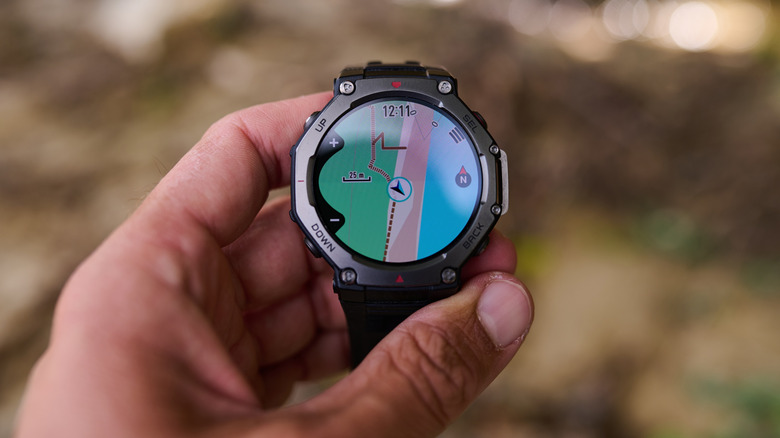
If you own a smartwatch, you may occasionally wonder how accurate Global Positioning System (GPS) tracking is, and how often GPS locations are updated during activities. The most popular smartwatches from brands such as Apple, Garmin, and Samsung generally get satellite pings once every second (1 Hz) as an industry standard. This will capture location pings often enough for most applications like regular running workouts or walks.
However, each smartwatch manufacturer offers options that allow for more or less frequent updates in settings, but opting for more frequent location updates could result in increased memory usage and degraded battery life. Garmin gets around this problem with solar trickle-charging, which increases battery life markedly, even when using more frequent GPS updates. Garmin also has Smart Recording that can change update frequencies based on activities, or a consistent per-second mode that records position updates once every second regardless of position, speed, or heart rate.
Samsung's Galaxy Watch7 and Watch Ultra have two options. One gives an approximate location (with an option to use your phone's GPS), while the other gives a precise location using the watch's own GPS sensor during workouts, pinging every 150 seconds. The Apple Watch Ultra 4 pushes the boundaries of this capability, offering an Extended Workout mode that can record walks or hikes for up to 45 hours while still maintaining GPS readings every second. If you have an early-generation Apple Watch Ultra, you can make your battery last for up to 60 hours by using Low Power Mode, which uses less frequent GPS updates.
Global Navigation Satellite System
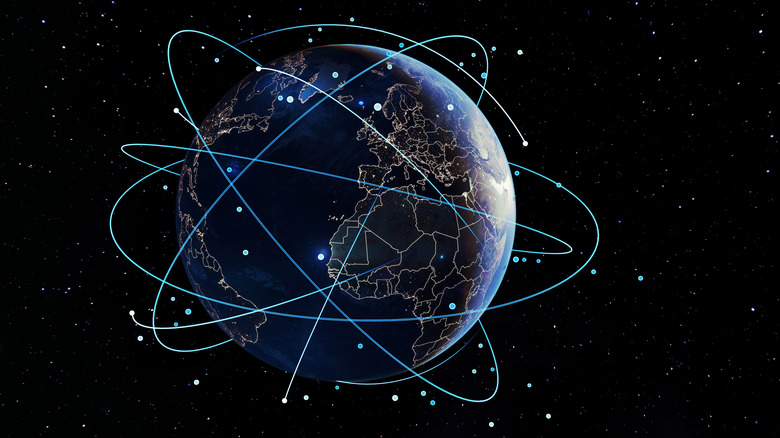
When most people think about satellite-based tracking, the acronym GPS comes to mind, but GPS is only one of several different satellite constellations that brands like Apple, Garmin, and Samsung have access to. GPS, GLONASS, Galileo, and BeiDou are some of the satellite constellations that fall under the Global Navigation Satellite System umbrella. Manufacturers have the option to use more than one constellation to provide multiple location pings simultaneously, increasing accuracy and correcting for tracking errors. Line of sight is an important factor in satellite navigation.
When moving between buildings, for instance, a single satellite connection may experience intermittent connection losses. This leaves gaps that are usually calculated and filled by a watch's other sensors. This is why many smartwatch manufacturers use a combination of satellites. By using two or more satellite constellations, accuracy is improved greatly and intermittent loss of signal is avoided.
The first Apple Watch Ultra model, for instance, has the capability to use GPS, GLONASS, Galileo, QZSS, or BeiDou constellations for multi-satellite tracking capability. Apple made a notable change with the Apple Watch Ultra 4, which dropped GLONASS support. Smartwatches have the ability to use either a single-band or dual-band tracking system, with single-band typically using the old L1/E1 band, and dual-band receivers capable of using both the L1/E1 and more accurate L5/E5 bands.