

Garmin's Solar Trickle-Charge Is A Secret To Better Battery Life That Apple Can't Beat
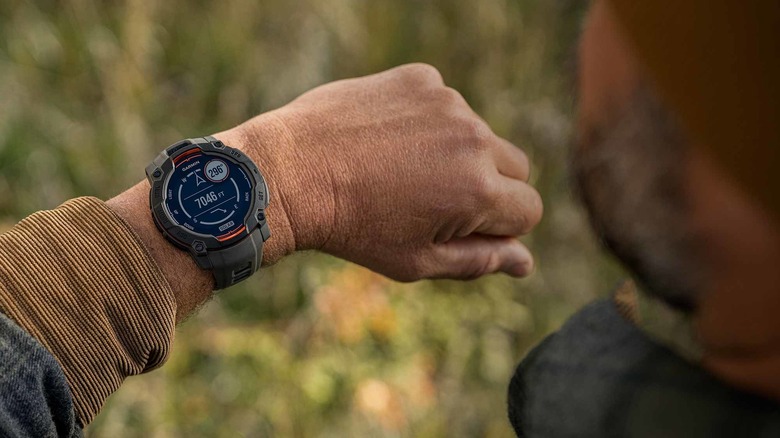
If you're comparing smartwatches, there are many features and specifications you can use to classify and differentiate them. Arguably, the most important is battery life. It determines how long you can wear and use your device before you need to take it off to charge. It also dictates how long you can explore outside your home without being tethered to an outlet, unless you bring a portable power station or a portable charger. The point being, battery life determines a lot about how you use a smartwatch, and if you don't want to be forced to charge often, you'll want something with a reasonable battery capacity. Enter Garmin's excellent selection of long-lasting smartwatches, with unique solar-powered models that can be charged by, yes, sunlight.
Standard Garmin smartwatches like the Venu offer about 4 to 12 days of battery life on a single charge, depending on usage. The latest Apple Watch, Series 11, lasts for about 24 hours on a single charge, considerably less. You can stretch that to 38 or 40 hours in low-power mode, but that's still under two days maximum. Then you look at Garmin's solar-powered models, like the Instinct 3 Solar, and the difference is stark. Instinct 3 can last for up to 28 days of typical usage with solar charging and GPS active — 40 days with GPS off. With the built-in GPS constantly running, battery life drops to about 150 hours. But there's no denying that's a massive advantage for Garmin's models, especially if you spend a lot of time outdoors hiking and exploring. Solar trickle charging is something Apple simply cannot beat with its current designs. That's not the only thing a Garmin watch can do that an Apple Watch can't, either.
How Garmin's design philosophies differ from Apple's
For those who spend more time at home and want a more stylish option, the Apple Watch makes sense. It's not a big deal if the battery needs to be charged every night, because there's always an outlet nearby. So, regarding capabilities and needs, your lifestyle does play a role. And if you look at some of the biggest reasons why people choose the Apple Watch over other options, like Android smartwatches, a lot of it has to do with the design, software, and experience, all of which Apple is unmatched in.
Garmin's smartwatches, though loaded with bells and whistles for outdoor activities, are for a very different crowd. Moreover, while Apple Watch health tracking is best in class compared with other standard touchscreen options, Garmin offers a host of specialized tracking and monitoring tools that are invaluable for someone with an active lifestyle. Garmin watches actually beat the Apple Watch for some fitness users.
The Instinct 3 Solar can monitor daily movements, HRV status, heart rate, stress, body stats like sleep and recovery, blood oxygen, respiration, and much more. In fact, many of those tracking tools and sports modes are built for more extreme activities, whereas the Apple Watch can measure body stats during basic exercise, such as runs and swims. Someone who never ventures out into the wilderness isn't necessarily going to need or use most of what Garmin's devices offer, and that's okay.
How does Garmin's solar technology work?

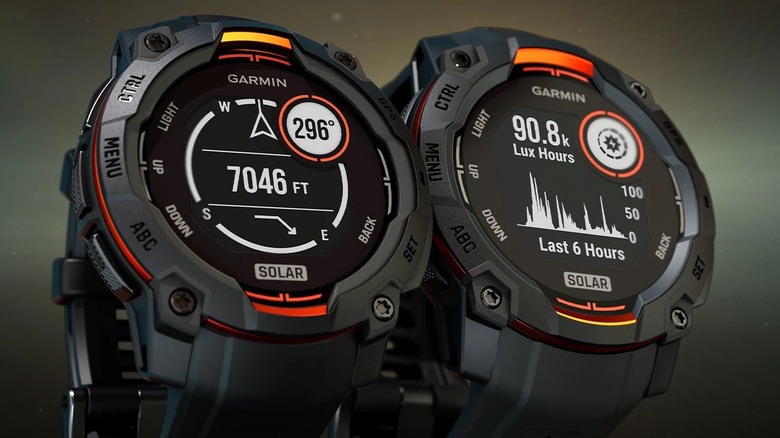
Garmin's solar tech, as featured in the Instinct 3 Solar, is described as "Power Glass" charging. What that means is the crystal face, the glass you look through to see the digital watch components inside, is harvesting solar energy at all times. That's because inside the 'power glass' are thin, transparent photovoltaic cells that capture ambient light. If you compare power glass with solar panels, you'll notice that most solar panels are usually opaque. Even though transparent, Garmin doesn't recommend using a screen protector over the Power Glass crystal.
The crystal is basically the built-in panel that generates energy to charge the battery when there is reliable access to sunlight. As with most solar technologies, charging efficiency depends on how much sunlight is available and on nearby obstructions, such as tree cover and other shade.
This is a fairly recent design. Some of Garmin's older devices use a different form of solar charging, like the Fenix 6X Solar or the Instinct 2 Solar — the previous generation of the Instinct — which had a special ring around the display to capture light, rather than the entire crystal.