

3 Portable Internet Devices To Consider Instead Of Starlink
We may receive a commission on purchases made from links.
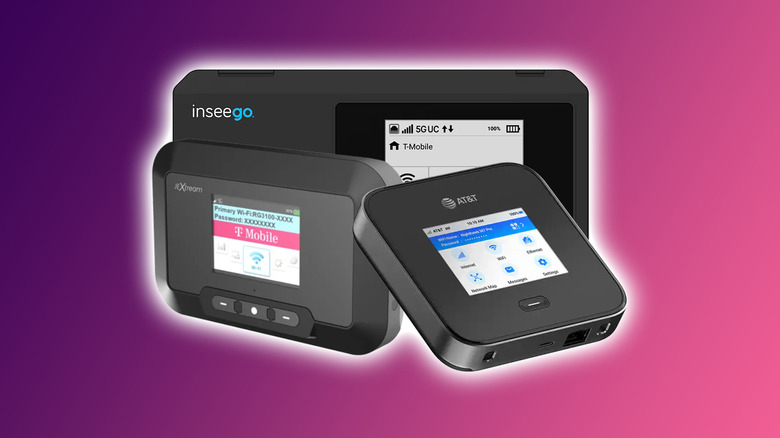
Starlink, the Elon Musk-backed satellite internet service, is not only backed by a one-time trillionaire, but is also surrounded by alternatives. While satellite internet is constantly being expanded in different regions and is great for those in the boonies or some remote location, it's not always necessary, especially with its high costs. Oftentimes, portable internet devices like hotspots are more than enough to supply internet while out and about.
Mobile hotspots are different from, say, a travel router, which creates its own private network for you to use based off of 5G or other incoming connections. Hotspots leverage the incoming mobile connection and allow you to latch onto it by piping it back out as Wi-Fi. In fact, you can use your phone as one, saving you additional costs of having to buy new hardware.
That said, if you're going to need the phone to remain powered up through your trip, it's best not to use the hotspot tethering feature on your phone. This will likely drain your power, which is where the little gizmos below come in handy.
Franklin Wireless JEXtream RG2100/RG3100
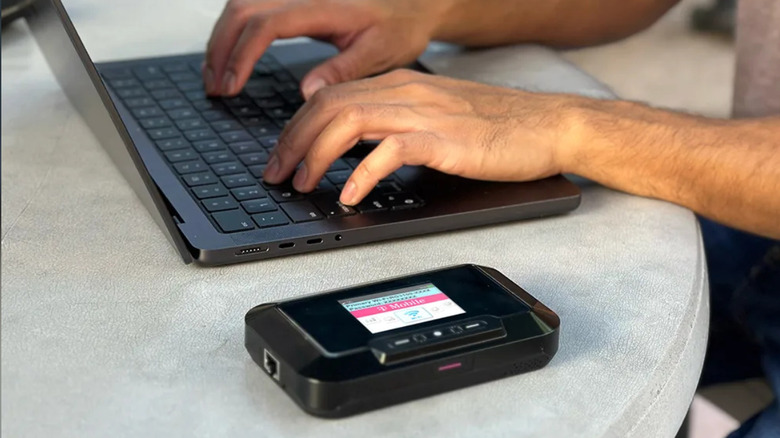
Highly praised by users online and several outlets, including PCMag, the Franklin Wireless JEXtream RG2100 5G Hotspot is by far one of the most praised products in this category. In the U.S., it mostly appears tied to T-Mobile if you want a carrier, but it still outputs plenty of speedy Wi-Fi by latching onto the company's 5G network. One element that PCMag did complain about is that there's a lack of an Ethernet port on the RG2100, which has since been added to the JEXtream RG3100 model, though the newer version is not as widely available.
The main differences between the two are the types of Wi-Fi they can output. You'll still get decent to great speeds depending on your location with the 2100, but the 3100 now supports Wi-Fi 7, which fixes some minor issues with Wi-Fi 6 embedded on the 2100. One user who put the 2100 through its paces in the real world reported that it burned up about 10% battery per hour and found that the lack of need for external power was a great boon when traveling.
The RG2100 is still available via Amazon for $165 usually, but at the time of writing is on sale for $140. This version is also tied to T-Mobile, so there doesn't seem to be much in the way of escape from the company for both editions, with the two interwoven.
Inseego MiFi Pro M4
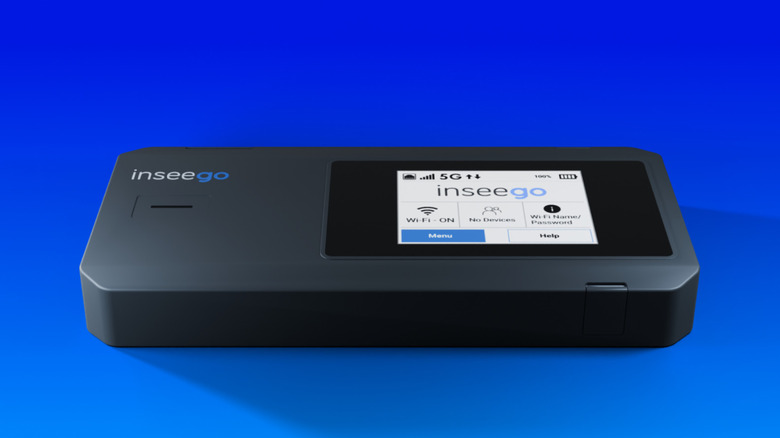
Don't be fooled by the various names attached to these devices; different carriers have the same version, just rebadged. The Inseego MiFi Pro M4 is one of the two hotspots The New York Times recommended, with this unit being available via AT&T, T-Mobile, and Verizon. There's also a fully unlocked one, but it's not as straightforward to get your hands on.
Priced at around $210 MSRP, the Inseego MiFi Pro M4 provides Wi-Fi 7, a small screen to manage on-device settings, and decent battery life. The biggest issue with the MiFi Pro M4 is that getting it unlocked and without a carrier attached, you have to go through "value added distributors" (third-party sellers you've likely never heard of); there's no official store page outside of these outlets.
That said, it does boast "enterprise-grade security," among a host of other options, and a 5,050 mAh battery that should provide a full-day connection while out. There's an Ethernet port, OpenVPN support, and the option for multi-SSID isolation so that different users can access their own slice of the network without interfering with other devices. If you're someone who thinks about networking, this might be the one to go for.
Netgear Nighthawk M7 Pro/M8 Pro
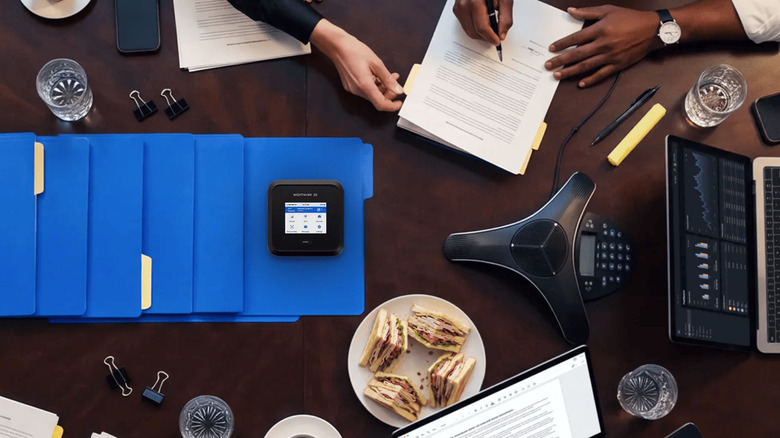
Providing up to 6 Gbps speeds over 5G and offering two options for wired connections — USB-C included — the Netgear Nighthawk M7 Pro can easily be your chosen travel router. Currently, the direct store doesn't have the M7 Pro in stock, nor does it have the recently released M8 Pro. However, the difference between the M7 Pro and M8 Pro is the internal modem.
Netgear has fitted the M8 Pro with the X85 cellular modem, which should provide a more stable connection. However, there's not much in the way of differences when it comes to the actual hardware, with both M7 and M8 capable of producing Wi-Fi 7 and 2.5 Gbps over Ethernet. For those who need an unlocked M8 Pro or can't find the M7 Pro unlocked, that'll hit shelves next year, along with eSIM plans.
One of the more expensive options, if you want to pay it off monthly with a contract, AT&T has it for $12.50 a month. According to some Amazon listings, some devices should support Verizon as well.
Methodology
A device's inclusion in this article was mostly dictated by outlet reviews and some user reports outside of the manufacturer or carrier websites. A majority of the user comments range from perfect scores to poor reviews due to poor service from the user's carrier or a technological misunderstanding. As such, user reviews made on Reddit or forums were given more prominence during the decision making process. The writer's prior experience with Wi-Fi hotspots was also taken into account during the selection process. Lastly, travel routers were entirely discounted for this piece since they effectively re-share another device's internet connection, whereas portable hotspots provide their own — much more analogous to Starlink service.