

4 Popular OLED TVs With A Matte Screen
We may receive a commission on purchases made from links.
Samsung is the sole TV manufacturer in the U.S. that sells OLED TVs with a matte screen. Other brands offer matte displays, but they focus on different panel technologies, like Samsung's The Frame TVs, which use quantum-dot technology. That said, if you're looking for an OLED TV with a matte screen, you might have to choose between Samsung's 2026 S95H and S90H models, the 2025 S95F version, or the 20204 S95D iteration. Still, while there aren't many options, reviewers have praised Samsung's OLED TVs with a matte display for their glare-free look, while still preserving deep blacks, rich colors, and a bright panel.
Since there aren't many options on the market, BGR kept the selection to Samsung TVs. However, we do have other lists, including the best ultra-thin OLED TVs available right now. If you're curious about the differences between matte and glossy displays when buying a new OLED TV, we can also explain the key points. After all, even though the glossy panel has more poppy colors, if your TV is close to a source of light, then depending on how bright the environment is or how much outside light your TV display gets, a matte screen can completely change your experience, as you don't have to worry about those very dark Game of Thrones-like scenes while you're watching TV on a sunny Sunday afternoon. That said, here's what you need to know about the current OLED TVs with matte displays available.
Samsung S95H

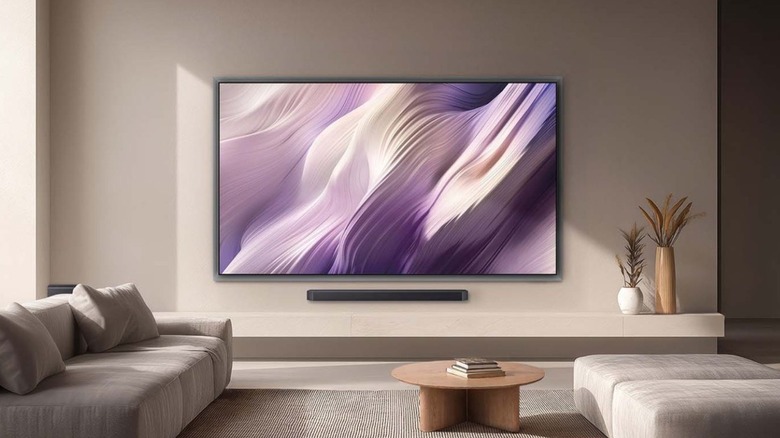
The best OLED TV with a matte display on the market, Samsung's S95H combines self-lit pixel precision with the third generation of the company's proprietary Glare Free matte coating. In the U.S., the company sells 55-inch, 65-inch, and 77-inch models with advanced QD-OLED panels that pair blue self-emissive OLEDs with a quantum dot color conversion layer, while a massive 83-inch model uses a Tandem WOLED panel that delivers the best colors and the most brightness. This generation of TVs runs the NQ4 AI Gen3 processor with 128 neural networks so that the TV can deliver up to 3,000 nits in HDR brightness alongside a 165Hz variable refresh rate for PC and console gaming.
What makes the S95H stand out from other matte OLED displays is its sheer luminance headroom, its ultra-thin FloatLayer flush-mount design, and compatibility with Samsung's optional Wireless One Connect Box. Basically, this TV uses brute-force peak brightness and refined anti-reflective chemistry to preserve deep blacks even in bright rooms. After all, a matte display can scatter light and slightly soften perceived contrast under heavy light. This is also Samsung's first flagship OLED TV with the Samsung Art Store available.
In the U.S., the S95H launched from $2,499.99 for the 55-inch to $6,499.99 for the 83-inch model, though seasonal sales can make the 65-inch version the most popular, at roughly $2,299.99. The S95H model may be the right choice if you have a living room with large windows, as its matte surface can reduce mirror-like reflections without sacrificing picture quality.
Samsung S90H
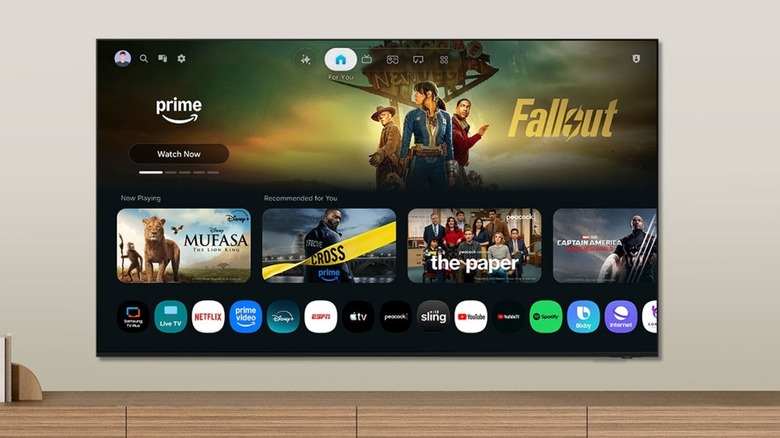
The best thing about Samsung is that after a few generations, the company takes its best technologies and starts offering them across different lines. The Samsung S90H is a mid-range OLED TV with a matte screen that brings this innovative technology to a cheaper price point. As a result, the S90H is the company's first mid-tier OLED to feature Samsung's UL-verified Glare Free matte screen tech. Available in an expansive range of sizes from 42 inches up to 83 inches, this TV relies primarily on WOLED panels paired with the same NQ4 AI Gen3 processor and 165Hz Motion Xcelerator gaming suite found in the flagship model. It supports 4K at 165Hz across four HDMI 2.1 ports, Nvidia G-Sync, AMD FreeSync Premium Pro, and OLED HDR+ tone mapping.
The main difference of the S90H is the price-to-performance ratio. Unlike the S95H, the S90H has its ports and power supply built into the TV chassis instead of relying on an external or wireless One Connect Box, and it trades a bit of peak HDR luminance for a much friendlier price tag. After all, retail pricing in the U.S. starts at $1,399.99 for the 42-inch model and goes up to $5,299.99 for the 83-inch version. Still, during holiday promotions, the company can sell the 65-inch model for as low as $1,399.99, an unbeatable price for anyone looking for a top-tier TV with a twist: a matte display on a beautiful OLED panel.
Samsung S95F
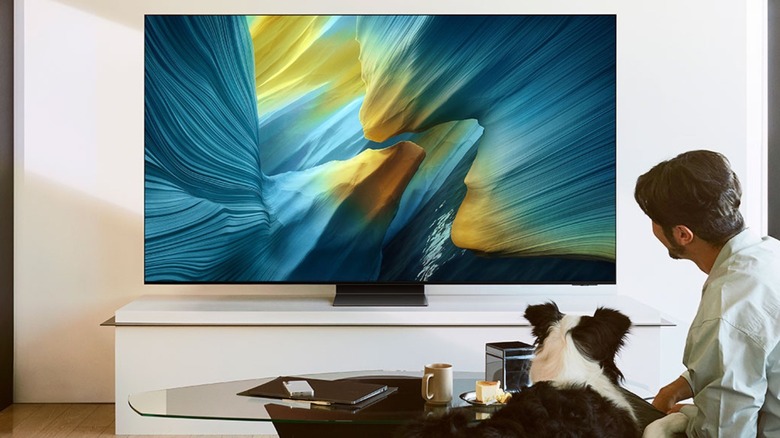
Released as Samsung's 2025 flagship, the Samsung S95F refined the matte OLED formula with second-generation Glare Free 2.0 technology across its 55-, 65-, 77-, and 83-inch lineup. Built around high-efficiency QD-OLED panels, it runs on the same NQ4 AI Gen3 processor available on the 2026 models. Still, while the 2026 flagship can reach up to 3,000 nits, this model comes in at 2,000 nits with 165Hz variable refresh rate support for gamers. According to Samsung, its self-illuminating pixels deliver Pantone-validated color volume and dark-room contrast. On top of that, the AI Motion Enhancer Pro and Auto HDR Remastering Pro help to sharpen fast-moving sports and older broadcast feeds.
The primary difference between the S95F is its physical architecture and current market value. Unlike the all-new S95H, the S95F includes a wired external Slim One Connect Box, so a single cable runs to the Infinity One chassis for effortless, flush-to-the-wall installation. Plus, because it's in the market for a full product cycle, users get almost everything available on the 2026 flagship models at a much more affordable price.
While the original price in the U.S. for these TVs started at $2,499.99 for the 55-inch size and up to $6,499.99 for the 83-inch model, remaining inventory can be found for around $2,248 for the 65-inch model. That's at least a third off the original price for the bigger panels, meaning users can get better value for a panel almost as good as the one currently available.
Samsung S95D
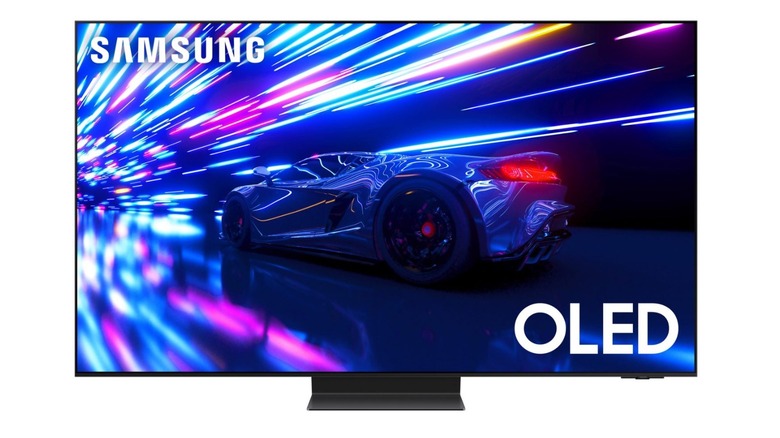
Last but not least, customers can still find the original glare-free TV: Samsung's first OLED TV with a matte display, introduced in 2024. Available in 55-inch, 65-inch, and 77-inch sizes, the S94D uses the company's third-generation QD-OLED panels with Samsung's NQ4 AI Gen2 processor, bringing up to 1,800 nits of peak HDR brightness, 144Hz Motion Xcelerator gaming performance, and 100% DCI-P3 color coverage. Like the S95F, it uses an ultra-thin, uniform profile paired with an included wired One Connect Box that features all four HDMI 2.1 inputs and power circuitry away from the wall.
With that, the S95D can be the most affordable gateway into proper QD-OLED matte performance. While the first-generation matte coating can show a slight gray haze when a bright flashlight or direct sunbeam hits the screen, it still outperforms any glossy OLED TV on the market when facing lamps, windows, or other room lights. Plus, the 144Hz refresh rate is still enough for PlayStation 5, Xbox Series X, and most gaming PC users, so people can still enjoy this massive TV without compromises.
While original U.S. launch prices ran from $2.599.99 for the 55-inch up to $4,599.99 for the 77-inch model, customers can now get refurbished/pre-owned units for around $1,200 for the 55-inch model. With that in mind, customers should buy this model if glare is their biggest enemy and they don't want to give up the OLED perks in their living room.
Methodology

While BGR's lists usually include many models and options, this is a unique case, as Samsung is currently the only manufacturer of OLED TVs with a matte display. Even though we could expect other players to join the scene in the upcoming years, Samsung continues to be the leader in TV sales, as the company can virtually reach all the customers, from the ones who just want a cheap display to others who want the best experience that they might have never dreamed of before.
That said, the best OLED TVs with a matte display on the market are currently all the models that have been available so far. Even though Samsung now tackles the mid-tier with its 2026 lineup, we're talking about premium TVs here, meaning they will deliver fantastic colors, great brightness, Samsung's praised TV software, and all the perks users can expect from a flagship model, including AI processing, variable refresh rate, and a very good remote control — which Samsung has mastered for years now.
That said, when choosing your next TV, you should know the different kinds of OLED displays so you can pick the model that makes the most sense for your home. After all, if you only watch TV at night, then a glossy OLED TV might be the best option, but if ambient light has been bothering you, a model with a matte coating can be exactly what you've been looking for.