

This Chinese Company Just Took A Big Step Towards Flying Cars Becoming A Reality
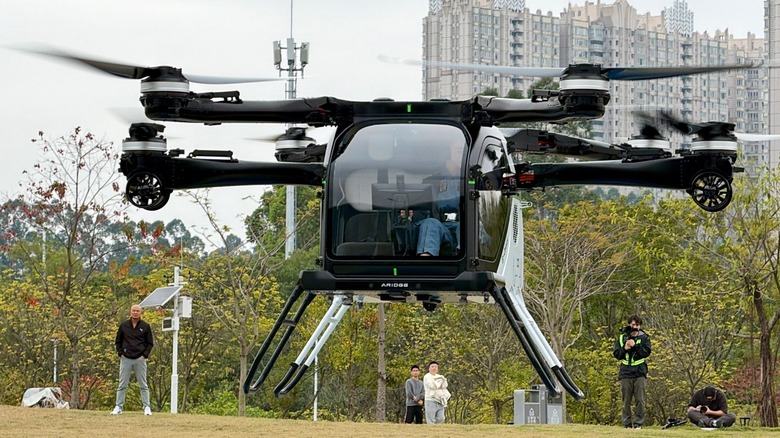
Chinese electric vehicle (EV) maker Xpeng is working to make its flying car business a reality. In 2025, during its AI Day in Guangzhou, China, the company unveiled the Aridge project. The flagship product is a truck-like vehicle with a detachable electric aircraft (that looks like a small helicopter) that you can fly inside of. The spin-off company is also working on a larger six-seat electric vertical take-off and landing (eVTOL) aircraft, and even a futuristic car with propellers that could come to the market in the next decade.
When Xpeng first made these announcements, they felt like future promises. But during the company's 2026 AI Day, it proved how most of these products are about to become a reality. The Land Aircraft Carrier (the truck with the detachable aircraft) is entering mass production in 2027. At the end of November 2026, BGR visited Guangzhou, invited by Xpeng, to have exclusive experiences with its latest Iron humanoid robot, test drive its self-driving vehicles, and even get a first look at its first commercial flying car.
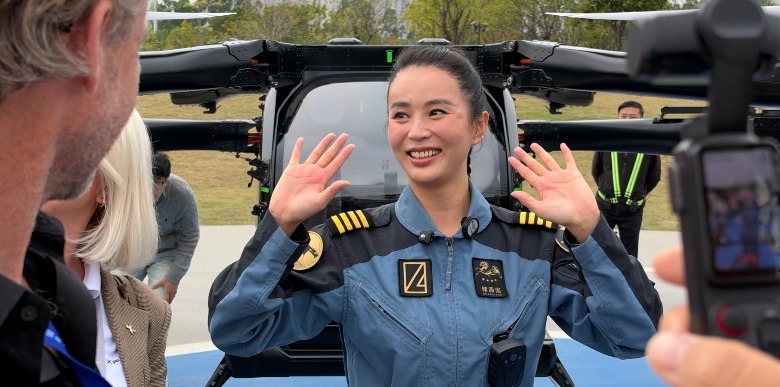 José Adorno/BGR
At the company's headquarters, BGR had two different experiences. One was seeing Aridge's Land Aircraft Carrier detaching the craft from the ground vehicle, and the other was seeing the aircraft flying with a pilot inside. Back in 2025, we could only see a car mockup with the helicopter-like vehicle already outside the car. Basically, Aridge's Land Aircraft Carrier consists of a ground module and a flying module stored folded inside the trunk. Unlike traditional aircraft that require runways and hangars, the car serves a movable hangar and charging station, allowing users to drive to scenic locations and deploy the aircraft on site. We saw the vehicle flying for about five minutes, so there's a lot to talk about.
Here's why Xpeng's flying car is something nobody's ever seen before
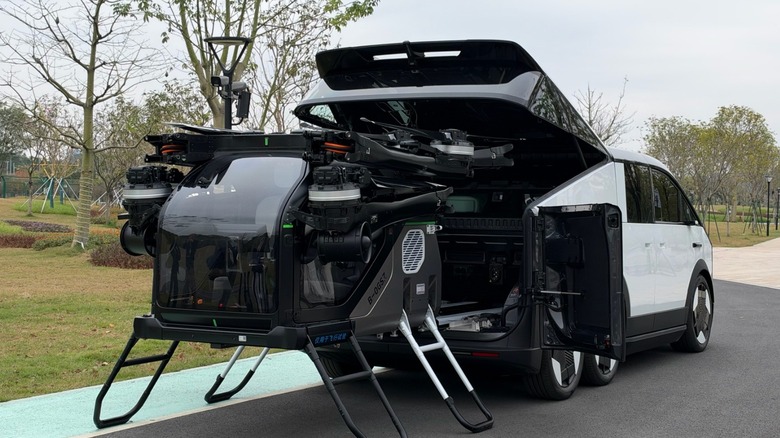
What makes this product so exciting is that Xpeng is betting on an eVTOL, much like the already-available Jetson One. While traditional helicopters require complex hand-and-foot coordination, this device has a simplified single control stick that makes flying a complex machine more similar to playing a gaming console. The company says that customers will be able to fly the aircraft for a maximum of 20 minutes (due to battery constraints), though the ground module can recharge it six times, taking about 30 minutes per full charge. The vehicle has been designed for a maximum ceiling of 8,200 feet, though it is currently legally restricted to flying under 394 feet in China. In addition, it can handle wind speeds up to 25 mph. It also has AI-powered autopilot software and manual modes, assisted landing, and collision avoidance by using visual flight rules alongside onboard cameras, monitors, and lasers to alert the pilot of nearby aircraft.
For the tests, pilots require a commercial pilot license and have completed Type Certificate flight testing. With the hardware design finalized, public operation is awaiting updated aviation laws and regulations. Still, Xpeng tells BGR that it's expecting to sell its Aridge vehicle in the Middle East before it becomes available in China, with the possibility to expand the product to other overseas markets like Brazil. Costing approximately $300,000, Aridge expects to commercialize this vehicle by the second half of 2027 — around the same time its Iron humanoid robot will land in the Chinese market as well.
Aridge's A868 flying car also achieved another milestone
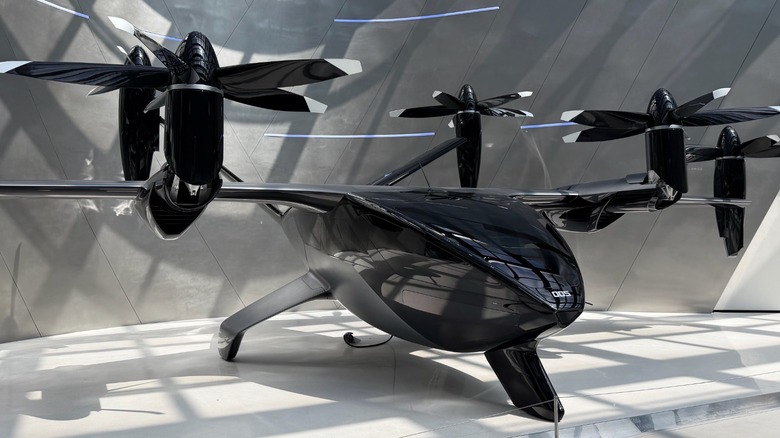
Xpeng announced that another of its Aridge products — specifically, the A868 flying eVTOL prototype — has successfully completed a full-tiltrotor transition flight. With that, the aircraft showed that it can repeatedly convert between vertical hover and high-speed, fixed-wing horizontal cruise, including executing a reverse-tilt transition for descent. This marks an important milestone for electric vertical takeoff and landing development, as the full-tiltrotor configurations are considered the most capable and yet demanding path to medium- and long-range flight.
To achieve this, the A868 integrates a hybrid-electric powertrain targeting a 311-mile range and a 224 mph cruise speed. The company says that safety and reliability are backed by an aviation-grade dual-winding electric drive, which sustains power for a safe landing even if a single winding fails, alongside a fully redundant flight-control architecture that keeps the aircraft flyable if an onboard system malfunctions.
What's interesting about this vehicle is that the multi-seat A868 is built for high-efficiency business commuting across urban landscapes, and with tests proving that everything works as expected, the company is also ramping up negotiations (and waiting for legislation) to start selling this vehicle. While BGR couldn't see this other product in action, Xpeng tells us that tests are being conducted in another city in China. It marks a big departure from what a year ago looked like just a concept, and it shows that AI-driven flying taxi companies in the U.S. aren't alone in another big futuristic competition.