

The Affordable Tool That Can Save Your Computer From A Deadly Shock
We may receive a commission on purchases made from links.
Whenever you're working inside electronic devices, such as a desktop computer, upgrading your Steam Deck, or repairing parts in other devices, experts generally recommend grounding yourself. That is because static electricity can build up between you and your surroundings when there's an imbalance between positive and negative charges within a material — in this case, your skin or clothing. Most of the time, that static electricity won't do anything besides give you a small shock when you reach for a doorknob, for example. But inside a computer or electronic device, if you touch the metal or components while you have a static charge, it can flow to the device, causing an electrostatic discharge (ESD) that could potentially destroy the part or device you're touching. But you can generally prevent this from happening with an anti-static wristband.
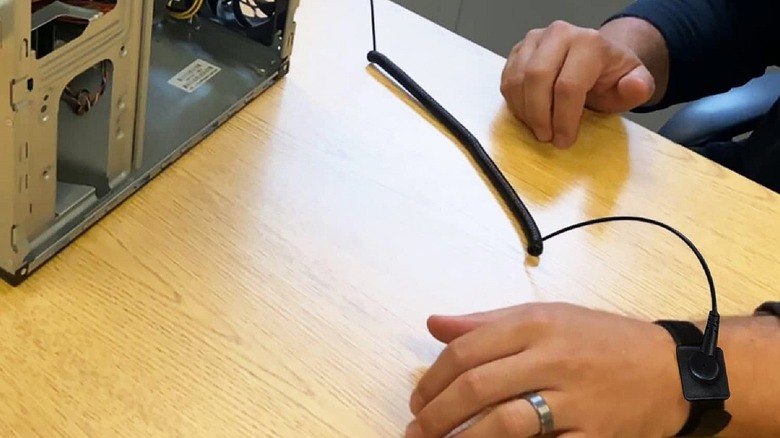
An anti-static wrist band, or wrist strap like this $5 Arctic Eagle gadget from Amazon, is designed to ground you, just as the experts recommend. On the inside of the strap is a conductive yarn material that helps prevent a static discharge build-up or ESD. You first connect a small alligator clip to a grounded, unpainted metal surface, such as the device you're working on, like the metal chassis of a desktop tower. Then, any static electricity is removed or nullified thanks to a line wire — the conductive material — and a built-in resistor with a resistance value of 1 MΩ (megaohms) to 1000 MΩ. That setup, with the resistor and the clip, grounds you, but allows any static build-up to flow out through you, the bracelet, and the ground — via the clip. When it reaches the grounded or "earthed" surface, it is then absorbed.
You can ground yourself without the band, but it provides consistent coverage

Some PC upgrades probably aren't worth your money, so if you choose the right system, you may never have to open it. That would negate the need for a bracelet like this. Admittedly, you don't actually need an anti-static band or wrist strap to ground yourself before working on electronics at all. You can simply touch a grounded metal object, or, if you're using a screwdriver or similar tool, touch that to a grounded metal object instead. But there is an important point to make, and it's that static electricity and a resulting discharge can still happen intermittently at some point after grounding yourself the first time. A bracelet or tool like the one mentioned can help prevent this from happening more consistently.
In other words, to ground yourself repeatedly, you'd have to keep touching the affected material, like a part of the computer chassis that's unpainted. This bracelet, or a similar tool, helps prevent that consistent build-up, which is good if you are working inside electronics, like a desktop computer, for an extended period. It follows the rule that you're better off safe than sorry, especially when it comes to expensive electronic components from major PC brands. Imagine frying a costly CPU, GPU, or power supply because you didn't ground yourself beforehand. That's precisely why workers in electronics factories and sterile environments wear bracelets like this, or sometimes anti-static gloves, to protect the components they're working on.