

Why Do Some Backpacks Have USB Ports On Them?
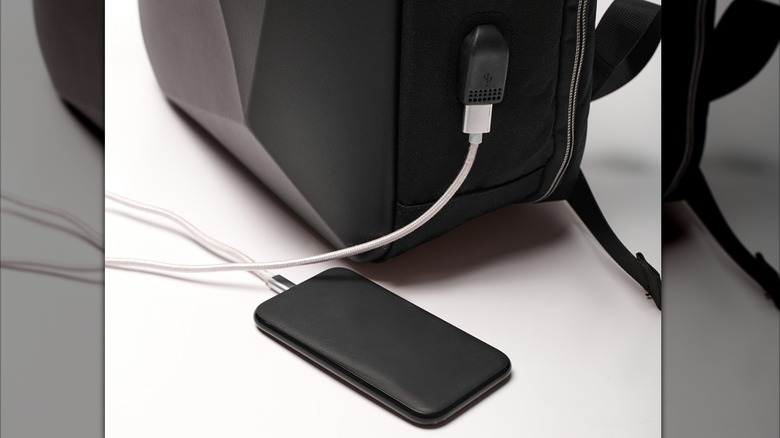
General advancements in technology have led to little accommodating shifts in various parts of our lives, including from manufacturers of unrelated products. For example, backpacks with USB ports. These are designed to house portable chargers for the smartphones we all tote around. If you're carrying your favorite USB-C power bank for fast charging around with you, it might as well have a dedicated home.
Not unlike backpacks with openings for headphone wires, some modern backpacks have integrated USB ports. While your first assumption may be that these setups have some sort of special feature, the reality is more utilitarian than that. These backpacks simply provide a convenient spot to stash a portable charger for quick smartphone juice-ups. A power bank is one of the most useful travel gadgets you can have, and these backpacks give you an easy way use them.
The ports are for connecting to a portable charger
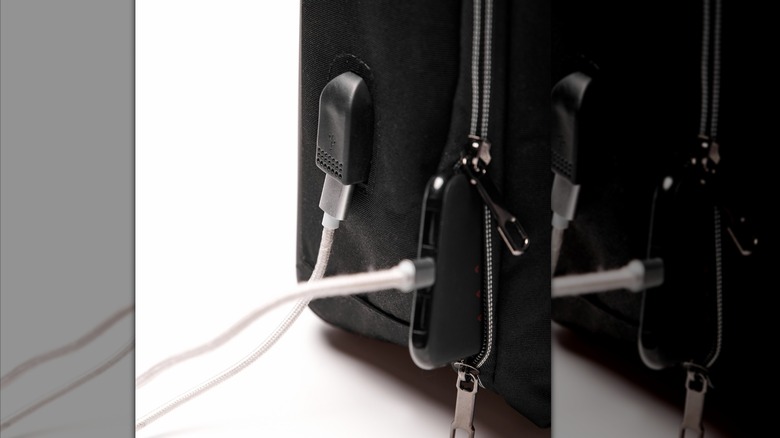
If you look inside a backpack with a USB port, you'll likely find a small pocket near another, similar USB port. The purpose of this setup is to place a pre-charged power bank inside the pocket, connect it to the internal port, and then connect your phone or other device to the external port for power. Certain backpacks with USB ports may have internal batteries, but most of the time, you'll need to provide your own portable charger.
In some cases, the USB port on these backpacks may simply be a pass-through for your USB charging cable. With this setup, you're connecting directly to the portable charger, as opposed to having internal and external USB ports serving as an intermediary. Depending on the backpack, it may come bundled with a USB charging cable.
In either case, you plug your phone into the external port or pass-through cable, and leave it to charge while your phone remains outside the bag. You could also use this type of system for a larger device like a computer, turning your backpack into a perfect laptop accessory for helping you stay productive.