

What Do Costco Price Tag Codes Really Mean?
If you shop at Costco, you may notice that price tags sometimes look different. Some end in $.99 and others in $.97, for example. Then there's the "death star" asterisk that means low inventory and likely end of run. When you understand the numbers, dates, and symbols, it can help you shop better, save money, and get items not only before they're gone, but at the best price possible. Costco sometimes brings items in seasonally or to test them. Some stay stocked long term while others are only available for a limited time. At Costco, you can't always see something and decide to come back and buy it later. If you love something and it's a good deal, you may want to get it now before it's gone.
Knowing the tricks of the trade will help you get the most out of your Costco membership. Many members follow deals posted in local Costco groups on sites like Facebook and by popular content creators. But understanding Costco pricing patterns puts you on another level. The superstore uses the same price codes in both the U.S. and Canada, so if you're from one country and shopping in the other, the same conventions ring true, too. Here's how to decipher Costco's price tag codes.
Most common price endings
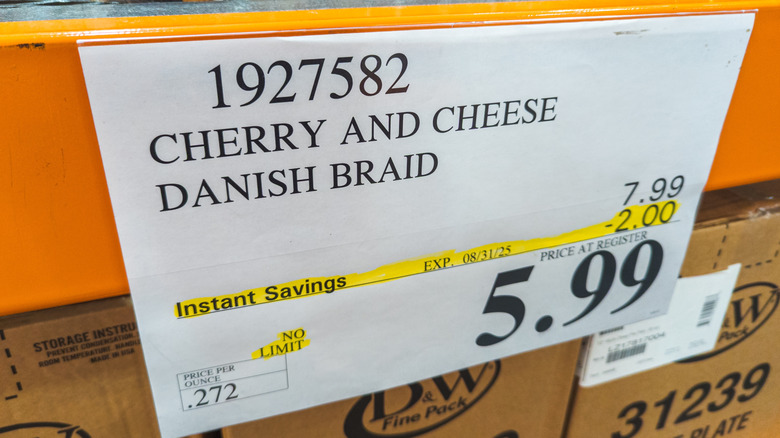
The two numbers that represent cents at the end of a Costco item price have more meaning than you might think. If the price of an item ends in $.99, this means it's being offered at full price. It's still typically a great deal since you're buying in bulk, but it's the original price Costco offers on this item with no additional markdowns, unless you see additional instant savings.
If an item is marked with $.97 at the end, this means it's a clearance item or the manager of that location has manually marked it down. This is usually specific to the location, so while you might see this price in your local Costco, a friend who lives in another city may not see it in theirs. It usually means the price isn't going to go any lower, so if it's something you have been eyeing, grab it now. Sometimes, this marking will appear in pen over a crossed-out original price, so it's easy to tell that it's a further markdown. With plenty of Costco electronics worth buying along with lots of other items for smart homeowners, you'll want to take advantage of these $.97 deals.
More unique price endings
You may occasionally notice product marked in $.00 or $.88. This could mean one of a few things. It could be that the store is running low on inventory for this item, and the manager is clearing out the remaining stock. It could also mean that it's a returned item, it may have damage, be open-box, or it's missing parts. It could also be a discounted floor model. Your best bet in this case is to ask a manager on duty for more specific details.
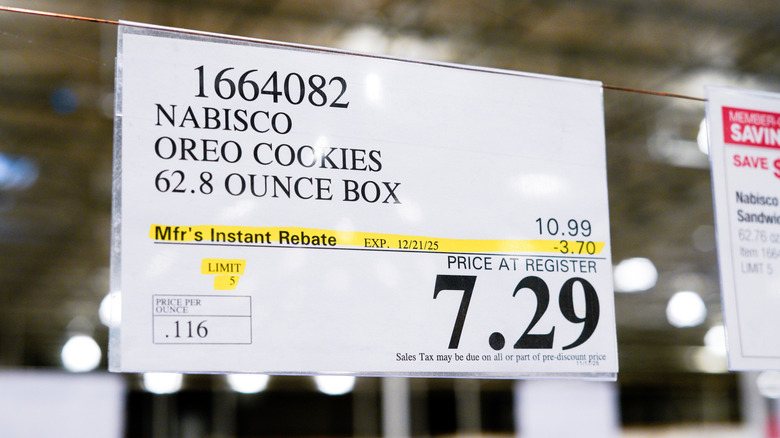
Some items may end in a "9" but have another number before it, like "$12.89" or "$22.59." If you spot one of these, it usually means there is a promotional deal being offered directly from the manufacturer as a test for pricing adjustments and placement. This is typically done for limited sales periods. If it's something like coffee beans or toilet paper that you know you'll use and has a long shelf life, stocking up when you see these deals can save you a lot in the long run. The same goes for some of the best Costco electronics. But you may also want to wait for potential deeper discounts when Costco holds its own manager discounts.
Important symbols
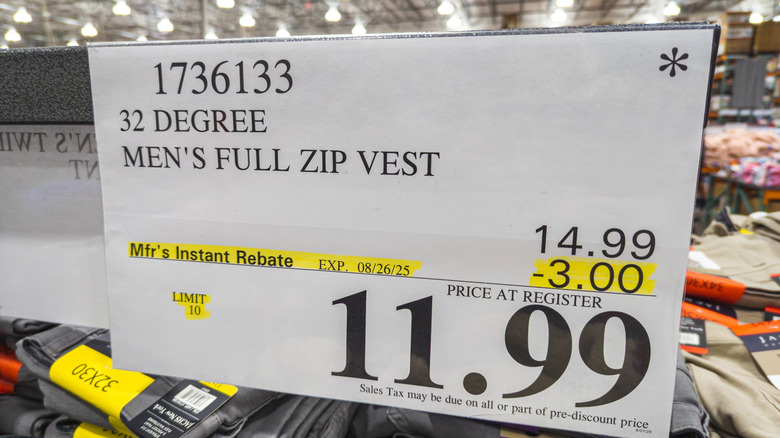
Along with different pricing conventions, you might notice symbols on price placards for all types of items, like DIY gadgets at Costco, which have meaning, too. Known as the "death star" for a product, when you see an asterisk, this means the item likely won't be restocked once the current inventory depletes. It's either discontinued, seasonal, or isn't selling well, and it probably won't be returning, at least not for a long time if at all. This could also designate a simple SKU or packaging change, so check with a manager to clarify so you don't miss out.
Price signs often have dates underneath the cost as well. This informs the last time the price changed for that item. Based on this date, you can theorize about when the item might go down again in price, or if it seems like something that goes on seasonal sales, for example. Costco rotates deals so if the date is at least a few weeks ago, you might want to wait to see if the item goes on sale again. If there's no asterisk on the tag, this means there's plenty of stock, and chances are, it might drop even lower in price.
Other details to note

One other detail to note about Costco price tags is that if it's green, the product is organic. Note that not everything that's organic at Costco will have the green price tag, so you should still read labels. But everything that has a green price tag is organic.
Overall, look or the prices that end in $.97 for the best deals. Pricing that ends in $.88 or $.00 are good deals, too, that could be specific to your location. Manufacturer discounts that end in a $.X9 could be decent, but chances are if the item stays, you'll get a better deal down the road. That one's a toss-up judgement call you'll have to make. If you see an asterisk, get the item now, maybe even stock up with more than you need if it isn't perishable because it will likely be gone soon. Following these tips, you can save even more at Costco, won't miss out on the best deals and limited inventory items, and have plenty left over for the always $1.50 hot dog to satiate your hunger after a long shopping session.