

A Tesla Drove Across The US Without Human Influence In Record Time
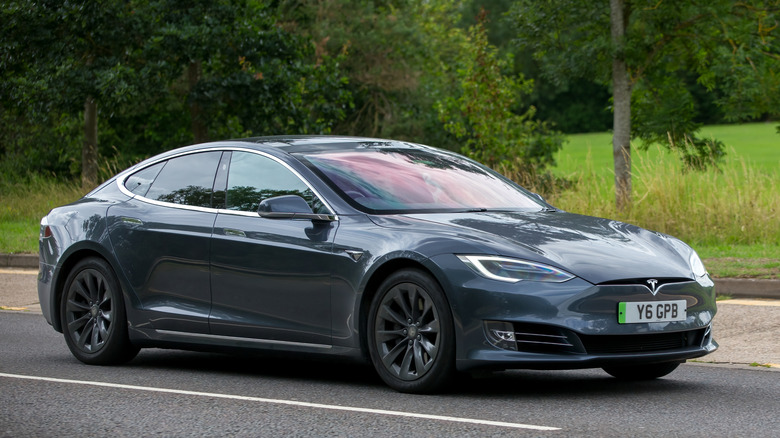
Artificial intelligence isn't just used for things like terrifying us during the Super Bowl, it can be used for powering things like the Full-Self Driving (FSD) capabilities of electronic vehicles, such as the technology found inside a Tesla. It's the kind of tech that just helped an automotive journalist break records with his "Cannonball Run" drive across the U.S., and fans of FSD are seeing it as a major victory for electric vehicles.
For those unfamiliar, a Cannonball Run is a coast-to-coast drive from Los Angeles to New York (or vice versa). In 2016, Elon Musk vowed that a Tesla would complete said drive autonomously by 2017. Now, the prophecy has finally been fulfilled, as a Tesla has successfully completed the drive while setting a new time record in the process. Though a Tesla vehicle has completed an autonomous coast-to-coast drive prior to this new record, this is the first time an electric vehicle has done so with Musk's promised location parameters.
While Tesla as a company is eliminating the vehicle model that completed the trip to focus on building robots, the feat nonetheless helps show that FSD can take long drives without human intervention. It's rather nice timing for Tesla, as its robotaxis recently nixed safety drivers from their vehicles in a number of U.S. cities. That said, we're still waiting on Musk's $25,000 Tesla EVs promised by 2025.
Tesla breaks records in cross-country drive
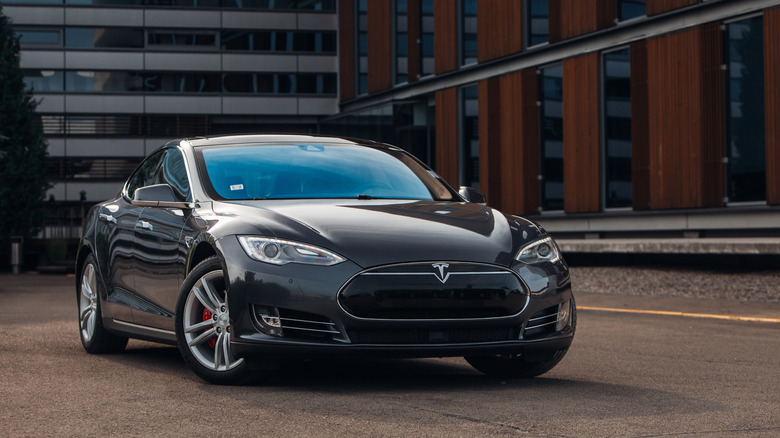
As first reported by The Drive, a 2024 Tesla Model S featuring FSD 14.2.2.3 and A14 Full Self-Driving hardware handled all driving tasks for the duration of its 3,081-mile cross-country trip from Redondo Beach, Los Angeles, California to midtown Manhattan, New York City. Averaging a speed of 64 mph, the trip totaled 58 hours and 22 minutes, with 10 of those hours going to vehicle charging. Along with handling periodic winter conditions, driver and automotive journalist Alex Roy noted that the vehicle's cameras needed cleaning in order to keep up FSD performance.
Roy's team consisted of AI executive Warren Ahner and "self-driving enthusiast" Paul Pham. Though the trip was completely autonomous, Roy admitted he did accidentally touch the steering wheel once. The team also added a 90-minute detour to circle around for a team member at a Pennsylvania rest stop so they didn't have to disengage FSD. This means the drive can potentially be shaved down by another 90 minutes, but Roy also mentioned the trip could have been faster without passengers.
While Roy's time is the fastest for a Cannonball Run trip without human intervention, David Moss was actually the first to complete an autonomous cross-country trip in December 2025. However, Moss' trip took 2 days, 20 hours, and only covered 2,732.4 miles from Los Angeles to Myrtle Beach, South Carolina. Moss used a gray Model 3, which also featured AI4 hardware yet relied on FSD v14.2.1.25. No word on whether these drives should be something to consider when buying a used Tesla.