

5 Useful Google Chrome Features You Should Be Using In 2026
So, you're one of the one billion who chose Google Chrome as your default browser. Maybe that's because it's one of the, if not the most, popular out there. Or perhaps it's because Chrome feels familiar, with it belonging to Google.
Whatever the case, it's not hard to see why Chrome is a first pick. It offers a wide array of perks, including a built-in password manager, nifty PDF viewer, and extensive selection of essential extensions. And that's actually just scratching the surface of what Chrome can do. This Google browser is more powerful than you think, packing a whole lot of features hidden in plain sight. Some of these have been around for years now, while others are new improvements — and, in fact, big changes are coming to Google Chrome in 2026.
If you're looking to get the most out of your browser, here are five of the Google Chrome features — both old and new — that you should be taking advantage of in 2026.
Share tabs between devices
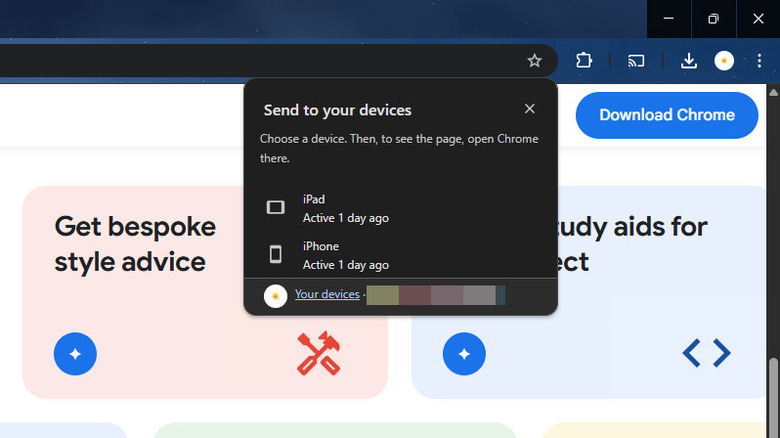
When you need to send a link from your computer to your phone, you usually copy and paste it to a messaging app to send it to yourself. But that takes effort. Instead of going to a different app or tab just to send a link, you can simply use Google Chrome's built-in feature for sharing tabs. This lets you access tabs from any devices with Google Chrome installed, as long as they're all logged in to the same Google account. To send a tab from your computer to another device, here's what you need to do:
- Launch Chrome on both devices.
- Sign in to the same Google account if you haven't already.
- On your computer, visit the webpage you want to share.
- Right-click on the address bar or tab.
- Select Send to your devices.
- In the pop-up, choose which device you want to share the tab with.
- On your other device, wait for the in-app "Tab received" notification to show.
- Tap Open to visit the webpage.
If the notification disappears before you can press Open, resend the tab from your computer. To do the reverse and send a tab from your other device to your computer, follow these steps:
- Open Chrome on your computer.
- Hit the More icon (three vertical dots) in the top-right corner.
- Navigate to History.
- Click on History.
- Choose Tabs from other devices on the left side panel.
- Go to the device where the tab you want to open is.
- Scroll through the browsing history to find the tab you're interested in.
- Select the page to open it in another tab on your computer.
You can now browse through the shared webpage as you normally would.
Gemini in Chrome
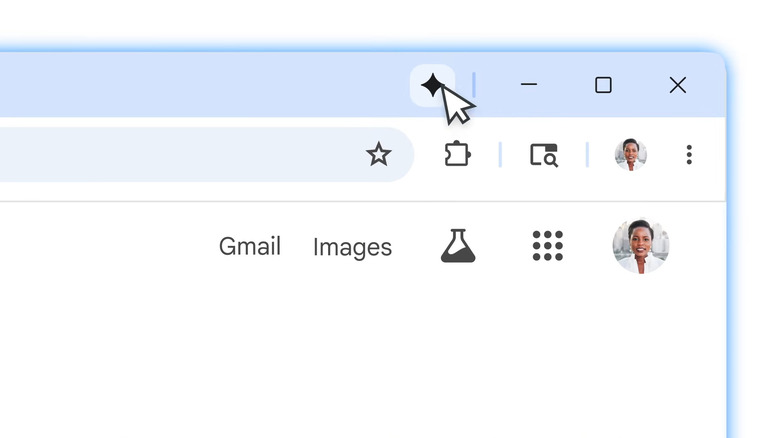
Gemini, Google's AI chatbot, has been making waves for its powerful image generation capabilities and convenient integration with Google Workspace. With continuous improvements — and plans for Gemini to replace Google Assistant — it only makes sense for Google to add Gemini directly on Chrome too. This new feature was introduced in May 2025 and is now available in the latest version of Chrome on Windows, Mac, and Chromebook Plus. Follow this guide on how to access Gemini in Chrome and use some of its features:
- Launch Chrome.
- Go to the webpage where you need help.
- Hit the Gemini sparkle icon in the upper right of the browser window.
- Hit "Yes, I'm in" to proceed.
- In the side panel that opens, choose a suggested prompt or type your own.
- Chat with Gemini.
To edit an online image without having to download it:
- Open the image in a new tab.
- Enter your prompt in the side panel.
- Click on the image to view it in another tab.
To let Gemini auto browse a page for you (maybe to search for local events on a specific date or find cold sales pitches in your email):
- Describe what you want Gemini to do.
- When prompted, give Gemini permission to take control of the tab.
- Wait for Gemini to finish clicking around the page to do the task.
- Confirm any step Gemini requires.
If Gemini takes a while to put together an answer, you can open another tab and do other work. Then, go back to the first tab to view Gemini's response. It's important to note, though, that Gemini in Chrome is yet to roll out to everyone. At the moment, it's limited to users in the U.S. who are at least 18.
Chrome Actions
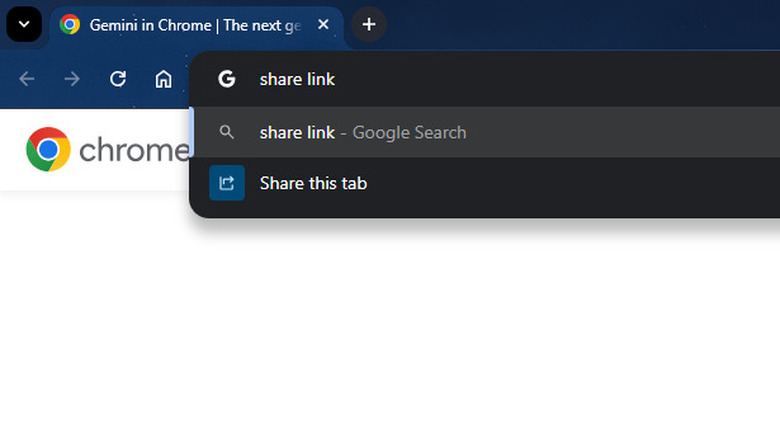
For power users, Google Chrome keyboard shortcuts are essential. Unfortunately, not every Chrome feature and functionality comes with a keyboard shortcut. The good news is, Chrome offers an alternative in the form of Chrome Actions. Just like keyboard shortcuts, Chrome Actions let you jump to settings pages, open Chrome menus, and even use Google Workspace. The only difference is that Chrome Actions are written commands — not key combos. To use Chrome Actions, hit Ctrl + L to jump to the address bar and type the Action of your choice. Then, press down and Enter to select it.
There's a wide range of tasks Chrome Actions can do. But to narrow them down, here's a list of our favorite ones, specifically for making new files and entries in Google Workspace:
- Create doc – Opens a new Google Doc file in a new tab.
- Create event – Opens a new Google Calendar event for you to fill out.
- Create sheet – Opens an empty Google Sheet file.
- Create note – Opens Google Keep with a floating new note panel already displayed.
You can also use Chrome Actions to use built-in Chrome features:
- Share link – Displays the Share dialog in the top right of the screen.
- Translate page – Opens the Translation popup.
- Customize chrome – Goes to the home page, where you can edit the theme, toolbar, and shortcuts.
- Delete incognito – Quickly close all your incognito tabs.
- Passwords – Jumps to Chrome's built-in Password Manager.
- Edit settings – Go to Chrome's Settings page.
- Manage cookies – Opens Third-party cookies from the Privacy & security menu in Settings.
You'd want to try typing in "Chrome dino" too if you're a fan of Chrome's classic Dino game.
Split view
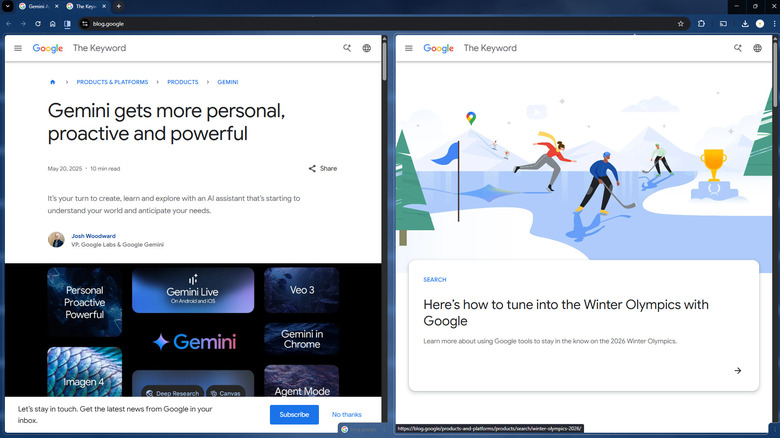
When drafting a document in Chrome while checking information from an online article, you may go back and forth between tabs. The same scenario happens when you're taking notes during a video conference or referencing an image while designing a graphic. But you don't really need to switch between tabs when there's a simpler way to multitask on Chrome: using split view. It allows you to open two web pages in a single tab and popped up in users' Chrome browser sometime in 2025. Here's a quick guide on how to use split view:
- Update to the latest Chrome version if you haven't already.
- Go to the first tab you want to open in a split view.
- Right-click on the tab at the top.
- Select "Add tab to new split view" to display it on the left half.
- On the right half, click on the second tab you want to add to split view, or enter a URL in the address bar.
- Use each tab as you normally would.
In split view, you'll see the split view icon on the left of the address bar. You can click on it to close either page, switch the left and right tabs, and exit split view altogether. You can also do all these from the More icon (three vertical dots) on the bottom-right corner of each webpage. If you want to adjust the size of both tabs, grab and drag the divider between them. If you find yourself using split view all the time, you can pin it to the toolbar for easy access later. Type "customize Chrome" in the address bar and select Customize Chrome. Then, expand the Toolbar section and turn on Open in split view.
Reading mode
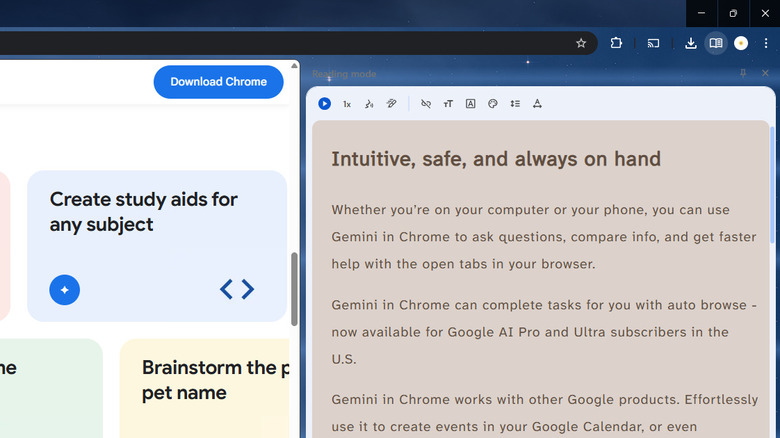
As you browse, you may run into a webpage cluttered with images, ads, and other elements. It can be so unreadable. Thankfully, you can declutter right on Chrome with the help of Reading Mode, which extracts only the text from a webpage and displays it in a minimalist and customizable layout. This way, it's much easier to focus on reading.
Activating Reading Mode on Chrome is pretty straightforward. Visit the website you want and right-click on any empty space. From the menu, choose Open in reading mode. You can then customize how the Reading Mode panel looks like:
- To remove the underlined links from the text, click the chain icon at the top.
- To make the text smaller or larger, select the TT icon and hit either – or +.
- To modify the font style, press A-in-a-box icon and choose one of the preset options.
- To change the background and text color to options like Sepia light, Blue, and High contrast, hit the palette icon.
- To set the line height to Standard, Loose, and Very loose, use the three-line icon.
- To adjust the letter spacing to Standard, Wide, or Very Wide, choose the A with an arrow underneath.
On top of these customization options, Reading Mode also features text-to-speech functionality for when you want to listen instead of read. All you have to do is click the play button. If you prefer a different voice, go to the speaker with waves icon and set it to your voice of choice. You can change the voice speed by clicking on 1x and alter the highlighter by pressing the pen icon or choosing between Word, Sentence, Adaptive highlighting, or Off.